1 month ago
One-week ceasefire in Lebanon to begin tonight, according to pro-Hezbollah media
The pro-Hezbollah outlet al-Mayadeen, citing an Iranian official, has reported that a one-week ceasefire will take effect in Lebanon starting tonight.
The move comes after pressure from Iran, according to the official. The truce will coincide with the final week of the temporary ceasefire between the US and Iran.
Israel’s Channel 12 news, however, reported that Israel has not yet decided on the issue, according to its sources. A senior Israeli official claimed the idea of declaring a week-long ceasefire in Lebanon was raised by US special envoy Steve Witkoff.
Channel 12 reported that the Israeli cabinet will convene tonight to discuss the matter, but noted that some ministers “are pressing for the exact opposite – to resume the attacks in Beirut and beyond the Litani [river]”.
Key events Show key events only Please turn on JavaScript to use this feature
The Israeli prime minister, Benjamin Netanyahu, said the military continues to strike at Hezbollah and was about to “overwhelm” Bint Jbeil, as pressure mounts for a ceasefire between Israel and Lebanon.
In a video statement, Netanyahu said he has instructed the military to continue reinforcing the security zone in southern Lebanon.
On Iran, Netanyahu said the US keeps Israel updated and the two countries are aligned.
Should the ceasefire with Iran fail, “we are prepared for any scenario”, he said.
US blockade of Iranian ports applies to ships of all nations, says White House
Asked how long the US blockade of the strait of Hormuz will last, Leavitt declines to commit to a timeline.
“I will never set timelines on behalf of the president of the United States,” she says.
“But with respect to the blockade, as you know, it has been fully implemented, and it’s being enforced against vessels of all nations entering or departing Iranian ports.”
She also says she’s seen some “misreporting” on the blockade, adding that for vessels transiting the strait outside of Iranian ports, US forces are “supporting freedom of navigation”.
I’ve seen some misreporting on that as well. This includes all Iranian ports on the Arabian Gulf and the Gulf of Oman, and our US forces in the region are supporting the freedom of navigation for vessels that are transiting the strait to and from non-Iranian ports. So I know some in the press were confused about that. We are supporting the freedom of navigation, just not with respect to any tanker or vessel that would benefit the economy of Iran as these negotiations continue.
US will not extend waiver on Russian oil sanctions, Bessent says
Bessent says the US government will not be renewing the general licences on Russian and Iranian oil.
Those waivers – which allowed purchase of some Iranian and Russian oil without facing US sanctions – were on “oil that was on the water prior to March 11th, so all that has been used”, he adds.
Xi told Trump that China is not giving Iran weapons, White House says
Leavitt was asked if Donald Trump’s threats of a 50% tariff on China are still on the table after the US president wrote a letter to Xi Jinping telling him not to supply weapons to Iran.
Leavitt says the Chinese president assured Trump “they are not supplying Iran” with weapons in this conflict.
Bessent adds that two Chinese banks (he doesn’t identify which banks) received letters from the US treasury saying that if they can prove there is Iranian cash in their accounts the US is “willing to put on secondary sanctions” on those banks.
Bessent says 'Operation Economic Fury' under way against Iran
Bessent says the US has launched “Operation Economic Fury” (a riff on “Operation Epic Fury”, the Trump administration’s name for its war on Iran), with the aim of putting financial pressure on Iran.
He says Iran made the “fatal mistake” of bombing their neighbours in the Middle East, “who are now being more transparent” about the Iranian funds held in their banking systems.
The US has requested that those countries freeze the funds of the IRGC leadership, he says.
He adds that countries are being cautioned against buying Iranian oil. If they have Iranian cash in their banks, the US will consider secondary sanctions, he says.
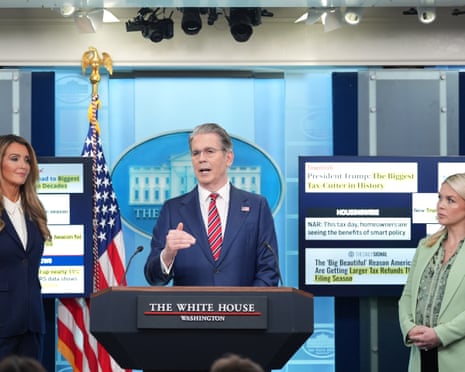
White House says next round of US-Iran talks would 'very likely' be in Islamabad again
Asked if a potential second round of talks with Iran would be held in Islamabad again, Leavitt says negotiations “would very likely be in the same place as they were last time”.
She adds that Pakistan is “the only mediator” in these discussions and praises their efforts.
White House denies US has requested Iran ceasefire extension and says talks are 'productive and ongoing'
Asked about the status of extending the Iran ceasefire, Leavitt says:
I saw some reporting – again, bad reporting – this morning that we had formally requested an extension of the ceasefire. That is not true.
At this moment, we remain very much engaged in these negotiations, in these talks.
You heard from the vice-president directly and the president this week that these conversations are productive and ongoing, and that’s where we are right now.
She adds the US “feel good about the prospects of a deal” with Iran.
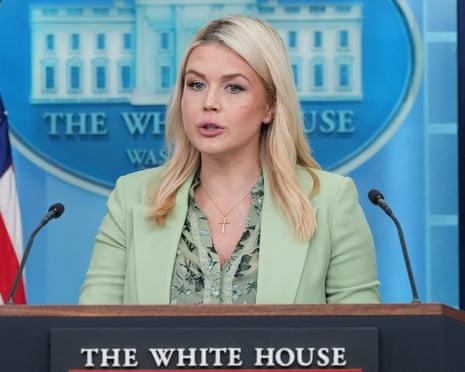
Bessent 'optimistic' US gas prices will fall before late September
Leavitt is joined at the press briefing by the US treasury secretary, Scott Bessent.
Asked about gas prices (“when are we going to get $3 gas?”), Bessent says it will come down to “how the negotiations go [with Iran]”.
The US kept its side of the ceasefire, he says, but the strait of Hormuz has not been reopened.
“So we will see, and I’m optimistic that during the summer we will see gas with a 3 right in front of it, sooner rather than later,” he says.
He says he’s been meeting with his Middle Eastern counterparts, who say that “once the strait is open they can start pumping again within one week”.
Pressed on whether this can be achieved by the summer, Bessent says:
I am optimistic that sometime between June 20 and September 20, we can have $3 gas again.
White House press briefing
There is a White House press briefing due to take place imminently, hosted by US president Donald Trump’s press secretary Karoline Leavitt.
My colleague Lucy Campbell is taking over this blog now and will bring you any news lines that may emerge from that in relation to the Middle East crisis.
The day so far
US president Donald Trump said that China and the United States are working together and that Beijing is happy that he is opening the strait of Hormuz. “China is very happy that I am permanently opening the Strait of Hormuz. I am doing it for them, also - And the World. This situation will never happen again. They have agreed not to send weapons to Iran,” Trump said in a post on Truth Social.
Donald Trump said the war was “close to over” as he hinted at another round of peace talks in Pakistan in the coming days. Speaking to Fox News, the US president said the conflict was near its end. “I think it’s close to over, yeah, I mean I view it as very close to over.
The pro-Hezbollah outlet al-Mayadeen, citing an Iranian official, has reported that a one-week ceasefire will take effect in Lebanon starting tonight. The move comes after pressure from Iran, according to the official. The truce will coincide with the final week of the temporary ceasefire between the US and Iran.
The US military said that it successfully stopped nine vessels from sailing out of Iranian ports during the first 48 hours of a naval blockade against the Islamic republic. “Nine vessels have complied with direction from US forces to turn around and return toward an Iranian port or coastal area,” US Central Command (Centcom), which is responsible for American troops in the Middle East, said in a post on X.
Pakistan’s prime minister Shehbaz Sharif arrived in Saudi Arabia on Wednesday at the start of a four-day tour before a possible second round of US-Iran peace talks, his office said in a statement. Sharif will also visit Qatar and Turkey on his trip, which comes after Washington and Tehran held their highest-level talks in decades in Islamabad last weekend.
Lebanon’s health ministry said Israeli strikes targeted paramedic teams in south Lebanon on Wednesday, killing at least three of them. “The Israeli enemy targeted paramedic teams in the town of Mayfadoun, Nabatiyeh District, three consecutive times,” the ministry said in a statement.
Israel’s military chief of staff said he had ordered areas south of Lebanon’s Litani River to be turned into a Hezbollah “kill zone” as troops pressed a major offensive there. “I have ordered that all of the area of south Lebanon up to the Litani (River) line be turned into a Hezbollah terrorist kill zone,” chief of staff Lieutenant General Eyal Zamir said on a visit to troops operating in the area.
The pro-Hezbollah outlet al-Mayadeen, citing an Iranian official, has reported that a one-week ceasefire will take effect in Lebanon starting tonight. The move comes after pressure from Iran, according to the official. The truce will coincide with the final week of the temporary ceasefire between the US and Iran.
Israeli prime minister Benjamin Netanyahu’s security cabinet will convene on Wednesday at 8pm to discuss a possible ceasefire in Lebanon, a senior Israeli official has said.
The United States has not formally agreed to the extension of its ceasefire with Iran, a senior official said on Wednesday. “There is continued engagement between the US and Iran to reach a deal,” a senior US official told Reuters.
Iran’s foreign ministry has said that Tehran’s right to enrich uranium was “indisputable” although the level of enrichment is “negotiable”. In a weekly press briefing, foreign ministry spokesperson Esmail Baghaei said the right to peaceful use of nuclear energy could not be “taken away under pressure or through war”.
Finance ministers from more than 10 countries, including the UK, have called for a “swift and lasting” end to the US-Iran war. In a joint statement issued by the UK Treasury, the ministers said the US-Israeli strikes and Iran’s retaliatory attacks have caused “unacceptable loss of life and significant disruption to the global economy and financial markets”.
The world’s top 100 oil and gas companies made more than $30m every hour in unearned profit in the first month of the US-Israeli war in Iran, according to exclusive analysis for the Guardian.
The conflict pushed the price of oil to an average of $100 a barrel in March, leading to estimated windfall war profits for the month of $23bn for the companies.
Lucy Hough speaks to Damian Carrington, the Guardian’s environment editor…
Israel’s military chief of staff said he had ordered areas south of Lebanon’s Litani River to be turned into a Hezbollah “kill zone” as troops pressed a major offensive there.
“I have ordered that all of the area of south Lebanon up to the Litani (River) line be turned into a Hezbollah terrorist kill zone,” chief of staff Lieutenant General Eyal Zamir said on a visit to troops operating in the area.
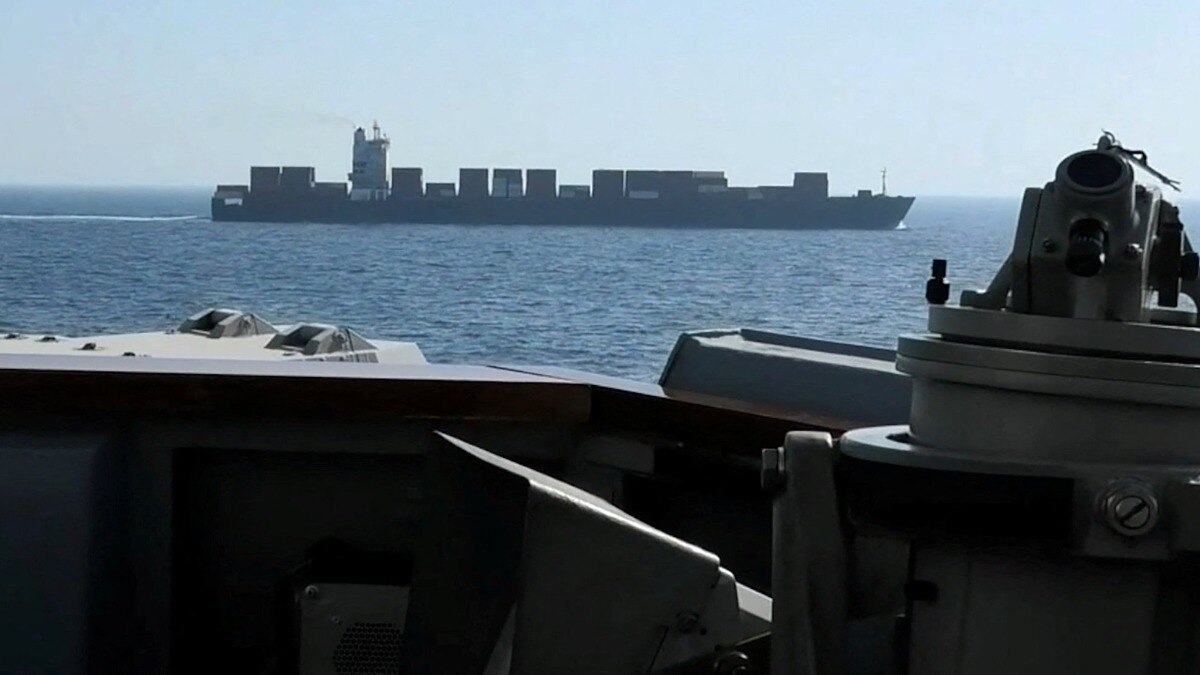
The US military said that it successfully stopped nine vessels from sailing out of Iranian ports during the first 48 hours of a naval blockade against the Islamic republic.
“Nine vessels have complied with direction from US forces to turn around and return toward an Iranian port or coastal area,” US Central Command (Centcom), which is responsible for American troops in the Middle East, said in a post on X.
“No vessels have made it past US forces,” Centcom said.
However, maritime tracking data appeared to contradict the US assertion.
Tracking data from Tuesday indicated at least three ships sailing from Iranian ports crossed the strait of Hormuz, though some vessels taking the route later turned back.
Pakistan’s prime minister Shehbaz Sharif arrived in Saudi Arabia on Wednesday at the start of a four-day tour before a possible second round of US-Iran peace talks, his office said in a statement.
Sharif will also visit Qatar and Turkey on his trip, which comes after Washington and Tehran held their highest-level talks in decades in Islamabad last weekend.
The Pakistani leader will discuss the “regional situation” with crown prince Mohammed bin Salman, the Saudi de facto ruler, his office said.
Lebanon’s health ministry said Israeli strikes targeted paramedic teams in south Lebanon on Wednesday, killing at least three of them.
“The Israeli enemy targeted paramedic teams in the town of Mayfadoun, Nabatiyeh District, three consecutive times,” the ministry said in a statement.
“This resulted in the martyrdom of three paramedics and the injury of six others, while one paramedic remains missing.”

Lisa O’Carroll
Donald Trump’s counter blockade of the strait of Hormuz has “reversed” a gradual increase in ships getting through the choke point since the US launched its war with Iran in late February.
Data from AXSMarine said that an average of five vessels per day crossed in most of March rising to 10 at the end of the month and into early April “before any ceasefire was announced, suggesting traffic was already beginning to recover”.
“The early-April ceasefire added modest momentum, with crossings peaking at 17 on 12 April. However, within 24 hours of the counter-blockade enforcement, daily crossings fell back to single digits.
“As of 15 April, 949 merchant vessels are tracked west of Hormuz inside the Gulf, with 307 operating without Automatic identity signals (AIS). This puts the AIS-dark rate at 32%, more than double the pre-conflict baseline of 17%” it said in its latest report on strait traffic.
Diplomatic efforts by Iran and other regional countries could produce a ceasefire in Lebanon “soon,” senior Hezbollah lawmaker Ibrahim al-Moussawi told Reuters on Wednesday, saying Tehran had used its blockade of the Strait of Hormuz as leverage.
“The Iranians are exercising high pressure against the Americans and they have put their conditions that the Americans should include Lebanon in the ceasefire. If they don’t do it, they are going to continue their blockade of Hormuz. It’s the economic card,” Moussawi said.
“The Iranians have opened up to several regional and international parties to achieve this goal,” he said.
Moussawi declined to comment on whether the group would abide by such a ceasefire.
Iranian state TV said Tehran will welcome a Pakistani delegation led by army chief Asim Munir on Wednesday, after the Islamic republic confirmed that exchanges with the US had continued via Pakistan after failed talks in Islamabad to end the war.
State TV reported that Iranian foreign minister Abbas Araghchi will welcome the delegation, which will bring a new message from Washington following the negotiations in the Pakistani capital over the weekend.
Israeli prime minister Benjamin Netanyahu’s security cabinet will convene on Wednesday at 8pm to discuss a possible ceasefire in Lebanon, a senior Israeli official has said.