 1 month ago
US says three jets 'went down' over Kuwait 'due to an apparent friendly fire incident'
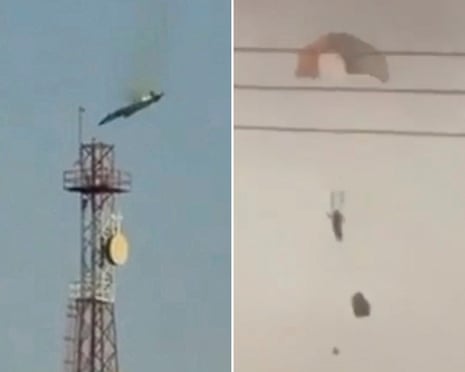
Kuwait air defences mistakenly shot down three US F15 fighter jets flying in Iran-related operations, the US Central Command (Centcom) said. All six aircrew ejected safely, have been safely recovered and are in stable condition, it said in a statement which you can read in full here.
“During active combat-that included attacks from Iranian aircraft, ballistic missiles, and drones – the U.S. Air Force fighter jets were mistakenly shot down by Kuwaiti air defenses,” Centcom said, saying the three jets “went down over Kuwait due to an apparent friendly fire incident”.
Centcom added that the circumstances surrounding the incident remain under investigation and that additional information would be released as it becomes available.
We reported in an earlier post that several American warplanes had crashed in Kuwait this morning but the cause was unclear.
Key events Show key events only Please turn on JavaScript to use this feature
Two drones heading towards RAF Akrotiri in Cyprus intercepted, spokesperson says

Dan Sabbagh
Two unmanned drones heading towards RAF Akrotiri in Cyprus were “succesfully intercepted”, Cyprus government spokesperson Konstantinos Letymbiotis said.
This comes after an Iranian drone was reported to have crashed into the UK military base last night. The incident is not thought to have caused any casualties and only limited damage. You can read more here.
The Guardian’s Caribbean correspondent, Natricia Duncan, and Kejan Haynes have filed this report:
On Saturday, the Caribbean woke up to the news of the US-Israeli attack on Iran. This was just hours after leaders had wrapped-up an extraordinary regional summit, attended by Marco Rubio and one that exposed strong divisions over US policies.
Dominated by concerns about the Trump administration’s military interventions in the region – with deadly strikes against suspected drug boats, an attack on Venezuela and an oil blockade on Cuba – the meeting ended with a commitment to send humanitarian aid to Cuba.
On Iran, governments emphasised de-escalation and negotiations as tensions intensified over the weekend. But there were notable differences in tone and positioning.

Trinidad and Tobago, a strong US ally, whose prime minister Kamla Persad-Bissessar has consistently showered Trump and Rubio with praise, expressed its “support for the continued actions of the United States of America aimed at preventing oppressive regimes from acquiring nuclear weapons capabilities that would jeopardize international peace and security”.
Guyana adopted a firmer tone, condemning what it described as an “unprovoked attack by Iran” on Bahrain, the United Arab Emirates, Qatar and Kuwait.
While the Barbados government expressed concern “that military action affecting a number of other countries in the region has the potential to undermine international peace and security,”, adding that it joined UN secretary general António Guterres in condemning the military escalation and calling on member states to “respect their commitments under international law”.

Helena Smith
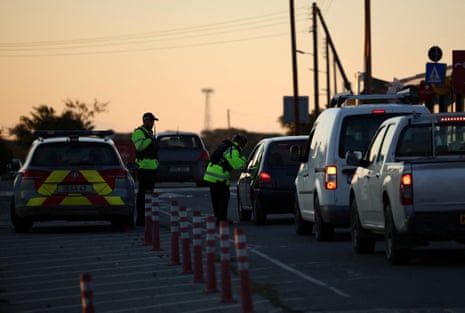
More now from Cyprus, the EU state closest to the conflict, where authorities have opened emergency shelters following Iran’s combat drone strike against RAF Akrotiri.
The island’s interior ministry said civil defense forces had also been seconded to inform citizens of steps to be taken in the event of an attack.
One local official in the village of Akrotiri told the Guardian that residents were “panicked by the blast of sirens and fearful of what might happen” in the wake of the British prime minister’s decision to allow the UK’s military installations to be used by the US against Iran’s missile cache.
As part of authorities activating the civil defense plan trained wardens will be relegated to neighbourhoods.
An emergency reception centre has been set up in Limassol, the nearest town to Akrotiri, to accommodate citizens, many of whom are choosing to leave villages in the affected area.

Lisa O’Carroll
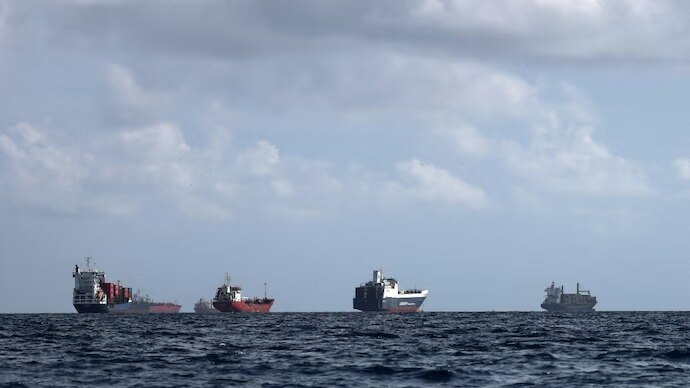
A vessel in the Port of Bahrain has been hit by two “unknown projectiles,” the UK maritime security watchdog has reported.
The UK Maritime Trade Operations Centre (UKTMO), which provides mariners, shipping companies the regional authorities with verified and corroborated security information, issued an alert this morning.
“UKMTO received a report of an incident in the Port of Bahrain. The Company Security Officer reported that the vessel had been struck by two unknown projectiles causing a fire.
“The fire has been extinguished and the vessel remains in port. All members of the ships crew are safe and have evacuated the vessel.” It said authorities were investigating.
“Vessels are to remain cautious and report any suspicious activity to UKMTO,” it added.
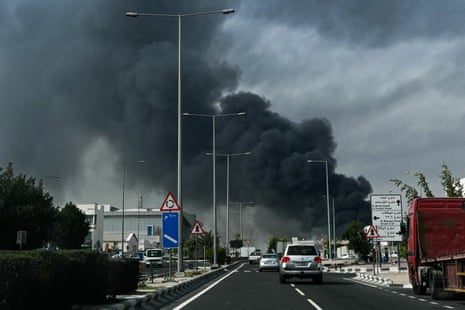
A huge fire at the port, home to the US Navy’s central command and fifth fleet, was reported on Sunday.
US says three jets 'went down' over Kuwait 'due to an apparent friendly fire incident'
Kuwait air defences mistakenly shot down three US F15 fighter jets flying in Iran-related operations, the US Central Command (Centcom) said. All six aircrew ejected safely, have been safely recovered and are in stable condition, it said in a statement which you can read in full here.
“During active combat-that included attacks from Iranian aircraft, ballistic missiles, and drones – the U.S. Air Force fighter jets were mistakenly shot down by Kuwaiti air defenses,” Centcom said, saying the three jets “went down over Kuwait due to an apparent friendly fire incident”.
Centcom added that the circumstances surrounding the incident remain under investigation and that additional information would be released as it becomes available.
We reported in an earlier post that several American warplanes had crashed in Kuwait this morning but the cause was unclear.
Iran's 'reckless' attacks threaten regional stability, US and allied Gulf states say
We can now bring you a joint statement from the US and six allied Gulf states – Kuwait, Saudi Arabia, Bahrain, Qatar, Jordan and the United Arab Emirates – condemning Iran’s “indiscriminate and reckless attacks” across the region, which they say “targeted sovereign territories, endangered civilians, and inflicted damage on civilian infrastructure”. The statement goes on:
Iran’s actions represent a dangerous escalation that violates the sovereignty of multiple states and threatens regional stability.
Targeting civilians and non-combatant states is reckless behavior that undermines stability.
We stand united in defense of our citizens, our sovereignty, and our territories, and we reaffirm our right to self-defense in the face of these attacks, while underscoring our commitment to regional security and commending the effective cooperation in air and missile defense that prevented greater loss of life and destruction.
The statement says attacks occurred in Bahrain, Iraq (including the Kurdistan Region of Iraq), Jordan, Kuwait, Oman, Qatar, Saudi Arabia and the United Arab Emirates.
We have a picture showing the moment an apparent fighter jet falls from the sky in Kuwait and someone parachuting to safety (see earlier post for more details).
Saudi Arabia halts some operations at Ras Tanura refinery after reported attack
Saudi Arabia’s energy ministry has said some operations at its Ras Tanura refinery had been halted on Monday, after an attack that caused a fire at the complex.
The ministry was quoted as having said the refinery sustained “minor damage from falling debris” due to the interception of “two drones in the refinery’s vicinity”.
“Some operational units at the refinery were shut down as a precautionary measure, without any impact on the supply of petroleum products to local markets,” an official source at the ministry said in a statement published by the Saudi Press Agency.
The Ras Tanura complex houses one of the Middle East’s largest refineries with a capacity of 550,000 barrels per day (see earlier post for more details).
Iran’s nuclear programme has been among the reasons Israel and the US have given for the attacks, alleging Iran was getting too close to being able to eventually make an atom bomb.
Iran has a stockpile of uranium enriched to 60%, close to weapons grade, but has expressed willingness to down-blend the purity to 20% or below.
Iran says it is not pursuing weapons and that its programme is intended for peaceful, civilian purposes.
“An Iranian regime armed with long-range missiles and nuclear weapons would be a dire threat to every American,” Donald Trump said as he tried to justify his attacks, despite the fact that there is no credible evidence Iran was trying to build a nuclear weapon.
“We cannot allow a nation that raises terrorist armies to possess such weapons that would allow them to extort the world to their evil will. Not going to happen,” the US president said.
Iran’s Natanz nuclear facility was hit during US-Israeli attacks against the country, Iran’s ambassador to the UN nuclear watchdog said earlier today, according to the Reuters news agency.
“Again they attacked Iran’s peaceful, safeguarded nuclear facilities yesterday,” Reza Najafi told reporters at a meeting of the Atomic Energy Agency’s board of governors.
As my colleague Patrick Wintour noted in the previous post, the nuclear watchdog said there were no signs that any of Iran’s nuclear facilities had sustained damaged or hit.
The Natanz nuclear facility was among the sites attacked in the US and Israeli airstrikes against Iran in June 2025.
Mass evacuation of cities across Middle East may be necessary if nuclear power stations attacked, UN nuclear chief says

Patrick Wintour
The mass evacuation of cities across the Middle East may be necessary if civil nuclear power stations are attacked leading to radiological release, Rafael Grossi, the director general of the IAEA UN nuclear inspectorate, warned on Monday at the opening of the quarterly board meeting of the IAEA.
He admitted “a strong sense of frustration” that an agreement between the US and Iran over Iran’s nuclear program had eluded the parties in their recent negotiations. Grossi had attended the talks providing technical assistance.
Opening the board meeting, he said diplomacy “is hard and never impossible. The use of force has been present in international relations since times in memorial. This s a reality, but it is always the least preferred option.”
“I remain convinced that the lasting solution to this long existing discord lies on the diplomatiic table when it comes to nuclear matters, a crystal clear understanding of the scope and verifiability of an agreement is of the essence.
“Diplomacy is hard, but it is never impossible. Nuclear diplomacy is even more difficult, but it’s never impossible. It is not a matter of if, but of when we will again gather at the diplomatic table. We simply must do so as quickly as possible.”
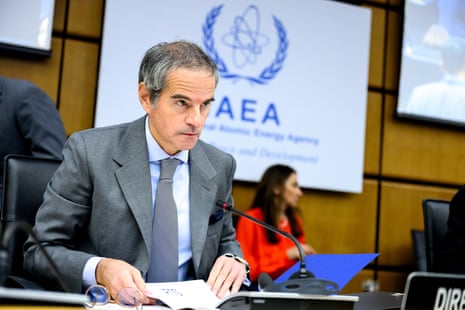
Turning the impact of the current fighting across the Middle East he said: “We cannot rule out a possible radiological release with serious consequences, including the necessity to evacuate areas as large or larger than major cities.”
“Let me underline that the situation today is very concerning. Iran and many other countries in the region that have been subject to military attacks have operational nuclear power plants and nuclear research reactors, as well as associated fuel storage sites, increasing the threat to nuclear safety.
He added: “The United Arab Emirates has four operating nuclear reactors. Jordan and Syria have operational nuclear research reactors. Bahrain, Iraq, Kuwait, Oman, Qatar, and Saudi Arabia have also been attacked. These countries all use nuclear applications of some sort or the other. We therefore urge utmost restraint in all military operations.”
Discussing Iran’s remaining nuclear installations, he said: “We have no indication that any of the nuclear installations, including the Bushehr nuclear power plant, the Tehran research reactor, or other nuclear fuel cycle facilities have been damaged or hit. Efforts to contact the Iranian nuclear regulatory authorities continue with no response so far.”
Experts have said the attacks by Israel and the US on Iran are illegal, as they were in violation of the ban on the use of force under the UN charter and international law.
Here is an extract from an opinion piece by Kenneth Roth, a Guardian US columnist and former executive director of Human Rights Watch who believes the attacks on Iran were an illegal act of aggression.
We shouldn’t beat around the bush: Donald Trump’s and Benjamin Netanyahu’s military attack on Iran is an illegal act of aggression. There is no lawful justification for it. It is no different from Russian president Vladimir Putin’s invasion of Ukraine or Rwandan president Paul Kagame’s invasion of the Democratic Republic of Congo.
The United Nations charter allows the use of military force in only two circumstances – with authorization of the UN security council, or as self-defense from an actual or imminent armed attack. Neither was present.
In his video justification for the war, Trump spoke of Iran’s “imminent threat”, but there is no evidence to support it. He recited a litany of past attacks that he attributed to Iran, but none of them is ongoing or imminent. At best Trump sought to prevent future harm – Netanyahu used the term “pre-emptive” – but prevention is no justification for war because it would open Pandora’s box to countless armed conflicts.
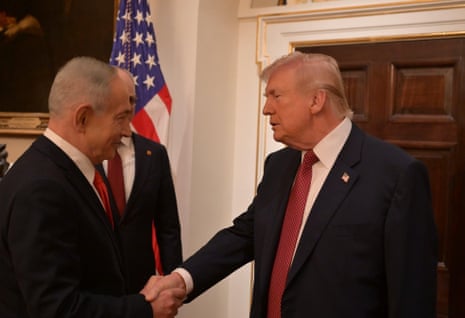
In a brief update to X, the IDF said it “struck” a “senior terrorist” from Hezbollah in Beirut a “short time” ago and will be providing more details in due course.
IDF says 'all options on table' in response to question about possible ground invasion of Lebanon
An Israeli military spokesperson has been briefing reporters in Israel. When asked if the IDF is preparing for a possible ground invasion of Lebanon, the spokesperson was quoted as having said that “all options are on the table”.
He said Hezbollah “made a very bad mistake” by choosing to strike Israel overnight.
“The IDF will react very swiftly and they will pay a heavy price,” the spokesperson told reporters. “Hezbollah opened fire at us last night. It knew exactly what it was doing.”
At least 555 people have been killed in Iran by US-Israeli attacks, Iranian Red Crescent Society says
The Iranian Red Crescent Society (IRCS) has said in a Telegram post that 555 people have been killed in Iran by Israel-US attacks across 131 cities.
Over 100,000 rescuers are on “full alert” across the country, the IRCS said, adding that a “network of approximately 4 million volunteers is on standby” to provide “humanitarian services” and “psychosocial support” to those affected.
We have not been able to independently verify these figures yet.
Saudi oil refinery reportedly halts operations after drone attack
Saudi Arabia’s Ras Tanura oil refinery came under attack on Monday from drones, the country’s defence ministry said. Authorities downed the incoming aircraft and there were no reported injuries.
The announcement follows an earlier report in Bloomberg saying that Saudi Arabia’s state oil company Aramco had paused operations at the Ras Tanura refinery after a drone strike in the area.
The Ras Tanura complex houses one of the Middle East’s largest refineries with a capacity of 550,000 barrels per day.
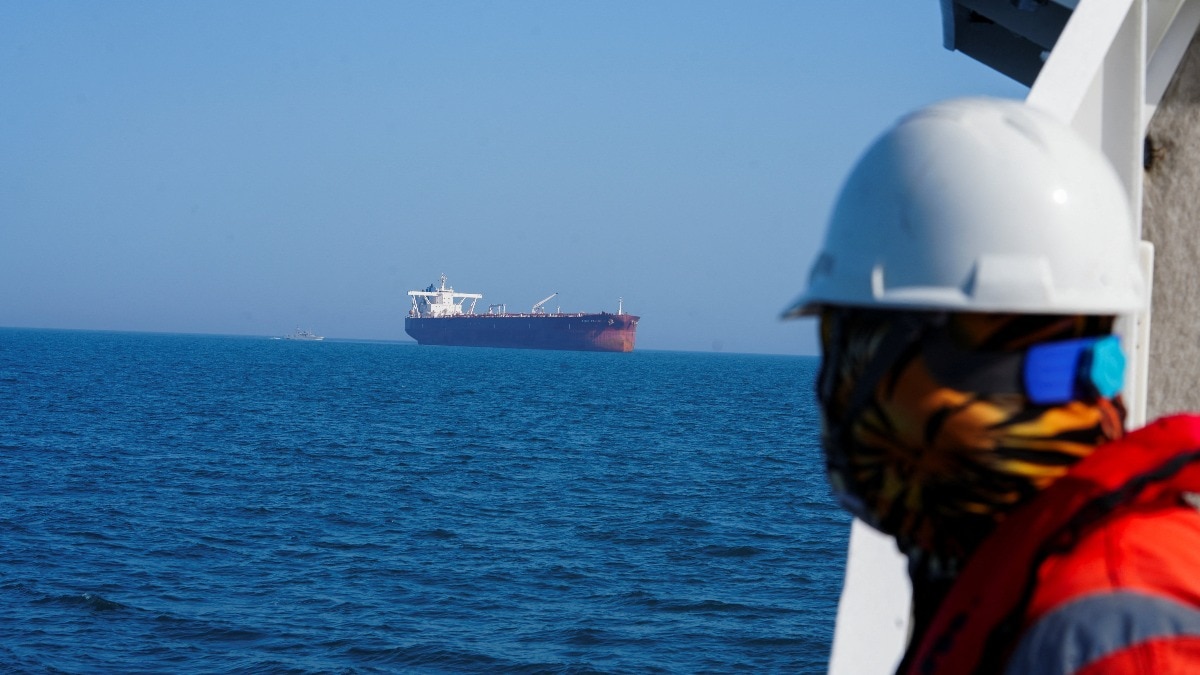
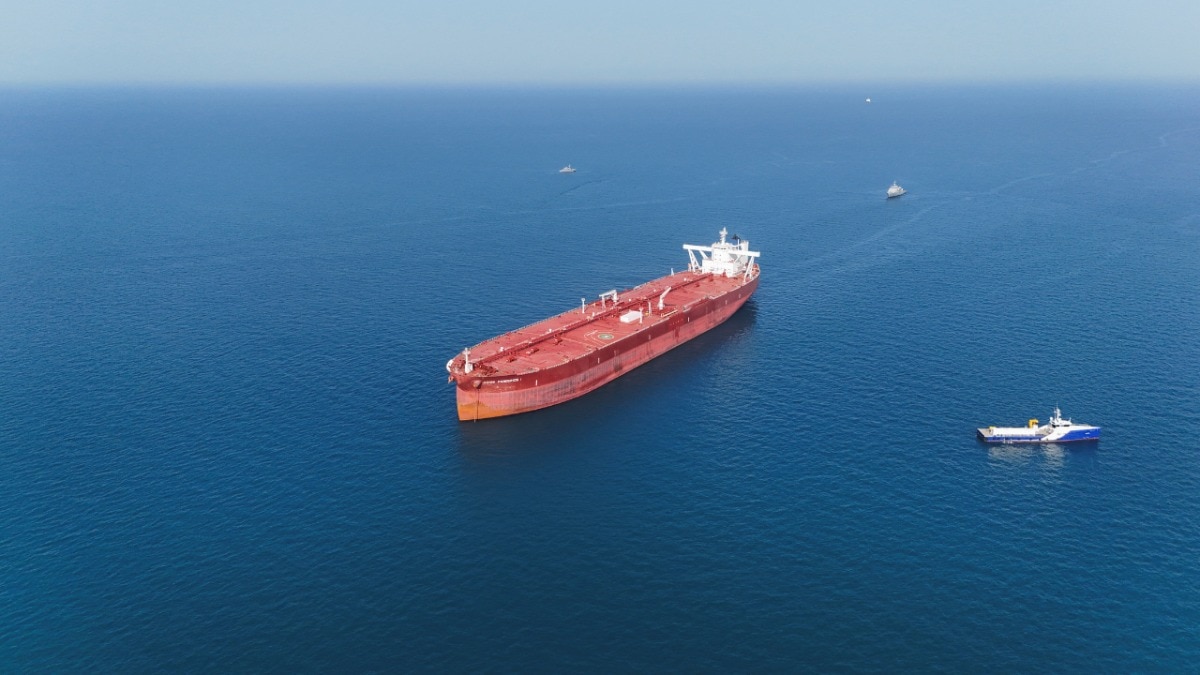
Its shutting will likely add to supply anxieties as shipping through the strait of Hormuz, through which 13-15 million barrels, or 20% of global supply, of oil flows – grinds to a near-halt after vessels were attacked around it yesterday.
Iranian missiles or drones have hit airports, luxury hotels and other civilian targets across the Gulf, with strikes reported in Bahrain, Iraq, Jordan, Kuwait, Oman, Qatar, Saudi Arabia and the UAE, sparking outrage among Gulf governments.

Amy Hawkins
Amy Hawkins is the Guardian’s senior China correspondent
China’s foreign ministry spokesperson Mao Ning said on Monday that a Chinese citizen had been killed in Tehran.
Beijing has urged Chinese citizens in Iran to leave “as soon as possible” via land routes to Azerbaijan, Armenia, Turkey and Iraq. China’s embassy in Israel also advised nationals to evacuate to safe areas or leave the country.
China’s foreign minister Wang Yi has condmenned the US-Israel strikes on Iran, calling them “unacceptable” and called for a ceasefire. China is the biggest buyer of Iranian oil.
You can watch a video of Israel’s air attacks on the southern suburbs of Beirut in the early hours of Monday morning here:
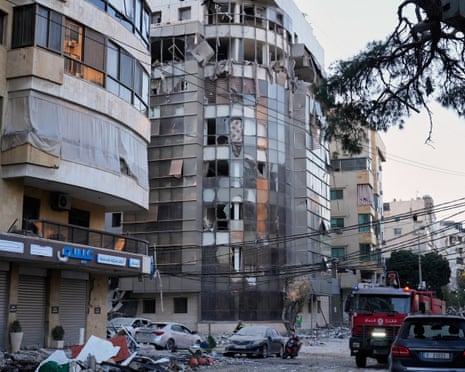
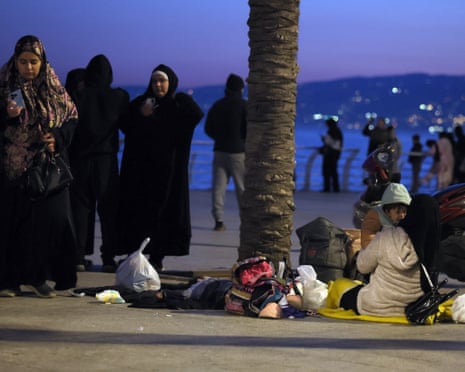
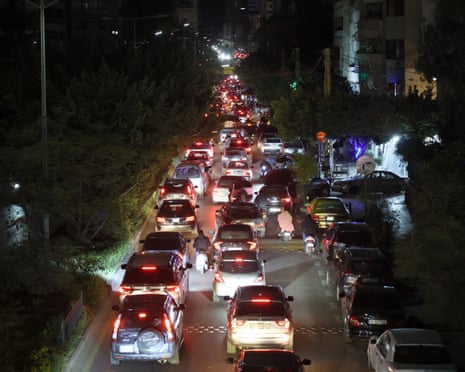
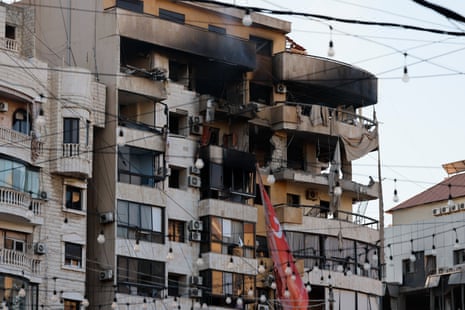
Here are some of the latest images coming in from Lebanon, where the country’s health ministry is saying Israeli strikes in Beirut and on the south of the country have killed at least 31 people and injured 149.
The deadly Israeli attacks came after Hezbollah, the Lebanese Shia militia group, launched missiles and drones towards Israel in retaliation for the killing of Iran’s Supreme Leader Ali Khamenei on Saturday.
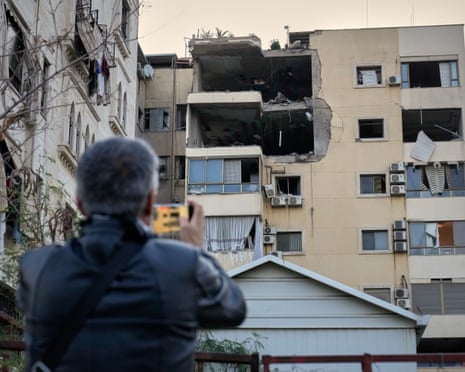
A man takes pictures of the damage in an apartment building after it was hit by an Israeli airstrike in Dahieh, Beirut’s southern suburb, on 2 March 2026. Photograph: Hussein Malla/AP