 1 month ago
HomeMarket NewsOne Year Of Operation Sindoor: How have Indian defence stocks fared and their road ahead
Former Defence Secretary Giridhar Aramane said the battlefield is increasingly moving towards aerospace capabilities, including drones, surveillance systems, AI-enabled platforms and autonomous vehicles operating across land, sea and air and incremental defence spending is likely to move towards these areas over the coming years.

A year has passed since the launch of Operation Sindoor, an offensive that fundamentally altered India's national security doctrine.
Over the last 12 months, the emphasis has been a great emphasis has been laid on defense modernization, defense procurement, and more importantly, domestic defense procurement. Since then, defence companies in India have been in focus.
The Nifty India Defense Index over the last 12 months, its a 30% up move that the index has seen. Among its top performers since then, MTAR tech is up almost 350% over the last 12 months. Axiscades is up 180%. Apollo Micro Systems has also gained over 160% during the last 12 months.
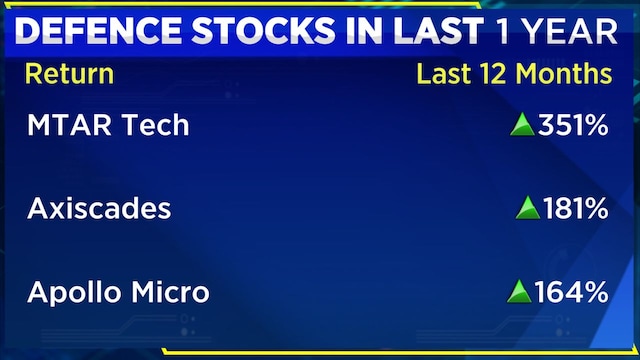
Other names like Dynamatic Tech, Data patterns, Bharat Forge, all of them have seen gains of anywhere between 70 to 90%.
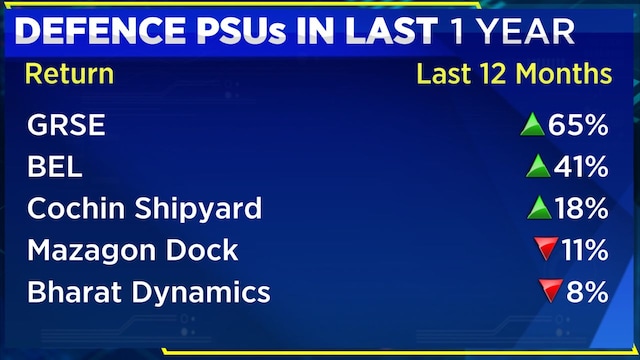
Emphasis was also on the defense PSU companies and Garden Reach Shipbuilders has emerged as the outperformer within this space, while its peer Mazagon Dock has underperformed with negative returns during this period. Bharat Dynamics is the other underperformer, while BEL, now a Nifty 50 constituent, is up 40%.
There was greater emphasis laid on the defense sector in this year's budget as well. The budgetary allocations were up 15% from last year, almost nearing ₹8 lakh crore. The Capex budget increased by 22% as well and most of that, as I highlighted earlier, was for domestic procurement. That has translated into the order books of these companies.
HAL has an order book of close to ₹1.5 lakh crore. BEL has an order book of nearly ₹80,000 crore and combining the three PSU shipbuilders, their order book also comes up to ₹80,000 crore.
There are big orders in the pipeline as well, ranging from the P75-I submarine order, which has kept Mazagon Dock in focus. The next generation Corvettes order is also in the pipeline. The potential orders for future ready combat vehicles which put stocks like Bharat Forge L&T in the spotlight, and the quick reaction surface to air missiles or the QRSAM, that is one big order that BEL has been banking upon.
Former Defence Secretary Giridhar Aramane said Operation Sindoor marked a turning point in India’s military doctrine and reshaped the approach towards future warfare.
He noted that the battlefield is increasingly moving towards aerospace capabilities, including drones, surveillance systems, AI-enabled platforms and autonomous vehicles operating across land, sea and air. He said incremental defence spending is likely to move towards these areas over the coming years.
Ashok Atluri, Chairman and Managing Director of Zen Technologies, said traditional missile-based defence systems are becoming too expensive compared to the relatively low cost of attack drones.
“The missile math is absolutely 100x,” Atluri said while explaining how low-cost drones are forcing countries to rethink air defence economics.
Zen Technologies recently launched an interceptor drone aimed at neutralising hostile drones at a much lower cost. The company has also introduced laser-based anti-drone systems and self-contained anti-drone platforms as it focuses on next-generation warfare technologies.
Read Here | One year of Operation Sindoor: Families still living with fear, loss and unanswered questions
He added that future wars would require large-scale domestic drone manufacturing capacity, especially in situations where thousands of drones may need to be replaced daily during a conflict. The government, according to Atluri, is supporting indigenous drone production and anti-drone capabilities.
Aramane also said India still depends on imports for certain drone components such as propulsion systems, batteries, composites and some specialised seekers, though domestic manufacturing capabilities are steadily improving.
Meanwhile, Zen Technologies maintained its growth outlook despite higher R&D spending. Atluri said the company expects margins to remain stable and anticipates stronger order inflows over the coming quarters, with visibility improving for FY28 execution.
Also Read | From BrahMos to drones: How Operation Sindoor reshaped India’s warfareFor the entire discussion, watch the accompanying video