 1 month ago
Gautam Chhaochharia, Head-Global Markets, UBS, said that while valuations have corrected to levels that have historically attracted long-term investors, global flows remain cautious and underweight on India. Domestic liquidity continues to offer support, but market direction in the near term will remain news-flow driven, with only selective contrarian buying visible at current levels.
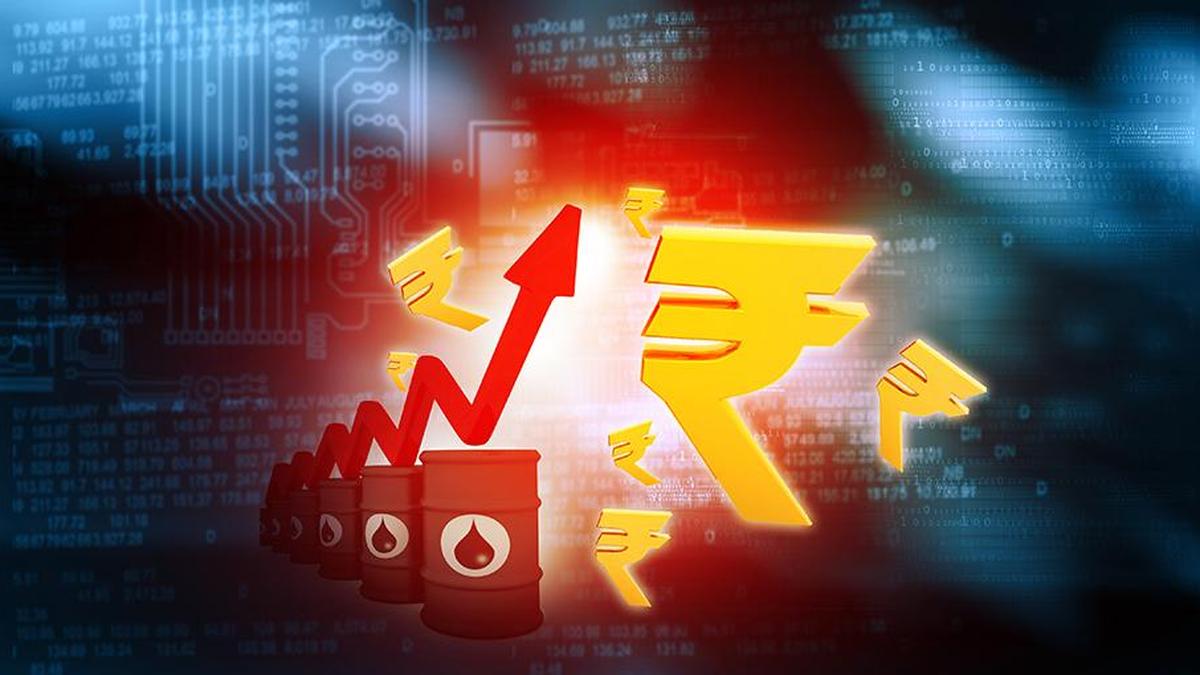
On the macro front, Tanvee Gupta Jain, Chief India Economist, UBS, highlighted that the rupee remains under sustained depreciation pressure, with UBS maintaining a 95 view for the June quarter.
She said the challenge is not just the current account deficit but also its funding, amid weak FII and insufficient FDI inflows. RBI measures may provide temporary relief, but structural pressures persist, and the risk of a balance of payments deficit remains elevated if oil prices stay high.
Growth and inflation outlooks are increasingly contingent on the duration of global disruptions. Jain indicated that India’s GDP growth could moderate from 7% in the base case to 6.3% under a $100 oil scenario, and even 5.5% if crude sustains above $120. Inflation, currently benign, could rise above 5% with partial pass-through of fuel costs.
Diviya Nagarajan, Head-India Research, UBS, noted that earnings risks are building, with sector- and company-specific impacts likely depending on how long disruptions persist, as higher oil prices pose asymmetric downside risks to both global growth and inflation.
These are edited excerpts from the interview.
Q: What is your view on rupee and the RBI’s directive?
Jain: The INR remains the biggest focus right now. We did see on Friday the measures being announced by the RBI, but we think it is a very temporary respite to INR. For the June quarter, INR view is still 95 so we are not expecting any sharp appreciation from here. Whatever you are seeing today, some currency appreciation or some support to currency it is very temporary.
What we realised is the biggest challenge, from an INR perspective, is not only the level of current account deficit, but the funding concerns. I don't see any quick respite on that. We are seeing FII outflows has been quite significant. FII debt has been muted, and overall, FDI flows are not enough. Especially net number is definitely not enough. We might be staring at one more year of a balance of payment deficit.
A lot of investors I am talking to a comparing it with the 2013 taper tantrum. But the difference this time around is that RBI has still a lot of policy steps that they can do to ensure that a free fall in INR could be contained. For example, if I look at past, we can announce a bilateral swap window for the oil importers that could be one step, maybe some curve on gold, maybe some view about raising NRI deposits. So, there are ways to manage the currency weakness, but near term, the entire focus is on de-escalation, if at all that can even be hoped for. But otherwise, we think that the depreciation pressure on INR is likely to stay.
Q: Across companies that you speak with, right, how severe is a disruption on a scale of one to 10?
Nagarajan: Right now, it is still a question of where supply of natural gas is being impacted. So, you would have seen where there's a cluster which is dependent on that that's gone down or utilisation has dropped in things like fertilisers. But across sectors, it's still very early. There are fears being priced in, but are we seeing anything on the ground yet? I think it's a little too early to see that.
Q: Your thoughts just, just top of the mind, top down kind of thoughts on what's happening and how is this likely to play out from an impact perspective?
Chhaochharia: Duration of disruption is the critical missing piece, which none of us are experts to make a call on at this stage. But the only hope which many of us and in the markets derive, is that one of the common, consistent comments coming from the US administration has been that we will not repeat earlier situations of a prolonged presence or war. Now, whether they stick to that or not, we don't know.
The second point on that is the definition of prolonged the kind of situation we are in, even a three month to six-month issue could be quite damaging, both for global growth inflation, as well as for India. So, the timelines are very different. We are not talking about years, even months is going to be bad. So, you need to keep these things in mind. Therefore, the way we'll put it is talking to investors, the tail risks of this being prolonged for months is still not priced in and there are asset classes, or even in the Indian context, rupee is one, one which than we mentioned, where this could show up much more clearly. So even though the rupee has moved, the tail risks are still there around the currency.
Indian markets, to some extent the local flows are helping very clearly. Look the retail is also kind of at the stage where their books are not necessarily looking attractive, and they see start seeing red, and how they behave is still early. They have been quite mature. So, the answer is duration, like, how long this last. At levels wise, this is a level where India bounced back for last year.
On a headline valuation basis this is where, in the last 10 years, Indian markets have largely bottomed out on a forward valuation basis. But again, just to put things in context before 10 years, if you go back to the taper tantrum era, or even before that, these are the levels where market used to peak at. So, the paradigm also changed because of the local retail flows. But this is an interesting level, and we are seeing some investors, a very small minority of investors, willing to take contrarian bets, also contrarian bets, not just defensive bets, but contrarian bets, but very small. So again, it will be news flow driven, if I have to just let it out like that, the way every, every overnight situation develops, that's how markets will react. For long term investors some will start dipping in here.
Q: What's the extent of the earnings cut that you see in the base case and perhaps a bear case?
Nagarajan: Again, it is going to be very sector specific, very company specific. The way I would characterise the situation is that, pre-this conflict, we were at a position where it looked like growth had bottomed, and inflation had bottomed as well. We were therefore looking at a possible early cycle recovery for the country and for the markets. Now, the real question here is that, as Gautam said, there is going to be earnings hit. But at this point, we have three scenarios.
The first scenario is that it de-escalates this week. The second scenario is that it takes a couple of months. The third scenario is that it goes on longer. In each scenario, the oil price impact gets asymmetrically higher, the impact on global GDP and inflation gets asymmetrically upfront. So, the base case scenario, we are probably looking at a 50 basis points or 60 basis points, global inflation risk. But at the 150 to the oil it becomes 190 basis points. So, the longer and to go back to Gautam’s point, we could put out a number now, but the number would essentially be dependent on how quickly this de-escalation happens, because the risk is asymmetric on the downside.
Q: How much have you scaled back your growth estimates because what has taken place? What about the deficit number? How much has it widened in comparison to what you are working with earlier and the RBI? Do you think that rate cut hope is now out of the way? Do you think at some point of time we see a rate hike?
Jain: We have still not revised our GDP growth assumptions downwards, because we are still working on scenarios, as Diviya mentioned, five-week, two month, or, an extended oil disruption scenario. But I can give you the numbers. We are right now at 7% real GDP growth forecast based on oil at oil at $75 a barrel. Oil at $100 a barrel, which basically means a two-month disruption where GDP growth is 6.3%, and oil remaining at more than $120 a barrel for an extended period, GDP can go even as low as 5.5%. So that is the asymmetric impact we are going to see on the growth.
On inflation, versus our 4.3% in our base case, we are seeing inflation clearly cross 5% depending upon the extent of pas through. We have been seeing that the government has cut the excise duty on gasoline and diesel, so basically have shielded the consumers so far. But if the disruptions are going to last longer, I am definitely expecting some partial pass through to retail prices post elections. April 9, when the two state elections get over in between, I would expect some partial pass through to retail prices for households.
The third is what it means from an overall macro perspective and the current account deficit perspective. So far, we have not really seen demand destruction directly. Yes, there is outside of direct price pass through, where we are seeing that even in the informal market, the prices have gone up. The cost of production is going up. Gas shortages is very acute. Companies are facing limited supply, the supply chain, capacity is getting affected. But if that situation is going to last longer, we really need to see what RBI can do. The biggest challenge, what we started during this conversation, is current account deficit and external financing from an RBI perspective.
Even if inflation goes up, and the starting point of inflation this time is very low, we are staring at a number maybe 3% inflation, and the current monthly number goes back to 5-5.5%, which is okay. I mean, we are somewhere between 4% plus 2 as inflation ban on the upper hand. But I think the biggest concern is the funding of your current account deficit.
Just to give you some numbers, when 2013 taper tantrum happened, we were a much smaller economy. You raise NRI deposit, you do some import cups. You were fine. You were able to stabilise your currency. Right now, even before the oil shock happened, we were staring at a current account deficit of $60 billion and with this oil remaining at $100 or more, it can clearly double. At least more than $100 billion could be a current account deficit. So either I am able to do some demand destruction so that my non-oil, non-gold import can get curved, or I need to figure out ways to fund this current account deficit if the situation is going to last longer. In terms of numbers, current account deficit, in my base case, is 1.5% that can clearly go well above 3% of GDP, depending upon the extent of duration of this overall oil disruption.
Q: We didn't party big time on the upside. Indian markets underperformed. Do you think going by the valuations that have come down a little bit, we went through a period of underperformance. FIIs are underweight the Indian markets as well relatively. Do you think Indian markets at least could outperform from year on or you believe that, we continue to underperform?
Chhaochharia: Firstly, our EM strategist has been underweight, still remains underweight. So that's the official published view from a research perspective. Talking to investors, I don't see any early signs from global investors that they will look at India as a contrarian trade. Still very early days. When I say contrarian stock picking it's more from the domestic investors, less from the global investors.
For India to outperform, one of the key ingredients beyond the situation or war in Middle East would be currency. And currency, the worst possible things which can hit Indian currency happen altogether, not just last one year, but even last three months. And even if one or two things change, currency could change very fast, like it's a very consensus view right now, rupee will keep on depreciating. But if any of these things change, that will get possibly the FPIs to come in as a tactical trade.
From a more fundamental perspective, the things which were constraining India, which were relatively slower growth and rich valuations, absolute and relative, they still hold true. I don't think that's changed enough for them to come back in a hurry and be over with India still early days.
For the entire discussion, watch the accompanying video