 53 minutes ago
Student and staff protests over school conditions in France have escalated into violent unrest. The government is now trying to restore order while addressing grievances over teachers, resources and ageing buildings.
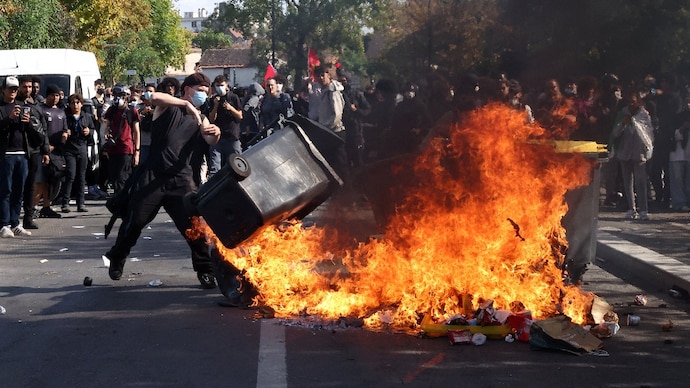
A masked protester throws a garbage bin into a fire set up by high school and university students in a street.
France's student protests have spread across the country after beginning last week over staff shortages, poor school conditions and a lack of educational resources. Students and teaching staff have taken to the streets to demand more teachers, better-equipped schools and decent conditions for learning and teaching.
The protests began on Monday and were initially largely peaceful, with students and school staff demonstrating and blocking schools in towns and cities across France. At the heart of the movement are complaints about absent teachers, a shortage of resources and ageing school buildings in need of renovation.
But within days, the demonstrations grew into a much larger national movement. Hundreds of schools have been affected and hundreds of people arrested as the protests spread. Students have also accused police of using heavy-handed tactics, including tear gas, while the government has acknowledged that the concerns being raised over conditions in French schools need to be addressed.
But what started as a campaign focused on education has taken a violent turn in several parts of the country.
According to local media, schools have been set on fire, a headteacher in Marseille was reportedly doused with petrol and firefighters responding to a blaze were forced to abandon their vehicle after it was attacked and then set alight.
The escalation has turned the student movement into a growing security and national crisis, prompting Prime Minister Sebastien Lecornu's office to hold a crisis meeting as authorities struggle to contain the violence while addressing the grievances that brought students and teachers onto the streets.
WHAT STARTED THE PROTESTS?
The demonstrations began last Monday, when students and teaching staff took to the streets over what they said were deteriorating conditions in France's education system. Among their main demands were the replacement of absent teachers, greater educational resources, renovations to school buildings and better conditions for both students and staff.
The protests included demonstrations and blockades outside schools, with the movement spreading from the Paris region to cities across the country.
Students have also accused police of responding to some demonstrations with excessive force, including the use of tear gas.
In Saint-Denis, a Paris suburb, crowds of young people gathered in front of police lines during the protests. One student held up a sign reading: "Can we explain ourselves without being teargassed?"
The government has said the concerns raised by students should be heard and addressed, while insisting that violence cannot be justified.
PROTESTS DESCEND INTO VIOLENCE
The situation deteriorated sharply as the protests spread.
According to figures cited by Reuters, 356 high schools were affected by the movement on Wednesday, while hundreds of people had been arrested. Most of those detained were teenagers, officials said.
The Daily Mail reported that more than 600 people had been arrested by Wednesday evening. It also reported that 83 police officers and gendarmes were wounded during the protests.
Interior Minister Laurent Nunez condemned attacks on police and other emergency workers, including the throwing of projectiles, verbal abuse and attempted arson. Nunez said troublemakers were moving from school to school in some areas to encourage violence.
The protests have also caused major disruption outside school grounds, with public transport services suspended in several cities.
But it was a series of incidents involving schools and emergency services that pushed the unrest to a new level.
HEADTEACHER DOUSED IN PETROL
In Marseille, a headteacher at Victor Hugo High School was attacked and doused with petrol, according to the prosecutor's office cited by Reuters.
The headteacher suffered injuries, although prosecutors did not immediately provide further details. The Daily Mail reported that staff at the school were splashed with petrol during an attempted arson attack and were forced to take refuge inside the building for their safety.
Another fire broke out at Saint-Exupery High School in Marseille, where firefighters arrived to tackle the blaze.
Instead, the emergency crew came under attack.
Reuters reported that hundreds of young people surrounded the fire truck, forcing firefighters to flee the vehicle. The truck was then set alight.
Black-clad young men were seen striking the emergency vehicle with metal objects before a fire quickly spread through it. A firefighter was injured in the attack.
Marseille Mayor Benoit Payan called for calm, saying young people had legitimate concerns about their future and public services but should be allowed to express them peacefully.
"Our youth is legitimately concerned about its future and that of the public service. It must be able to express itself in a calm framework," Payan said.
SCHOOLS SET ON FIRE
Marseille was not the only city to witness attacks on schools.
In Nantes, the entrance hall of Nelson Mandela High School was destroyed by a fire on Thursday morning. Fire crews brought the blaze under control, while people inside the building were evacuated. Students who were due to arrive were also turned away, Reuters reported.
There were no reported injuries in the Nantes fire.
The school's deputy head, Gaelle Cordier, described the incident as an act of "arson", according to the Daily Mail. Footage cited by the newspaper showed flames spreading through the entrance hall, with smoke later rising from the building.
MORE VIOLENCE ACROSS FRANCE
In Pas-de-Calais, the headteacher of Fernand Degrugillier vocational high school in Auchel was injured by a mortar-style firework. The man, who is in his 50s, was struck in the ear and taken to hospital. Regional authorities said 37 people had been arrested there since Thursday morning.
In Bordeaux, footage from Rue Sainte-Catherine showed teenage protesters setting aerosol cans alight in a pile. The pile later exploded, with people gathered nearby cheering.
The unrest has also disrupted transport.
Marseille suspended bus, tram and metro services after an attack on a bus driver near high schools in the northern and eastern parts of the city. Strasbourg suspended tram services, saying the move was intended to limit the movement of protesters and vandals.
Grenoble also announced the suspension of bus and tram services because of the high school student movement.
GOVERNMENT CALLS CRISIS MEETING
The escalating violence has placed Prime Minister Sebastien Lecornu's government under growing pressure.
Lecornu's office held a crisis meeting on Thursday afternoon to discuss the protests, which have left dozens of people injured and hundreds arrested. The unrest has also erupted at a politically sensitive time for the government, which announced a series of unpopular spending cuts in its 2027 budget on Thursday, according to Reuters.
Education Minister Edouard Geffray called for schools to hold classes remotely when protesters were preventing access to their premises.
"Violence will not keep our students from their fundamental right to an education," he said in a post on X.
President Emmanuel Macron, speaking in Madrid on Wednesday, also criticised politicians whom he accused of legitimising violence during the school protests.
French authorities are now attempting to restore access to schools and contain the violence while facing continued pressure to respond to the educational problems that brought students and staff onto the streets in the first place.
- Ends
With inputs from agencies