 1 month ago
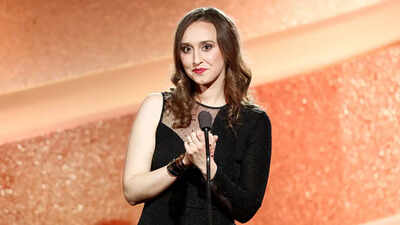
Nasa wanted her, Bezos offered millions, she said no to $1.1m and now she's proving we live in a hologram. (Getty Images)
When most teenagers are stressing over their GCSEs, Sabrina Gonzalez Pasterski was literally reaching for the sky. Now at 32, she's just made headlines again – and it's not the first time she's said 'no thanks' to millionsPicture this: you're 14 years old. Your mates are obsessing over their first driving lessons, and you're... piloting an aircraft you built yourself. Sounds like something from a film, right? For Sabrina Gonzalez Pasterski, it was just Tuesday.The latest buzz around this Cuban-American physicist? She's turned down a jaw-dropping $1.1 million offer from Brown University. Yes, you read that right. Over a million quid. Most of us would snap that up faster than you can say "student loan debt," but Pasterski isn't most people.The girl who couldn't sit stillBorn in Chicago in 1993, Pasterski didn't exactly have a conventional childhood. Whilst other 10-year-olds were playing with Lego, she was rebuilding actual airplane engines.
By 12, she'd started constructing an entire aircraft from a kit – a process that took her three years to complete by hand.Her teenage rebellion? Taking to the skies solo at 14, before she was legally allowed behind a steering wheel. She'd built the single-engine plane herself, and she was going to fly it, driving licence be damned.From Chicago classrooms to cosmic mysteriesBut here's where it gets properly mental. Pasterski didn't just tinker with planes for kicks – she channelled that same obsessive energy into physics.
She applied to MIT, and they were so impressed by her homemade aircraft that they fast-tracked her admission.At MIT, she didn't just attend – she dominated. Graduating in 2014 after just three years (because apparently four years is for mere mortals), she finished top of her class with a perfect 5.0 GPA. She was the first woman ever to achieve that particular feat in physics. Let that sink in for a moment. MIT. Perfect marks.
In physics. In three years.Most of us would be popping champagne and calling it a day. Pasterski? She was already knee-deep in her PhD at Harvard, which she completed in 2019.When legends take noticeHere's something that'll make you question your life choices: whilst at Harvard, she and her colleagues discovered something called the "spin memory effect" – a breakthrough in understanding gravitational waves and how information is stored in spacetime.
When she published her paper on it, Stephen Hawking – yes, that Stephen Hawking – cited her work in his final papers before he died.She'd discovered something that could fundamentally change how we understand black holes, gravity, and the very fabric of spacetime. No big deal.The recognition came flooding in fast. Forbes and Scientific American both named her to their 30 Under 30 lists. The media started calling her "the next Einstein" – a comparison that's both flattering and slightly awkward, given that Einstein never had to deal with Instagram or manage a YouTube channel.The woman who keeps saying noThen came the offers. Big ones.NASA knocked on her door. She said no.Jeff Bezos personally offered her a job at Blue Origin, his space company. She declined.Brown University waved $1.1 million in her face to become a professor – a staggering sum for an academic position. She said no to that too.Why? Because in 2021, she joined the Perimeter Institute for Theoretical Physics in Canada instead, becoming their youngest professor at just 27.
The money was less impressive, but the research opportunities? Unmatched.Chasing the impossible – and filming itNow, Pasterski leads something called the Celestial Holography Initiative at Perimeter. If that sounds like sci-fi technobabble, you're not entirely wrong. She's essentially trying to prove our entire universe might be a hologram – that all the information about three-dimensional space might be encoded on a two-dimensional surface, like a cosmic projection.Her current mission? Only solving the puzzle that stumped both Einstein and Hawking: how to unite quantum mechanics with gravity, bridging our understanding of spacetime with quantum theory. It's one of the biggest unsolved problems in physics, and she's taking it on before she's even 35.But unlike Einstein, who worked in relative obscurity for years, Pasterski is bringing her research to the masses. She runs a YouTube channel called PhysicsGirl, where she breaks down complex physics concepts and shares her research in ways that actual humans can understand.
Einstein never managed that – though in fairness, YouTube wasn't invented in his day.Why her story mattersWhat makes Pasterski's journey particularly brilliant is where she came from. This isn't some child prodigy from a family of scientists with unlimited resources. She's a first-generation American who went through Chicago's public school system – the same state schools that get routinely criticised for being underfunded and overcrowded.She didn't have connections. She didn't have a trust fund. What she had was an obsessive curiosity, a complete disregard for the word "impossible," and an apparently superhuman work ethic.There's a meme that's been circulating online that perfectly captures her energy:> be Sabrina Gonzalez Pasterski> decide to build an airplane at 14> finish it in 3 years, by hand> fly the plane yourself> go to MIT and graduate in 3 years> NASA offers you a job> Jeff Bezos offers you a job> you turn them all down> you're built differentAnd honestly? She is built different.