1 month ago
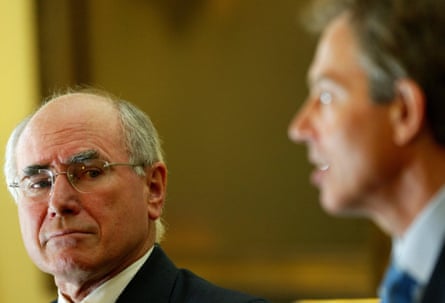
Tony Blair’s government discussed how to “influence” John Howard when it came to committing Australian troops to Iraq after the toppling of Saddam Hussein’s regime, newly released files in the UK show.
They also reveal that one of Howard’s own defence ministers told a Downing Street official that the Australian prime minister was not “keen” on sending troops to Afghanistan and privately advised the British leader should raise the issue with Howard “to get him focused on the need for Australia to contribute”.
The UK Cabinet Office and Foreign Office files, released by Britain’s national archives, provide an insight into how Blair’s government worked to flatter the Australian Liberal party prime minister, who appeared equally eager to foster a close relationship with the UK Labour prime minister.
This followed the re-election of Howard’s Coalition in the 2004 federal election. A note to key Downing Street staff recounting a congratulatory call by Blair to Howard on the day of the win recorded that the UK leader had hailed it as “an incredible result and a tribute to Howard’s leadership”.
“Comment: a notably warm call,” the letter added.
Less than four months earlier, a cable to Downing Street from the British High Commission in Canberra reported on conversations with Australian government figures as Howard’s government weighed up committing troops to the UN protection force in Iraq.
“If we are to influence Howard’s decision the timing for the prime minister’s call is perfect,” reported a diplomat, who said that speaking note prepared for Blair in advance of a call appeared to “strike the right tone”.
Later in the same year, another internal note to Downing Street reported on a meeting between Nigel Sheinwald, then Blair’s top foreign policy adviser, and Robert Hill, Howard’s defence minister, at a summit in Bahrain.
Hill had just come back from Iraq, where he had been reviewing Australian troops, and the security situation was worse than he expected. Sheinwald took the opportunity to broach the situation in Afghanistan where there was a shortfall in the Nato troop contribution and told Hill that Britain would “very much welcome Australian help”.
The note records: “Hill said this was a tricky political issue for his Government. Nor was Howard keen. He advised – in confidence – that the Prime Minister raise this with Howard to get him focussed on the need for Australia to contribute.”
By the following year, a focus had shifted to convincing Australia to commit hundreds of troops to Iraq.
A note prepared for Blair in advance of a call with Howard on 20 February 2005 at the Australian leader’s request noted that the cabinet in Canberra would decide that week on whether to send 450 troops to help replace a Dutch contingent protecting a Japanese unit in the Iraqi province of Al Muthanna.
“If the Australians do not take this one on, we will have to do it alone,” wrote David Quarrey, Blair’s private secretary.
“The Australian Cabinet is likely to approve the request. But it has required a complicated diplomatic dance to get this far. Howard, for domestic reasons, wanted to be asked by the Japanese (and us) to deploy Australian forces.”
Referring to the Japanese prime minister, Quarrey added: “Koizumi for his own domestic reasons (and a preference for UK rather than Australian protection for the Japanese) was reluctant to make the request.
“But we managed to get Koizumi to call Howard. And if Howard can tell his Cabinet on Tuesday that you have also spoken to him, then the deal should be done.”
Quarrey advised: “You do not need to ask Howard to send Australian troops. But you should say you would greatly appreciate it if his Cabinet were able to agree to send them.”