1 hour ago
US ambassador David Perdue said Donald Trump asked Xi Jinping if China wanted to buy American weapons during their talks. The remark drew scrutiny because US law bars such sales and Taiwan arms delays remain under focus.
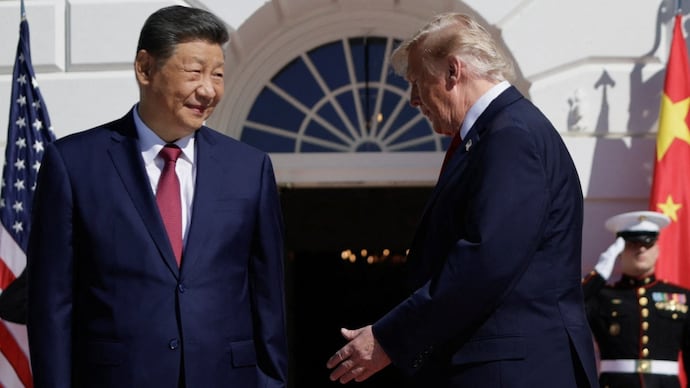
US President Donald Trump greets Chinese President Xi Jinping at the White House in Washington, DC. (File Photo: Reuters)
The US and China have been locked in a contest over military power, technology and influence for decades. But during Xi Jinping's latest visit to the US, Donald Trump put an unusual proposition to his Chinese counterpart: Would China like to buy American weapons? US Ambassador to China David Perdue revealed that Trump raised the question during their talks.
Perdue made the disclosure during an interview with Fox News on Sunday while discussing Xi's state visit to the United States last week. He did not say what Xi's response was or provide details about what kind of weapons Trump was referring to.
"President Trump continues to say, 'Hey, we sell arms to other people around the world,'" Perdue said. "He actually asked President Xi would he like to buy some at one point."
The remarks immediately raised questions because China is viewed in Washington as the United States' principal strategic competitor. The two countries are also deeply divided over Taiwan, military power in the Asia-Pacific and China's relations with countries that Washington considers adversaries.
US SAYS THERE IS NO PLAN TO ARM CHINA
The White House sought to draw a distinction between Trump's reported remark and any actual arms deal.
A US official told The New York Times that Washington had no plans to sell weapons to China. The State Department was more explicit, saying: "US law prohibits arms sales to China and there is no offer or plan to sell arms to China."
The issue is particularly sensitive because China has rapidly expanded its military capabilities, while US officials have repeatedly warned of the possibility of a military confrontation in the Asia-Pacific. Taiwan remains one of the biggest flashpoints, along with disputes involving Chinese claims in the South and East China seas.
US officials have also accused Chinese companies of providing dual-use technology, satellite imagery and other support to countries including Iran and Russia. Washington has imposed sanctions on some Chinese firms over such activities.
TAIWAN ARMS DEAL HANGS IN BALANCE
The ambassadors' comments came as the Trump administration faces growing questions over a 14 billion dollar weapons package for Taiwan that has been held up in Washington.
Taiwan has long relied on US weapons and other support to strengthen its defences against China. The law requires Washington to make defensive arms available to Taiwan, although the US does not maintain formal diplomatic relations with Taipei.
Trump has previously approved a separate 11 billion dollar arms package for Taiwan. But the larger package has remained pending, prompting bipartisan pressure in Congress for the administration to move ahead.
Four Republican senators, led by Senate Minority Leader Mitch McConnell, wrote to Secretary of State Marco Rubio and Defence Secretary Pete Hegseth shortly before Xi's arrival in Washington, urging them to advance the Taiwan sales. They also called for previously approved funds for Taiwan's weapons purchases and security cooperation to be allocated.
Perdue, when asked about the delayed sales, pointed to Trump's previous approval of weapons for Taiwan and said discussions over additional sales were continuing.
"He and President Xi talk about that every time they get together," Perdue said. It was in that context that Perdue revealed Trump's reported offer to Xi.
WHY TAIWAN IS THE BIGGEST FLASHPOINT
China strongly opposes US arms sales to Taiwan and has repeatedly urged Washington to stop supplying weapons to the island.
Trump has acknowledged discussing Taiwan's arms purchases with Xi. In a Fox News interview recorded during an earlier visit to Beijing, Trump described the weapons package as a "very good negotiating chip" in talks with China.
After last week's summit, Trump and Xi highlighted the fact that the US and China fought on the same side during World War Two. A White House fact sheet said the two countries "were allies in World War Two and fought side by side to win the war".
Taiwan has pushed back against that framing, arguing that the government representing China during the war was the Republic of China, which fought alongside the Allies. The Republic of China government later moved to Taiwan after losing the Chinese civil war in 1949.
Shen Yu-chung, deputy head of Taiwan's Mainland Affairs Council, accused Beijing of trying to shape the historical narrative around the war.
Taiwan Deputy Foreign Minister Francois Wu said: "China is trying to replace the Republic of China's role during World War Two," adding, "I think this is something we should feel very sad about."
Taiwan's concerns extend beyond history. Officials in Taipei are closely watching whether Washington's efforts to stabilise relations with Beijing could affect US support for the island.
Taiwan's de facto ambassador to the United States, Alexander Yui, said he remained confident that Washington's position on Taiwan had not changed, based on public statements by US officials. At the same time, he said he hoped the weapons package would be approved "as soon as possible".
Against that backdrop, Perdue's disclosure about Trump asking Xi whether China wanted to buy American weapons is likely to draw further scrutiny, particularly from officials and lawmakers focused on Taiwan's security.
- Ends