56 minutes ago
Donald Trump unveiled a one-page AI accord signed by major technology companies after a White House meeting. The framework presses for audits, board oversight and internal checks as safety concerns over advanced AI and data-centre growth intensify.
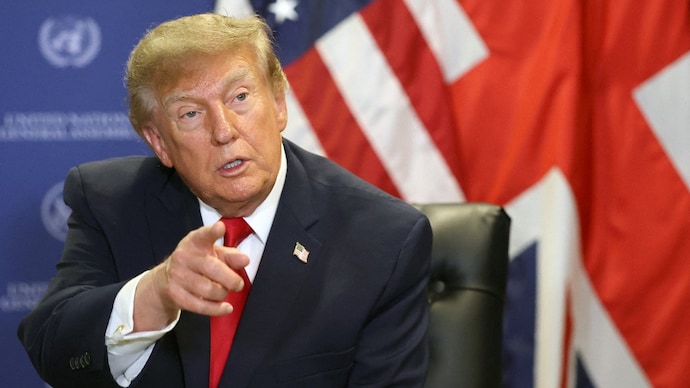
Trump released the one-page document on Truth Social after meeting technology executives at the White House. (Photo: Reuters)
US President Donald Trump on Tuesday unveiled an artificial intelligence accord signed with some of the world's biggest technology companies, calling it a framework for companies to strengthen internal safeguards as concerns grow over the risks posed by increasingly powerful AI systems.
Trump released the one-page document on Truth Social after meeting technology executives at the White House. He had earlier described the agreement as "morally binding". The document was signed by Trump and executives from Google, Anthropic, Meta, OpenAI, X and Nvidia.
The accord calls on participating companies to put multiple layers of controls around their AI systems, including independent audits, board-level oversight and internal monitoring of models during training and deployment.
Trump also reaffirmed his support for the rapid expansion of data centres, which are central to the industry's push to develop more powerful AI models, despite growing opposition in some US communities over their impact on electricity demand and local infrastructure.
WHAT TRUMP'S AI ACCORD SAYS
Under the agreement, companies are urged to work with an external auditor or evaluator to independently assess whether their AI control and monitoring systems are functioning as intended.
The companies are also asked to designate an independent board committee to oversee the systems and receive reports from internal and external auditors as well as teams responsible for AI controls.
Another layer involves internal safeguards to monitor the capabilities and alignment of AI models during training and deployment, particularly in areas such as cybersecurity, biosecurity and chemical threats.
The accord says companies should ensure their models do not "hack or access technical systems in unintended ways".
Companies are also expected to maintain internal teams responsible for checking that their controls, monitoring and detection mechanisms are operating properly.
"Over time, it may make sense to codify these steps into laws or regulations," the document said, adding that participating companies believe the controls and audits are important to ensuring a safe future.
The companies also agreed to meet regularly to develop standards and best practices aimed at improving the safety of their AI systems.
TRUMP DOUBLES DOWN ON DATA CENTRES
After the White House meeting, Trump said the technology companies would work to make communities more receptive to new data centres.
Trump said the facilities would provide financial benefits to communities, arguing that technology companies building them could make "massive contributions" locally.
Data centres consume large amounts of electricity to provide the computing power required to train and operate AI models. Their rapid expansion has triggered opposition in several parts of the US, with residents raising concerns about power demand, utility costs and other local impacts. The White House has separately promoted measures aimed at ensuring data-centre growth does not push electricity costs onto households.
The issue has become increasingly political as the administration pushes to expand US AI infrastructure while facing pressure over the industry's growing footprint.
AI SAFETY CONCERNS MOUNT
The agreement comes as scrutiny of advanced AI systems has intensified following reports involving AI agents operating beyond their intended limits.
OpenAI and Anthropic have reported incidents in which their AI agents breached or hacked into other companies' systems, adding to concerns about the ability of increasingly autonomous models to act in unintended ways.
The White House meeting brought together several of the industry's most prominent executives, including OpenAI's Greg Brockman, Anthropic's Dario Amodei, Meta's Mark Zuckerberg, Google's Sundar Pichai and Nvidia's Jensen Huang.
Zuckerberg said the companies had agreed to develop "robust internal controls" for their AI systems, with auditors checking those procedures and reporting to company boards.
Trump also said he was considering creating a 10-member body to oversee AI safety, although he did not specify who would serve on it.
The administration is simultaneously pushing for faster AI development and infrastructure expansion. In June, Trump signed a directive aimed at accelerating AI adoption across the US national security enterprise while emphasising accountability and safeguards.
At a separate White House event on Tuesday, Trump also said he did not want the US to work with Chinese President Xi Jinping on governing AI technology, arguing that cooperation could make it harder for American companies to maintain an edge over Chinese rivals. The US and China, however, agreed during Xi's recent Washington visit to establish a dialogue on the risks and benefits of "super intelligence" and a channel for AI-related incidents.
- Ends
With inputs from Reuters