 1 month ago
Civil rights leader Jesse Jackson has died aged 84, family says
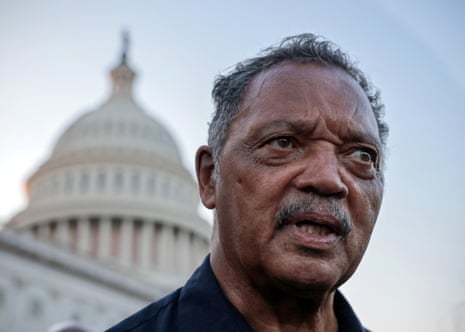
The Rev Jesse Jackson, the civil rights activist and two-time presidential candidate, died on Tuesday aged 84, his family said, according to NBC News.
A statement from the Jackson family read:
Our father was a servant leader – not only to our family, but to the oppressed, the voiceless, and the overlooked around the world.
We shared him with the world, and in return, the world became part of our extended family.
His unwavering belief in justice, equality, and love uplifted millions, and we ask you to honor his memory by continuing the fight for the values he lived by.
The cause of Jackson’s death was not given. His family said he died peacefully, surrounded by his loved ones.
Key events Show key events only Please turn on JavaScript to use this feature
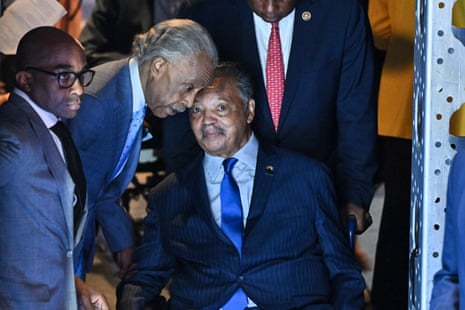
Al Sharpton calls his 'mentor' Jesse Jackson a 'transformative leader who changed the world'
The civil rights campaigner, Al Sharpton, has paid tribute to his “mentor” Jesse Jackson, whom he worked closely with over the civil rights era. In a tribute posted to X, Sharpton wrote:
My mentor, Rev. Jesse Jackson, has passed. I just prayed with his family by phone. He was a consequential and transformative leader who changed this nation and the world.
He shaped public policy and changed laws. He kept the dream alive and taught young children from broken homes, like me, that we don’t have broken spirits.
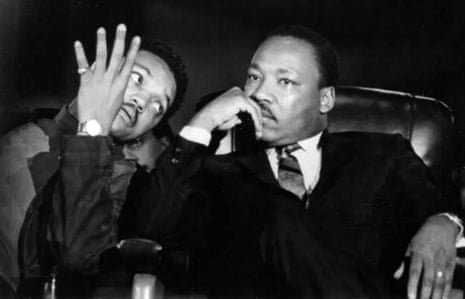
On 4 April 1968, Dr Martin Luther King Jr was shot by a sniper as he stood on the balcony of the Lorraine motel in Memphis, Tennessee. The Rev Jesse Jackson, in the motel courtyard at the time, was said to be one of the witnesses to King’s murder, as my colleague David Smith reported in this fascinating interview piece from 2018. Here is an extract:
Jesse Jackson still remembers the sound of the gunshot and the sight of blood. They have been with him for half a century. “Every time I think about it, it’s like pulling a scab off a sore,” he says. “It’s a hurtful, painful thought: that a man of love is killed by hate; that a man of peace should be killed by violence; a man who cared is killed by the careless.”…
Amid the tumult of the 1960s, King, outspoken against the Vietnam war, was one of the most hated men in America and his life was in constant danger. His house was bombed, his followers were killed, his name was trashed by newspaper editorials and his phones were tapped by J Edgar Hoover’s FBI. His two-thirds disapproval rating in a 1966 Gallup poll sits at odds with today’s “I have a dream” sanctification.
“They loved him as a martyr after he was killed but rejected him as a marcher when he was alive,” recalls Jackson, 76, still a dedicated activist, speaking by phone from an African development conference in Morocco. “We tend to embrace martyrs. In many ways he has a moral authority now you wouldn’t see if he was still alive. He is a universal frame of reference for moral authority, the global frame of reference for nonviolent justice and social change. If he had not died, that probably would not be the case.”
Jesse Jackson meeting world leaders and public figures over the years - in pictures
The Rev Jesse Jackson met numerous world leaders, politicians and other public figures over the years and has a remarkable collection of archive images as a result. Here are some of the best:
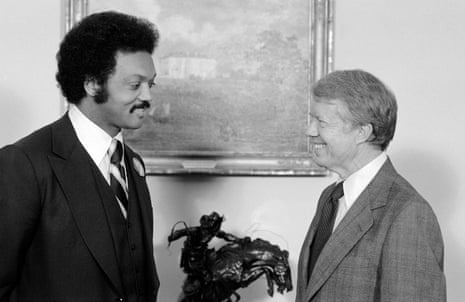
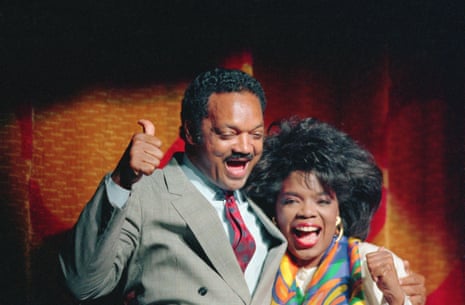
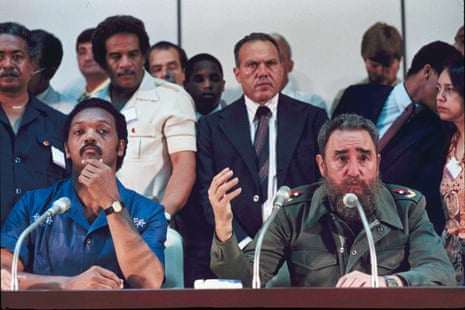
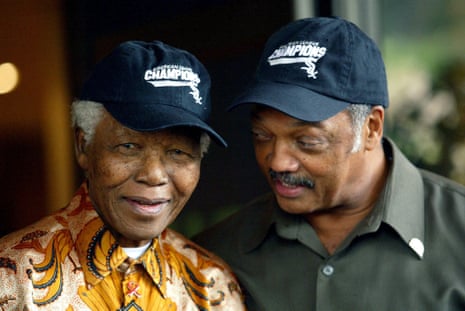
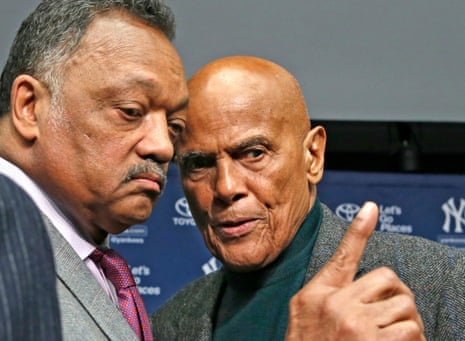
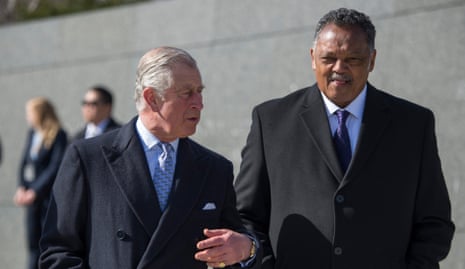
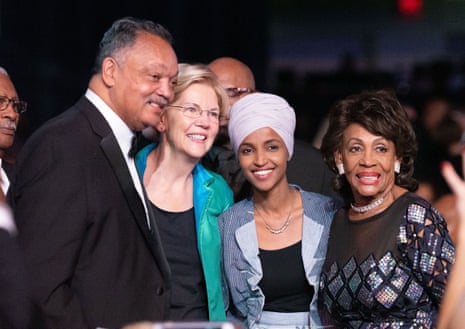
Here is an interesting extract from a 1984 New York Times Magazine profile on Jackson’s 1984 Democratic presidential nominee campaign, in which he finished third behind eventual nominee Walter Mondale and Gary Hart, but had a profound effect on Democrats going forward.
Jackson’s time in the sun as a serious candidate may be short, depending on what happens on March 13. But in this effort in which the party nomination is less important than his major quest, Jackson may continue trying to forge his coalition right up until and after the July convention – well after his potential for winning delegates has ended but long before the November elections, when his support will be needed.
Part of what is likely to continue driving Jackson could be seen recently when 80-year-old Nellie Cuellar, head of the Association of Black Aged, was among those paying tribute to Jackson’s successful Syria mission before more than 7,000 people at the University of Detroit’s Calihan Hall.
‘‘I’ve longed and dreamed to see the day when one of my people would be President, and I believe it’s going to become a reality,’’ she said. ‘‘It means don’t go laying down. Go down fighting.’’
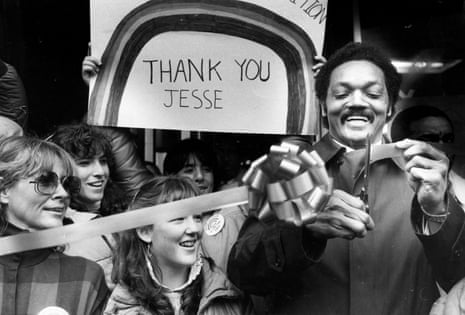
How Jesse Jackson moved from activism to the mainstream political arena
As well as being a prominent civil rights campaigner, Jackson became a focal point of black political power after running twice for the Democratic nomination for president in 1984 and 1988.
He was the first African American to make the giant leap from activism to major-party presidential politics, firmly cementing his place in the history books in doing so.
Here is some more from Jackson’s political career (courtesy of my colleagues’ story):
In 1984, Jackson ran as a Democratic candidate for president, becoming the second Black person to launch a nationwide campaign following Shirley Chisholm more than a decade earlier …
He lost the Democratic nomination to former vice-president Walter Mondale, with the incumbent Republican president Ronald Reagan ultimately winning the election.
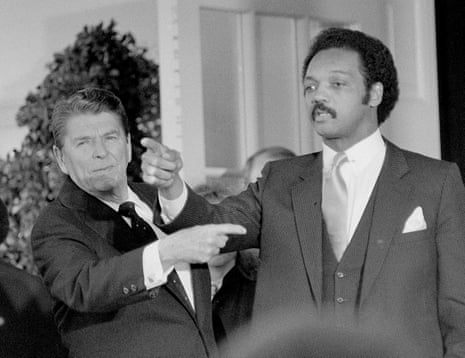
After his first presidential run, Jackson created the Rainbow Coalition to push for voting rights and social programs. In the mid-1990s, Jackson merged his two organizations together to form the multiracial group Rainbow Push Coalition, which focuses on educational and economic equality.
Throughout the years, the coalition has paid more than $6m in college scholarships, and gave financial assistance to more than 4,000 families facing foreclosures so that they could save their homes, according to their website.
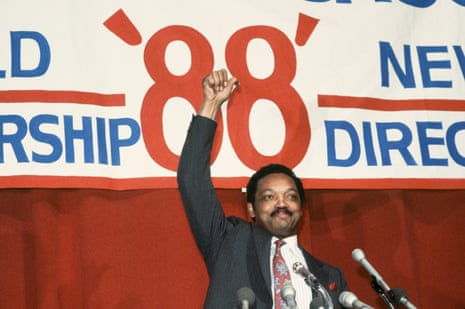
Jackson ran for the Democratic nomination for president a second time in 1988, performing strongly but losing out to Michael Dukakis, the Massachusetts governor, who was beaten heavily in the general election by George HW Bush.
What was Jesse Jackson's trailblazing role in the civil rights movement?
My colleagues Melissa Hellmann and Martin Pengelly have looked back at the Rev Jesse Jackson’s extraordinary contribution to the civil rights movement and how he fought for the rights of Black Americans and other people of colour alongside his mentor Martin Luther King Jr:
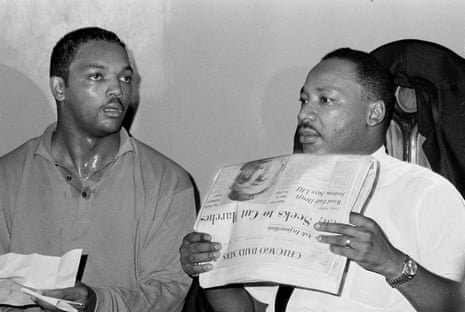
A fixture in the civil rights movement and Democratic politics since the 1960s, Jackson was once close to Dr Martin Luther King Jr.
In an interview with the Guardian in May 2020, Jackson said: “I was a trailblazer, I was a pathfinder. I had to deal with doubt and cynicism and fears about a Black person running. There were Black scholars writing papers about why I was wasting my time. Even Blacks said a Black couldn’t win.”
“It was a big moment in history,” Jackson told the Guardian, 12 years later.
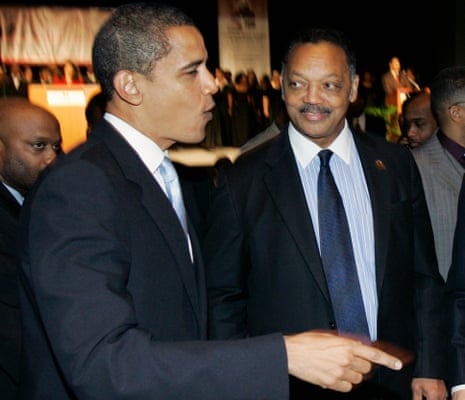
Twenty years later, the first Black president, Barack Obama, saluted Jackson for making his victory possible. Obama celebrated in Chicago, also home to Jackson …
In 1964, Jackson enrolled at the Chicago Theological Seminary, as he continued to be involved in the Civil Rights Movement. Jackson travelled with his classmates to Selma, Alabama to join the movement after he watched news footage of “Bloody Sunday, where King led nonviolent civil rights marchers across the Edmund Pettus Bridge in Selma, Alabama, who were then beaten by law enforcement. Impressed by Jackson’s leadership at Selma, King offered him a position with the civil rights group that he co-founded, the Southern Christian Leadership Conference (SCLC).
After a couple of years, Jackson put his seminary studies on hold to focus on SCLC’s Operation Breadbasket, an economic justice program that harnessed the power of Black churches by calling on ministers to put pressure companies to employ more Black people through negotiations and boycotts. In 1967, Jackson became Operation Breadbasket’s national director, and was ordained as a minister a year later.
“We knew he was going to do a good job,” King said at an Operation Breadbasket meeting in 1968, “but he’s done better than a good job”.
Tragedy struck soon after Jackson gained a leadership position at SCLC. On 4 April, 1968, Jackson witnessed King’s assassination from below the balcony at the Lorraine Motel in Memphis, Tennessee.
As we mentioned in the opening post, no cause of death was immediately given by the Rev Jesse Jackson’s family.
In 2017, he revealed he had Parkinson’s, an incurable neurological disease that can cause tremors and affect coordination.
“After a battery of tests, my physicians identified the issue as Parkinson’s disease, a disease that bested my father,” Jackson said at the time.
“Recognition of the effects of this disease on me has been painful, and I have been slow to grasp the gravity of it.”
Jackson had had progressive supranuclear palsy (PSP) for more than a decade. He was also twice hospitalised with Covid in recent years.
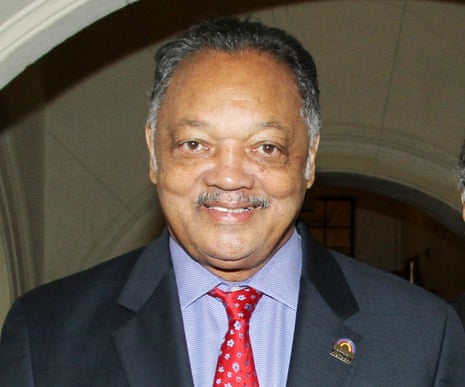
Our father left an 'indelible mark on history', family says
Here is the Jackson family statement in full:
It is with profound sadness that we announce the passing of Civil Rights leader and founder of the Rainbow PUSH Coalition, the Honorable Reverend Jesse Louis Jackson, Sr. He died peacefully on Tuesday morning, surrounded by his family.
His unwavering commitment to justice, equality, and human rights helped shape a global movement for freedom and dignity. A tireless change agent, he elevated the voices of the voiceless from his Presidential campaigns in the 1980s to mobilising millions to register to vote – leaving an indelible mark on history.
Reverend Jackson is survived by his wife, Jacqueline; their children – Santita, Jesse Jr., Jonathan, Yusef, Jacqueline; daughter Ashley Jackson, and grandchildren. He was preceded in death by his mother, Helen Burns Jackson; father, Noah Louis Robinson; and stepfather, Charles Henry Jackson.
“Our father was a servant leader – not only to our family, but to the oppressed, the voiceless, and the overlooked around the world. We shared him with the world, and in return, the world became part of our extended family. His unwavering belief in justice, equality, and love uplifted millions, and we ask you to honour his memory by continuing the fight for the values he lived by.”
Public observances will be held in Chicago. Final arrangements for Reverend Jackson’s celebration of life services, including all public events, will be released by the Rainbow PUSH Coalition.
Civil rights leader Jesse Jackson has died aged 84, family says
The Rev Jesse Jackson, the civil rights activist and two-time presidential candidate, died on Tuesday aged 84, his family said, according to NBC News.
A statement from the Jackson family read:
Our father was a servant leader – not only to our family, but to the oppressed, the voiceless, and the overlooked around the world.
We shared him with the world, and in return, the world became part of our extended family.
His unwavering belief in justice, equality, and love uplifted millions, and we ask you to honor his memory by continuing the fight for the values he lived by.
The cause of Jackson’s death was not given. His family said he died peacefully, surrounded by his loved ones.