1 month ago
Donald Trump's global tariffs have been struck down by the Supreme Court. Here are the judges who ruled them unconstitutional and beyond the president's powers.
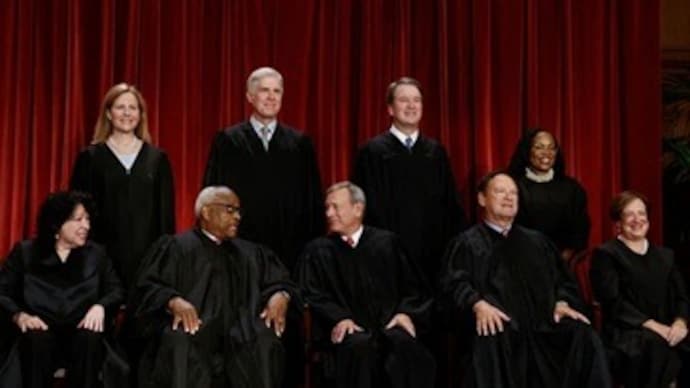
US Supreme Court declared Trump tariffs unconstitutional in major blow to president

New Delhi,UPDATED: Feb 21, 2026 08:56 IST
In a landmark 6-3 ruling on Friday, the US Supreme Court struck down sweeping tariffs imposed by President Donald Trump under the Emergency Economic Powers Act (IEEPA). The court held that while the president has emergency powers, they do not extend to the unilateral imposition of broad taxes or tariffs, an authority that the Constitution reserves for Congress.
JUSTICES WHO STRUCK DOWN TRUMP TARIFFS
John Roberts (Chief Justice)
Roberts authored the majority opinion, holding that the president does not have unilateral authority to impose sweeping tariffs under the IEEPA. He emphasised that the Constitution grants Congress the power to levy taxes and tariffs, framing the dispute as a separation-of-powers issue.
Neil Gorsuch
Gorsuch, a conservative appointed by Trump, joined the majority in striking down the tariffs.
Amy Coney Barrett
Barrett also joined Roberts’ opinion, a notable vote given that she was appointed by Trump.
Sonia Sotomayor
Sotomayor joined the majority, concluding that the IEEPA does not authorise tariffs. Her vote reflected the court’s liberal wing’s broader concerns about executive overreach and the need for clear congressional approval for major economic actions affecting trade and taxation.
Elena Kagan
Kagan joined the majority and also wrote a concurring opinion, along with Sotomayor and Jackson, arguing that the case could be resolved through ordinary statutory interpretation without invoking broader doctrines such as the “major questions doctrine.”
Ketanji Brown Jackson
Jackson joined the majority and wrote separately to note that legislative history also supports the conclusion that Congress never intended the IEEPA to grant tariff authority.
JUSTICES WHO DISSENTED
Brett Kavanaugh
Kavanaugh authored the principal dissent, arguing that the tariffs were “clearly lawful” under the statute and historical practice. He maintained that presidents have long used tariffs as a tool to regulate imports during emergencies and warned that the ruling could create practical complications, including the need to refund previously collected tariffs.
Clarence Thomas
Thomas joined Kavanaugh’s dissent and wrote separately to emphasise that Congress can delegate trade powers to the executive and that the statutory text permits tariffs. His opinion focused on constitutional structure and historical precedent supporting broad presidential authority over foreign commerce.
Samuel Alito
Alito also dissented, agreeing that the majority misinterpreted the statute and unnecessarily restricted presidential authority. He supported the view that the president had legal grounds to impose tariffs and that policy disagreements should not drive statutory interpretation.
The ruling split the court 6-3, with Roberts, Sotomayor, Kagan, Gorsuch, Barrett and Jackson forming the majority, and Kavanaugh, Thomas and Alito dissenting.
- Ends
Published On:
Feb 21, 2026
Tune In