1 hour ago
The Pentagon plans to livestream the execution of Nidal Hasan by firing squad at Fort Hood, 17 years after he killed 13 people at the military base. US War Secretary Pete Hegseth has defended the plan as a deterrent, but it has drawn criticism from the Pope, the UN and senators across party lines, with one likening it to executions carried out by the Islamic State (IS).
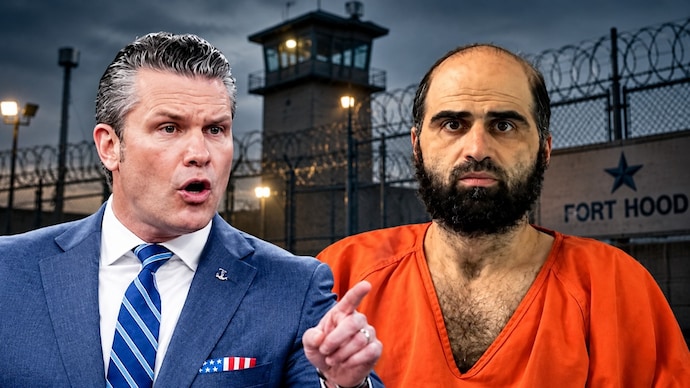
Former US Army psychiatrist Nidal Malik Hasan killed 13 people in 2009. Pete Hegseth called it a "radical Islamist attack" and said Hasan's execution would be livestreamed. (File)
The same military base, the same day of the week, the same hour, and 17 years after he killed 13 people (including 12 fellow US soldiers), Nidal Malik Hasan is scheduled to face a firing squad at Fort Hood in Texas. And, the Pentagon wants Americans, and potentially viewers across the world, to watch the former US Army major's execution live on December 3. US Secretary of War Pete Hegseth, calling it a "radical Islamist attack", said the public broadcast will send a message about the consequences of such crimes. But the decision has drawn sharp criticism from both Republicans and Democrats, with one senator comparing it to executions by IS.
Now, even President Donald Trump and Vice President JD Vance have cast doubt on whether the livestream will go ahead, while the United Nations and the Pope have condemned the proposal, reported Reuters.
"He's going to get a firing squad of soldiers, as it should be," US War Secretary Pete Hegseth said. "And we'll make sure that people are able to watch it, that it's public, because people need to understand that there are serious consequences for these types of things." Pentagon spokesperson Sean Parnell said "Nidal Hasan killed 13 people and wounded 32 others while shouting Allahu Akbar during the attack."
Hasan, a former Army psychiatrist, was convicted of killing 13 people and wounding 32 others in a shooting at Fort Hood on November 5, 2009. He was sentenced to death in 2013, and President Donald Trump approved his execution on October 2.
The Pentagon's decision to livestream Hasan's execution has drawn criticism, raising questions about why the US wants to revive the spectacle of public executions nearly 90 years after abandoning the practice. The controversy has now reached the White House. Trump said he has not decided whether the execution should be livestreamed, but has supported the death sentence.
"I don't really care how he goes, as long as he goes," Trump said on Friday. Asked whether the execution should be livestreamed, he said he had yet to make a determination. Vice President JD Vance also questioned whether the Pentagon would proceed with the broadcast. "I don't know that that's actually going to happen," he told reporters in Cincinnati. "I'm not going to be watching it," he added, reported German broadcaster, Deutsche Welle.
WHY IS HASAN BEING EXECUTED IN THE SAME PLACE, DAY AND HOUR?
The choice of Fort Hood is deliberate. Hasan opened fire on fellow soldiers at the Texas military installation on a Thursday afternoon in November 2009. His execution had been scheduled for December 3, at 1 pm Central Time, or 2 pm Eastern.
Hegseth said the location and timing were chosen to mirror the original attack, calling the decision a "no-brainer".
The former psychiatrist, who described his attack as an act of jihad, targeted soldiers preparing for deployment to Afghanistan. He was shot by responding officers and left paralysed from the waist down.
Hasan's disability, is another factor that could make the televised execution particularly controversial. His lawyer, John Galligan, has questioned the decision to transport him from Fort Leavenworth, Kansas, back to Fort Hood.
"I think it's more of a public spectacle, closely akin to almost, I see it more as political theatre," Galligan told ABC News.
Hasan, born in Arlington, Virginia, to Palestinian immigrant parents, had family roots in the West Bank, with his mother hailing from Al-Bireh, near Ramallah, according to The Washington Post.
WHY DOES HEGSETH WANT PEOPLE TO WATCH HASAN'S EXECUTION?
Hegseth's stated justification is deterrence. He said he believed making the execution publicly visible would demonstrate that attacks on American soldiers carry the gravest consequences. The war secretary has also invoked the military's World War II mentality, emphasising the importance of standing one's ground when attacked.
However, the argument that a public execution would deter future attacks has been challenged by former US counterterrorism officials. Joe Kent, who resigned earlier this year as Trump's director of the Counterterrorism Center, warned that broadcasting Hasan's death could instead provide extremist organisations with propaganda to recruit and radicalise followers, Reuters reported.
The choice of firing squad to execute Hasan also carries historical significance. The last US military execution by firing squad was that of Private Eddie Slovik in 1945, for desertion during World War II. The military's last execution by any method was in 1961, when Army Private John Bennett was hanged.
However, the Pentagon has not explained why an ordinary execution, witnessed by designated observers, would be insufficient to convey its message. It has also not announced which platform will carry the livestream or whether it will be accessible worldwide.
The Pentagon has also declined to say whether the families of those killed in the Fort Hood shooting would be invited to attend. Questions remain about how the firing squad will be selected and what protocols will govern the execution. The department has said further details will be released later, CBS News reported.
REPUBLICAN SENATOR CALLS HASAN'S EXECUTION BEYOND DISGUSTING
The announcement from Pete Hegseth has attracted criticism across America's political divide. Republican Senator Thom Tillis supported Hasan's death sentence but opposed turning it into a public broadcast.
"Hasan should face the death penalty, but making his execution public and streaming it? Beyond disgusting," Tillis wrote on X. "Public executions are what oppressive dictatorships like Iran and Afghanistan do. It should not be happening in America."
Democratic Senator Chris Murphy was equally critical. "I mean, that's disgusting. What is he, mimicking IS executions?" Murphy told CNN.
Murphy described public executions as "medieval" and said they were among the practices Americans condemned when carried out by terrorist organisations.
Republican Senator John Curtis warned against cultivating an appetite for executions as entertainment. Republican Representative Austin Scott said livestreaming executions was something jihadists did, not the US. Representative Rob Bresnahan argued that the suffering of victims and their families deserved respect rather than a public show.
The criticism has also come from within America's religious establishment. Archbishop Paul Coakley, president of the United States Conference of Catholic Bishops, described the proposed livestream as a "barbaric promotion of a culture of death" and called for the decision to be reconsidered.
On Saturday (October 10), Pope Leo XIV, the first American pope, reiterated his opposition to capital punishment on World Day Against the Death Penalty. He argued that justice could be served without executions. Although he did not specifically mention Hasan or the Pentagon, his remarks came amid the growing controversy over the planned broadcast, reported Reuters.
AMERICA ABANDONED PUBLIC EXECUTIONS 90 YEARS AGO
Public executions were once common in the United States, but its states gradually moved them behind prison walls. The last widely recognised public execution occurred on August 14, 1936, when Rainey Bethea was hanged in Owensboro, Kentucky, before thousands of spectators.
Nearly nine decades later, the Pentagon's proposed livestream would mark an extraordinary reversal.
The United Nations Human Rights Office has now joined the criticism. Speaking in Geneva, spokesperson Shabia Mantoo said public executions amounted to cruel, inhuman or degrading treatment or punishment and would breach the absolute prohibition on torture.
Geoffrey Corn, a Texas Tech University law professor and former Army legal officer, told CBS News that turning capital punishment into a public spectacle raised serious moral questions.
There are regulatory questions too. CNN reported that Army Regulation 190-55 restricts who might witness military executions and prohibits minors from attending, although certain waivers are permitted. The proposed livestream's compatibility with those rules remains unresolved.
Even some of Hasan's surviving victims have reservations about the public broadcast. Alonzo Lunsford, who was shot seven times during the 2009 attack, told ABC News he supported the execution and wanted to attend it, but believed any broadcast should be restricted to survivors and victims' families.
The US Army has scheduled Hasan's execution following Trump's approval and the completion of military appeals. But legal experts say further challenges in civilian federal courts could delay it. There is also the question of how the public would react to watching a disabled prisoner being shot by soldiers. The Pentagon intends the broadcast to demonstrate the consequences of killing American troops. Critics fear it could instead revive images of state-sanctioned public killing that the US abandoned generations ago. But the Pentagon has made its intention clear, as of now. And, the world might get to watch an American military execution unfold live, for the first time in the country's history.
- Ends