1 month ago
Several prominent women leaders of the NCP, the Bangladesh students' party backing the Muhammad Yunus-led interim set-up, have either spoken against the outfit or resigned in the last one week. Behind the anger is the NCP's alliance with the radical Jamaat-e-Islami. Did they overlook the Jamaat DNA?
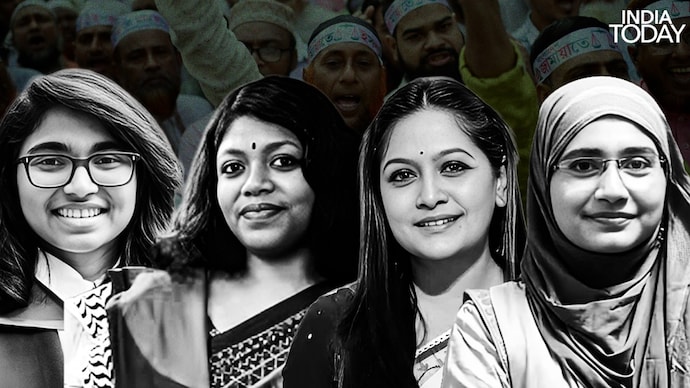
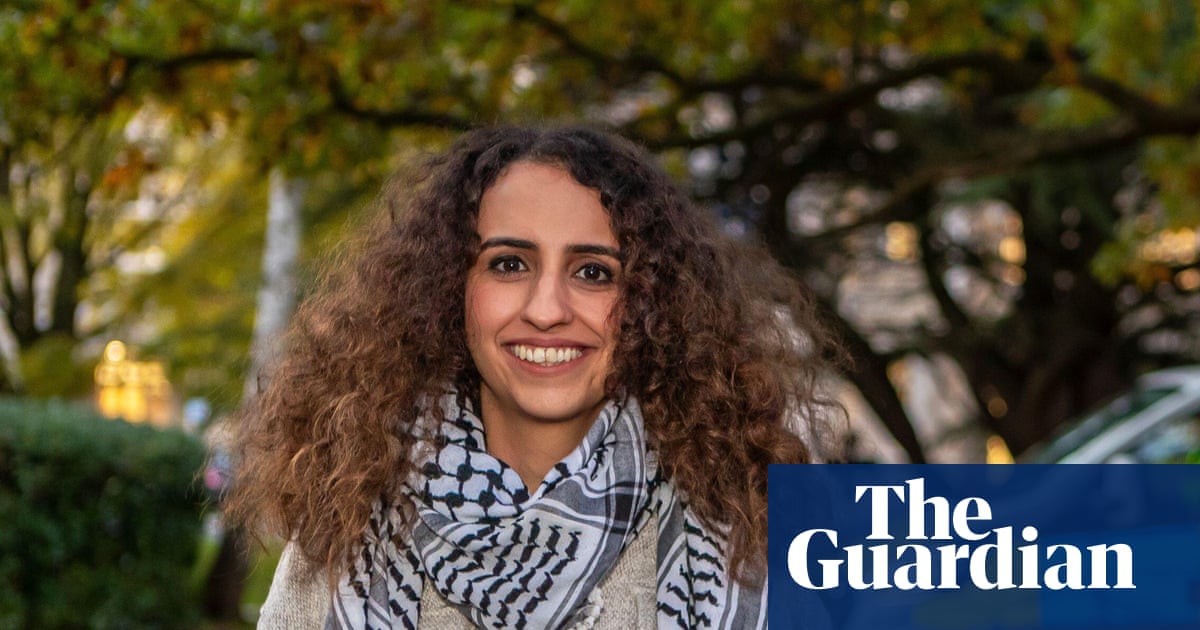
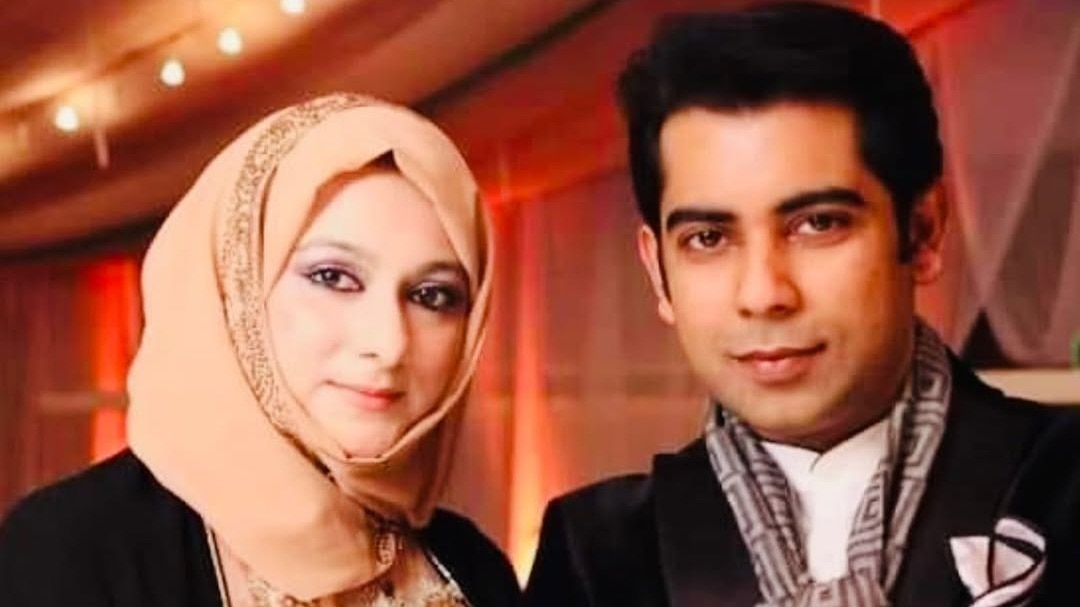
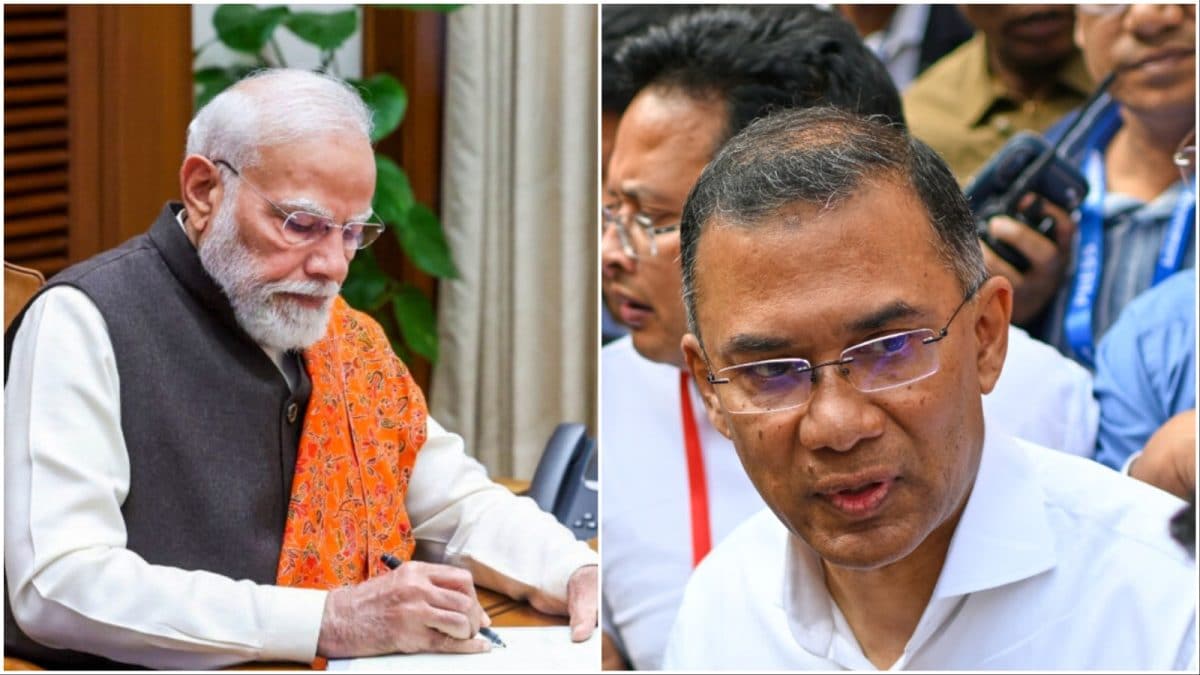
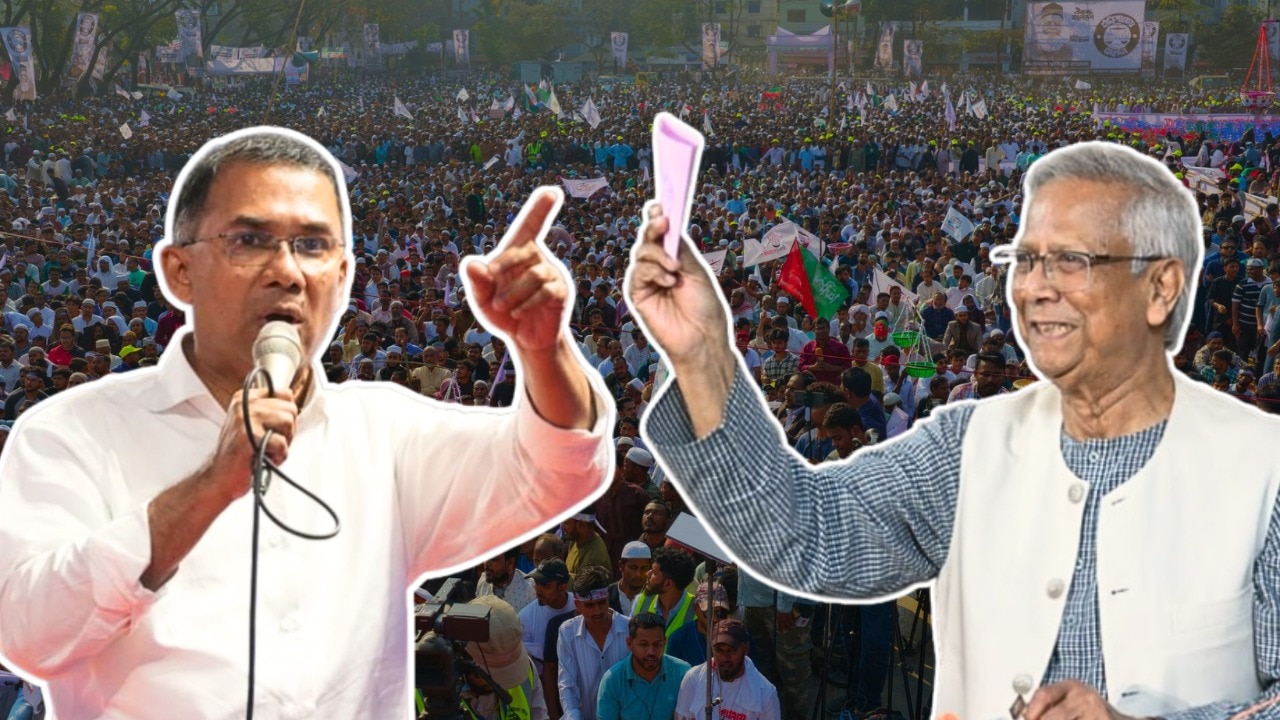
NCP leaders Tasnim Jara (L) and Tajnuva Jabeen (Centre right) have resigned from the party, while Samantha Sharmin (R) and Nusrat Tabassum have slammed the party over its alliance with the Jamaat-e-Islami. (Images: Social Media/India Today)
Just over a year ago, young university students, activists — men and women — took to the streets across Bangladesh against Prime Minister Sheikh Hasina, whom they branded a "despot". They fought together against an authoritarian regime, hoping for a "new Bangladesh". Over a year later, many of them, especially the women, are disillusioned as the party formed by the agitating students joined hands with the radical Jamaat-e-Islami for the February 2026 Bangladesh election. Several of the women members of the Citizens Party (NCP) have vented their anger in public and two of its leaders have resigned.
The anti-Hasina agitation of July-August 2024 was initially led by students and civil society, and then hijacked by Islamists of the Jamaat-e-Islami and Islami Chhatra Shibir. What the women leaders of the NCP might have overlooked is that several of the agitating students had cut their teeth in students' politics in Jamaat's Shibir. That they carry Jamaat DNA.
At least two of the women leaders of the NCP have quit the party, and a handful have distanced themselves from the party's Right-turn. NCP Senior Joint Convener Samantha Sharmin did not resign, but slammed her own party, saying the alliance with the Jamaat could make the party "pay a heavy price".
Even before the NCP-Jamaat alliance was formally announced by the Jamaat Ameer Shafiqur Rahman, at least 30 of the young leaders of the Nahid Islam-led party raised "principled objections regarding a potential alliance in light of the July mass uprising and party values". They argued that such a tie-up betrayed the very spirit of the movement that gave birth to the NCP.
In the letter written by the dissenting NCP group, the "misdeeds" of the Jamaat-e-Islami and its students' wing, the Islami Chhatra Shibir, were flagged as being a red line. The signatories also pointed to Jamaat's political history, its opposition to Bangladesh's Independence in 1971. They highlighted the fact that the people of Jamaat collaborated with the Pakistanis in genocide during the Liberation War. They said that the Jamaat's position on war crimes was fundamentally incompatible with Bangladesh's democratic ethos and the core values the NCP claimed to represent.
Bangladeshi authorities in 2023 said that Pakistani soldiers, aided by local collaborators, killed 30 lakh people, raped 2 lakh women, and forced one crore people to flee to India during the nine-month war from what was then known as East Pakistan, renamed Bangladesh after independence, reported news agency Associated Press. During the rule of Hasina, several of the Jamaat leaders were convicted of war crimes.
HOW BANGLADESH'S JAMAAT HAS A PAKISTAN DNA
Defence and strategic expert Sandeep Unnithan in India Today Digital's 'In Our Defence Podcast', last week recollected what Lieutenant General Ravi Shankar (Retired) had once said about the Islamists in Bangladesh. "What happened in 1971 was that India took Bangladesh out of Pakistan, but did not take Pakistan out of Bangladesh," Unnithan quoted Lieutenant General Shankar (Retd) as saying.
"There was a sizeable pro-Pakistan population in Bangladesh, from which Jamaat-e-Islami emerged. The radical strand has always been there. The Jamaat's end state is the imposition of Sharia law," Unnithan said in the podcast.
This is the very DNA of the Jamaat-e-Islami — its opposition to Bangladesh’s Liberation in 1971 and its collaboration with Pakistani forces — that has resulted in repelling some of these sane-minded Bangladeshi nationalists from the NCP, which, despite promises of not aligning with either the BNP or the Jamaat, has now joined hands with the latter.
Weeks ago, while trying to woo voters, the Jamaat Ameer said "aamra bhala hoii gessi" in his Bangla accent. It meant, "We have reformed". The question is, has that really happened?
WOMAN LEADERS RESIGN FROM NCP, SLAM PARTY OVER JAMAAT ALLIANCE
Because of the alliance with Jamaat-e-Islami, senior joint member secretary Tasnim Jara quit the NCP on December 27, saying the tie-up marked a departure from the party's reformist promise and the spirit of the "July 2024 uprising". She is now contesting independently for the Dhaka-9 seat.
The NCP's joint convener, Tajnuva Jabeen, resigned a day later, calling the alliance a "carefully engineered" political move that hollowed out trust and party values, and stepped away from the election altogether. Jabeen, in her Facebook post, also hinted at a conspiracy to deny women the opportunity to contest.
Apart from the two resignations, several woman leaders of the NCP have slammed the party over the alliance with the Jamaat.
NCP's Senior Joint Convener Samantha Sharmin on Sunday said that the party had deviated from its original political objective by joining an alliance led by Bangladesh Jamaat-e-Islami. She, however, added that there was no justification for her to resign from the party, reported the Dhaka Tribune.
Monira Sharmin, another NCP leader fielded from the Naogaon-5 seat, announced her withdrawal from the election but didn't resign from the party. "NCP is not the personal property of any individual," she wrote on Facebook on December 28, Bangladeshi outlet Somoy News reported.
Moreover, other women leaders of the NCP — senior member-secretary Nahid Sarwar Niva, joint member-secretary Nusrat Tabassum, and NCP's Faridpur coordinator Syeda Nilima Dola— have all opposed any alliance with Jamaat or other religion-based parties.
The resignations and dissent in the rank and file of the NCP come months after the exit of party leader Neela Israfil. In July, she announced that she was severing all ties with the party, citing the lack of justice and protection for women within its ranks.
"When a woman is harassed, silence is maintained in favour of the offender. I cannot stay in such an environment for a single moment," Neela Israfil wrote on Facebook in July.
While the NCP has portrayed itself as an independent and progressive party, critics, including the Awami League, have alleged that the student-led outfit and Jamaat had always been in collusion.
Awami League leader Mohammad Ali Arafat on X cited a report claiming that Jamaat secretary Mia Golam Parwar referred to the NCP as a "son" and warned it not to compete with Jamaat, which he described as the "father", immediately after the party's formation.
"Some people appear disturbed by the alliance between the NCP and the Islamist party Jamaat-e-Islami for the upcoming election. I find this reaction quite naive. We have long maintained that the leadership of the NCP is merely an offshoot of the Jamaat, sharing the same ideological foundation. This is not just our claim. Jamaat leaders themselves have openly acknowledged this on multiple occasions," Arafat said on X, underlining that both parties share a common ground and may have been hand in glove.
Before the announcement of the NCP–Jamaat alliance, former president of the Bangladesh Democratic Students' Union’s Dhaka University unit, Abdul Kader, warned that "if everything goes according to plan, the announcement of this alliance may come tomorrow" and that the NCP would, in effect, be "absorbed into the womb of Jamaat". The eventual tie-up has strengthened the argument that the NCP might have, from the outset, shared elements and ideological collusion with Jamaat and its Chhatra Shibir.
JAMAAT'S POLICIES ANTI-WOMAN, ALLEGE EXPERTS; 5-DAYS-WEEK WORK FOR WOMEN A PATRIARCHAL PLOY
While the women leaders of the NCP have cited the Jamaat's anti-Bangladesh record and underlined its pro-Pakistan role during the 1971 war, the Islamist party's view of women's roles through an Islamist lens, has been under the scanner of critics. The radical outfit has often emphasised the domestic duties of women.
The Jamaat has publicly framed women's rights within an Islamic framework. It has described women as holding a "sacred position" while underlining their primary role in the family and society, alongside limited space for "talented women".
Earlier this year, when the Yunus administration tried to bring in reforms through a Women's Affairs Reform Commission, a Jamaat-led coalition of Islamist outfits issued a stern warning to the regime to immediately abolish the "anti-Islamic" body. Threatening a mass agitation, they warned that the administration would face severe consequences, with one saying it would "not get even five minutes to escape" if it proceeded with the reforms, reported Dhaka-based Bengali daily Prothom Alo in May. It was an allusion to the 45 minutes that Sheikh Hasina got to leave Bangladesh on August 5, 2024.
The Jamaat deemed the Commission "anti-Quran", and said "recommending initiatives to ensure equality between men and women was a malicious effort to distort Islamic ideology".
The Jamaat is also a party that doesn't field women candidates, according to a report in the Kolkata-based newspaper, The Telegraph.
But interestingly, a May post by the UK High Commission in Bangladesh revealed that the Bangladesh Jamaat-e-Islami has a Women's Wing. The post said that the women's representatives met British High Commissioner Sarah Cooke and had an "insightful discussion about their community engagement and the policy issues that matter most to them and their members".
Tanjina Aman Tanjum, a media researcher and The Asia Foundation-IED Media Fellow 2022, questioned if the Jamaat's 5-hour work plan for women was a "patriarchal ploy", in her recent piece in The Diplomat.
In fact, the regime of Muhammad Yunus, which took over after the fall of that of Sheikh Hasina's, is reported to have the backing of the Islamists. In return, the Yunus administration has gone out of its way to appease Islamist groups by lifting the ban on Jamaat-e-Islami, and by releasing convicted terrorists like Jashimuddin Rahmani, according to Subir Bhaumik, a former BBC and Reuters correspondent who worked as Senior Editor in the Dhaka-based BD News24.
Since the Islamist-backed Yunus regime came to power, there has been a rise in sexual violence, particularly targeting women and children from minority communities like Hindus, Christians, Buddhists and others, according to The Human Rights Congress for Bangladesh Minorities (HRCBM), an NGO based in the US' San Jose. The HRCBM noted that 342 rape cases were officially recorded in less than three months during the first quarter of 2025, with 87% of the victims being girls under 18 years of age.
So, the exit of women leaders from the NCP, and the criticism by those who have not left, underlines the ideological rupture and compromise that might be beyond electoral arithmetic.
For many of these alienated NCP leaders, an alliance with the Jamaat-e-Islami is a moral red line, which is rooted in the outfit's 1971 legacy, its pro-Pakistan stance. To add to that is the Jamaat's restrictive view of women's roles. By embracing the Jamaat, the NCP appears to have compromised the "values of the July uprising" that brought it into existence. The question now is whether a party born out of a student movement can survive while carrying the Pakistan-nurtured ideological DNA of an Islamist outfit that many of its own leaders find unacceptable.
- Ends
Published By:
Sushim Mukul
Published On:
Dec 31, 2025
Tune In