 16 minutes ago
Everything you need to know about the World Chess Championship
India’s Gukesh Dommaraju is defending the world chess championship against fast-rising Uzbek grandmaster Javokhir Sindarov in the youngest title match in the competition’s 140-year history. The best-of-14-games contest is scheduled to take place from 24 November to 12 December at the Fondation Martin Bodmer outside Geneva, with an overall prize fund of $2.5m (£1.9m).
Game 1 starts at 3pm in Geneva, 2pm in London, 9am in New York and 7.30pm in India
Sindarov will have the white pieces for Game 1 and make the first move
Gukesh and Sindarov are both 20 years old, making this the youngest matchup in world championship’s 140-year history
Read the Guardian’s comprehensive watch guide for the Gukesh v Sindarov showdown
Go move by move through 22 of the most famous games in world championship history
Tale of the tape: Gukesh Dommaraju v Javokhir SindarovKey events
Both players give their approval to the unusually intimate playing conditions at the Fondation Martin Bodmer, where Fide has dispensed with the traditional soundproof glass enclosure that separated the players from spectators at previous world championship matches.
“Some people go out, some people come in, sometimes there’s some creaks on the floor,” Gukesh says. “But nothing too distracting. I was quite OK with it. And also I think it’s quite nice that spectators get to experience the world championship with actually seeing the players up close. I’m completely fine with it.”
Asked how it compares with playing inside purpose-built “fishbowl” in Singapore two years ago, the defending champion says with a laugh: “In the glass box, I’m used to seeing even less people in the room, so maybe it’s a welcome change.”
Gukesh adds: “As a sportsperson, you need to just adapt to different conditions and find a way to perform at your best.”
Sindarov, who has spoken of the peculiar loneliness of playing a tournament with only one other competitor, is similarly enthusiastic.
“As a professional, first of all, you need to be ready to play in any conditions,” he says. “It’s nice to have more people in the playing hall, otherwise it would be too boring.”
Sindarov singles out Gukesh’s adventurous king move (27 ... Kf6) as one of the most impressive moments of the game, admitting he had underestimated the safety of the black king in what appeared to be an exposed position.
“Kf6 was super strong,” the challenger says. “I didn’t give a good evaluation for this one. And the king is really pretty safe on f6.”
Gukesh, for his part, suggests he was entertaining thoughts of playing for a win at that stage. Asked by moderator Maurice Ashley whether he had calculated in advance that his king would be safe on f6, the champion replies: “I thought I’m more than safe.”
“More than safe even?” Ashley asks. “You started thinking maybe more?”
“Yeah, maybe more,” Gukesh says.
Sindarov also addresses the unusual denouement to the game, when his incorrect claim of a draw by threefold repetition resulted in Gukesh being awarded an additional two minutes.
“I was thinking we already did it two times,” he says. “But then, yeah, you need to offer it on the right move.”
“Then I just played two more moves and I offered the draw correctly. I was thinking we already did it three or four times.”
Gukesh sounds less concerned about the time trouble he faces than those of us watching. “Obviously, in the opening I started thinking quite a bit and had some little problems to solve,” he says. “But I knew that overall I didn’t really make any unsound moves. I thought I should be fine. I think overall it was a pretty good game. Maybe around when I went [31 … Bc3], I was getting a little optimistic.”
The Indian credits the time he spent earlier in the game with helping him find his moves quickly once the clock became a factor.
“I thought I was always under control, at least not in a place where I really needed to be worried. When I got into the time trouble, I’d already thought about the next few moves, what I was going to play. So I was happy that I managed to spend some time and find a good solution. And then the moves after that were pretty easy.”
Sindarov, meanwhile, makes no secret of his desire to exploit the disparity on the clock.
“Of course, I’m trying to push every moment because of the clock,” he says. “But in general, I understand my position is very close to equal. I’m trying to keep finding some interesting ideas, but then he defended very well.”
“It’s the easiest thing to actually go and play the game because there’s so much thinking, so much work to do before that,” Gukesh says at the post-game press conference, admitting the anticipation surrounding the match was more difficult to handle than the game itself. “Once you get to the game, it’s like your home. It’s a game you’ve been playing for a lot of years. It feels safe. Before that, with all the nerves and all the hype, I think it’s a little tougher to handle all that.”
Sindarov, making his world championship debut, expressed similar sentiments.
“Before the start of the tournament, I was very nervous, thinking a lot about the game and everything,” he said. “But today I’m just trying to enjoy the game.”
Asked whether he approached the opener as a feeling-out game, the Uzbek said: “In general, if you get a chance, you will always try to win. It doesn’t matter which game. But in the first game, I think mostly you try to learn about your opponent and play safe.”
Gukesh: 'I never felt like I was too much in trouble'
Both players seem satisfied with the quality of the opening game in a brief walk-and-talk interview with Fide presenter Charlize van Zyl en route to the post-game press conference.
“It felt like a really high-level game,” Gukesh says. “It just looked equal the whole time. As usual, some little problems to solve, but I think both of us played just a very good game.”
The defending champion admitted his mounting time trouble had become a concern. “There were some opening problems to solve, so I took my time. But I never felt like I was too much in trouble. Obviously, the time was getting a little scary.”
Sindarov acknowledged he had been looking to exploit his considerable advantage on the clock but ultimately decided the risks of playing on outweighed the potential rewards.
Game 1 ends in a draw!
The players have shaken hands after 38 moves (37 ... Kh7 38 Rh5 Kg8), bringing a tense opening game of the world chess championship to a close by threefold repetition. Gukesh has survived considerable time pressure to emerge with a half-point from his first outing with the black pieces, while Sindarov will have to wait at least another day for his first win on the world championship stage.
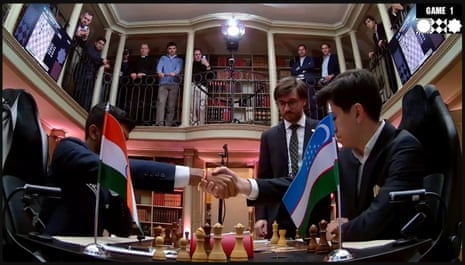
A curious bit of drama! Sindarov has incorrectly claimed a draw by threefold repetition and, in accordance with Fide’s by-laws, Gukesh has been awarded an additional two minutes on his clock. A welcome reprieve for the time-strapped defending champion, even if the game still appears headed for a draw.
Sindarov has picked off the h6 pawn to restore material equality (31 Rh5 Bc3 32 Bxh6+ Kg8). And now we have a repetition of moves (33 Rg5+ Kh7 34 Rh5 Kg8 35 Rg5+ Kh7 36 Rh5 Kg8 37 Rg5+), with Gukesh’s king shuttling between g8 and h7. The opening game appears destined for a draw by threefold repetition, which is permitted even before the 40th move under the match regulations.
A couple more moves (28 Rf2 Rgd8) and Gukesh is offering an exchange of rooks on the d-file. Surely any simplification would come as a relief to the champion. But Sindarov declines to accommodate, instead bringing his other knight into the action (29 Nd3) and attacking Gukesh’s bishop on b4.
The ensuing sequence (29 ... Bxf5 30 Rxf5+ Kg7 31 Rh5) sees the players exchange a bishop for a knight, with Sindarov turning his attention to black’s vulnerable h6 pawn. That leaves Gukesh with barely seven minutes to make his next 10 moves, but he appears to have escaped from danger.
Gukesh marches his king further up the board (27 ... Kf6) rather than retreating. The champion is down to 8min 39sec for his next 13 moves, while Sindarov still has more than 25 minutes.
Things are heating up (25 ... Nc6 26 f5 gxf5 27 Nxf5+). Sindarov has recovered the pawn he lost and given check to Gukesh’s king.
And we have our first material imbalance of the game (23 ... Nxe5 24 f4). Gukesh has won a pawn but Sindarov has immediately attacked the knight that captured it. The champion responds by threatening Sindarov’s own knight on the kingside (24 ... g6 25 Ng3).
The challenger has retreated and now Gukesh must navigate a delicate position with barely 10 minutes to make his next 16 moves.
A flurry of activity on the board (22 Ne1 axb3 23 axb3). Gukesh has initiated an exchange of pawns on the queenside, opening up the a-file for his rook. The game is becoming more dynamic at a moment when the champion can least afford to spend time calculating variations.
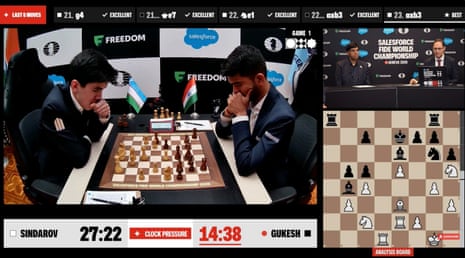
Sindarov has been in the think tank for 15 minutes and counting, but his overwhelming time advantage affords him that luxury.
Meanwhile, over on the Chess.com broadcast, Judit Polgar is telling war stories. Sindarov’s decision to play 21 g4 rather than Stockfish’s preferred 21 Ne1 has reminded the Hungarian grandmaster of a painful defeat to Veselin Topalov in a similar Berlin endgame during the 2005 Fide world championship tournament in San Luis, Argentina.
“At some point I played g4,” Polgar recalls. “Not because I wanted to play for a win desperately, but because I thought that was the best move I could make in that position.
“And after the game people came to me: ‘Why did you play for a win in that position? It was not better anymore.’ I said: ‘I was not playing for a win in that position. I just thought that was the best move.’”
Two more moves (21 g4 Ke7) and Gukesh is putting his king to work in the center of the board. For all the Berlin’s reputation as a drawish opening, this is shaping up to be a three-result game.
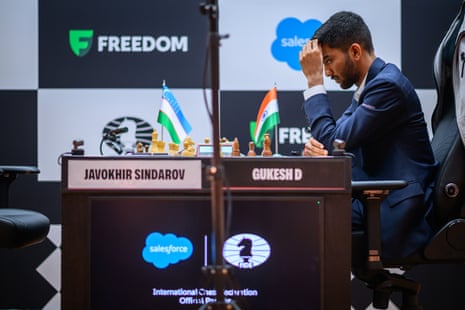
Gukesh has pushed another pawn forward (19 ... c5), reinforcing his bishop on b4 and restricting the movement of white’s pieces. Sindarov quickly moves his knight to the edge of the board, prompting Gukesh to bring his rook across to defend his g7 pawn (20 Nh5 Rg8).
The champion has reached the halfway point to the first time control with barely 16 minutes to spare, while Sindarov still has more than 55 minutes at his disposal. The defending champion is effectively going to have to play rapid chess against an in-form opponent who has the luxury of thinking things through.
That said, despite Gukesh’s visible suffering, the Hungarian grandmaster Peter Leko is beginning to warm to black’s position on the official Fide broadcast.
“Nh5 was played clearly out of ambition,” Leko says. “I don’t know how much this choice was influenced by the clock situation, whether Sindarov wants to keep the game going because of the time situation. And I was praising the move Ng3 because of the clock factor. Looking at the position now, with the knight on h5 stuck and black having a clear b7-b5 push in the air, I already kind of wonder if I would not be much happier with black now.”
Sindarov takes more than 18 minutes before repositioning one of his knights (19 Ng3), keeping his options open and maintaining the tension on the board. The Uzbek challenger still has 57min 11sec on his clock compared with less than 24 minutes for Gukesh.
Gukesh has finally nudged his h-pawn forward (18 … h6), denying a square from Sindarov’s bishop and knights. Even if the position remains objectively equal, the clock is giving Sindarov a significant practical advantage.
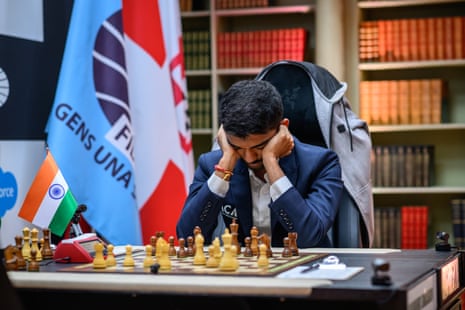
Latvian grandmaster Arturs Neiksans has entered the chat, suggesting that Gukesh’s struggles today could have implications well beyond the opening game. If the Berlin defense was intended to be a mainstay of the champion’s opening repertoire for this match, Sindarov may already have given him reason to rethink his preparations.
“It’s probably too early to draw any firm conclusions, but Gukesh’s opening choice is already looking concerning,” Neiksans writes on X. “If you’re facing this much discomfort in Game 1 with what could be one of the cornerstones of your repertoire against 1.e4 for the match, it’s hard to see how you can confidently rely on it in the games to come. Hopefully, Gukesh has a solid backup plan.”
Gukesh has been on the clock for nearly five minutes as he considers his response to Sindarov’s 18 Re2. That’s left him with 24 minutes to make his next 23 moves.
And finally Gukesh has made his move (17 ... Bb4), bringing his bishop forward to attack one of Sindarov’s rooks. But the champion has burned through 36min 14sec of precious time in the process. He now has less than 29 minutes to make his next 23 moves, an average of roughly 75 seconds per turn.
Sindarov thinks for just three minutes before moving his threatened rook out of harm’s way (18 Re2). The position remains finely balanced, but the disparity on the clock is becoming one of the major storylines of this opening game. Gukesh has put himself in a situation where even relatively straightforward decisions will need to be made quickly.
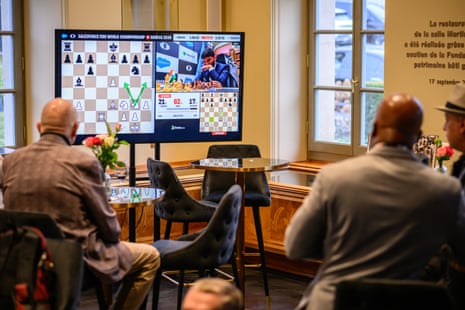
Gukesh has been pondering his response to 17 b3 for more than half an hour. That’s a considerable investment of time given he still has 24 moves to make before receiving another 30 minutes on his clock.
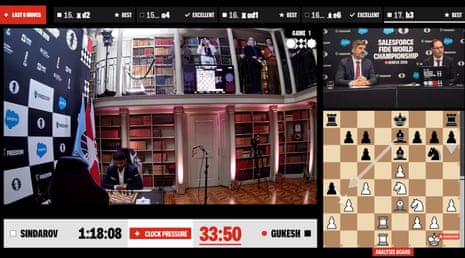
The clock is becoming a factor for Gukesh, who is below 50 minutes remaining with another 23 moves to make before he receives any additional time. Grandmasters Judit Polgar and David Howell, commenting on the Chess.com broadcast, have identified a tempting rook move (17 ... Ra5), but one that would land the champion in trouble if Sindarov answered with 18 Bg5. An important decision awaits Gukesh, and he can ill afford to spend too much time making it.
Two more moves in Geneva (16 ... Be6 17 b3). Gukesh has moved his bishop out of the path of Sindarov’s rooks, while the challenger has reinforced his position on the queenside.
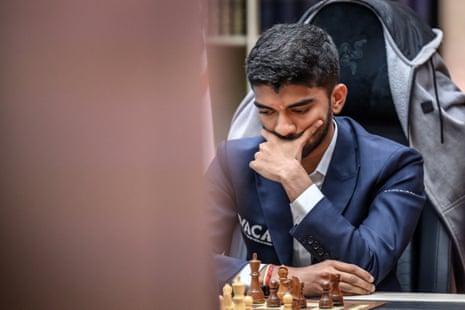
A few more moves to bring us up to date (15 Rd2 a4 16 Rad1). Sindarov has brought both of his rooks into the center of the board, while Gukesh has been steadily advancing a pawn down the left-hand side. Neither player has lost any material since the eighth move, with both looking to build up incremental advantages rather than force the issue. All of the popular engines and supercomputers continue to assess the position as dead even (0.00).
An excellent question from Justin Horton, writing in from Aragón, Spain, about the decor in the playing hall:
What are the books in the players’ lounge? They look like chess books but you wouldn’t have thought players would be allowed to consult chess books during a game. Nor would they be wise to do so given the cameras are there, but I can’t believe they’d put the players on an honour system not to open them. So are they real, or are they facsimiles, Potemkin books as it were?
Given the decidedly bibliothecal setting, it’s a particularly fitting question. The Fondation Martin Bodmer is one of the world’s great repositories of rare books and manuscripts, its 160,000 treasures including a Gutenberg Bible, Shakespeare’s First Folio and a copy of Isaac Newton’s Principia Mathematica once owned by his great rival Gottfried Wilhelm Leibniz.
The subject of the books came up at Sunday’s opening press conference. Gukesh said he had inspected the chairs, lighting and even the floor of the playing hall to ensure he would be comfortable during games that could last four or five hours, but admitted he had barely glanced at the books. “I don’t think I’ll be reading in between the games,” he joked.

A nugget of arcana from the Macedonian grandmaster Alex Colovic that may bode well for Gukesh. Of the four players who have deployed the Berlin defense in a world championship match, three of them (Vladimir Kramnik, Magnus Carlsen and Ding Liren) went on to win their matches. The lone exception? Vishy Anand against Carlsen.
Sindarov has expanded on the queenside and Gukesh has responded by pushing his a-pawn (14 c4 a5). The battle lines are becoming clearer: Sindarov has the more active pieces in the center, while Gukesh is looking for counterplay on the queenside to offset white’s long-term structural advantage.
“I think there were a lot of small surprises at first,” the Dutch grandmaster Anish Giri says on the Take Take Take stream. “I think on move one, maybe 1 d4 was a little more expected than 1 e4. Then from black, I think within the Spanish, maybe the Marshall was a little more expected than the Berlin.
“But then within the Berlin, I think finally the actual surprise is coming from Javokhir. I think this particular Ne4 move, we are in very rare territory. It is not something that I or many of my colleagues have studied deeply. I can imagine it’s a little bit of an obscure position.
“And yeah, a very exciting endgame ahead because there’s still a full board of pieces.”
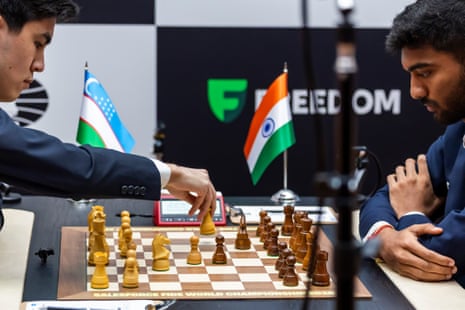
A little diversion for those of you who, like Sindarov, have been looking forward to getting stuck into Grand Theft Auto VI. It turns out there’s a chess Easter egg buried in Rockstar Games’ sprawling recreation of Florida.
The eagle-eyed team at Chess.com have spotted a chessboard in the game which appears to reproduce a position from an actual game between the English grandmaster Daniel Gormally and Brazil’s Alexandr Fier at the 93rd Hastings Masters in 2017-18. Gormally, rated 80 points below his opponent, went on to win with the white pieces.
Something for Sindarov, who has been mulling his response to 13 ... Bd7 for more than 20 minutes, to investigate when he finally gets his hands on the game after the world championship.
The American grandmaster Maurice Ashley has joined the official Fide broadcast and admits he was hoping for something a little more combustible than a Berlin endgame to get the match under way.
“Obviously, the Berlin is one of those you see and you go, ‘Oh, OK, how’s he going to break down this wall?’ It’s obviously a big challenge when you have the white pieces, but clearly it looked like Sindarov was well prepared for this eventuality. So I’m excited to see the match get off, but it would have been nice to see something wild, crazy, queens on the board.
“I feel like [Hungarian grandmaster] Peter Leko here is excited by these kinds of positions. We were talking about endgames and his ability when he was young to play these extremely well. But I think the fans probably wanted some more sauce.”
And finally Gukesh makes his move! After a think of more than 15 minutes, the world champion has opted for 13 ... Bd7, bringing his last minor piece into play. The bishop also shields the black king from a potential check along the d-file, giving Gukesh greater flexibility in repositioning his king and coordinating his rooks. He’s more than 35 minutes behind the challenger on time, though.
Gukesh is in another deep think as Javokhir leaves the board for the nearby lounge chair inside the cramped playing hall.
“Now I understand what Javokhir was playing for,” English grandmaster David Howell says on the Chess.com broadcast. “I would have expected this opening from two older players, not maybe two 20-year-olds. But now I understand he’s trying to bait Gukesh. He’s trying to tempt him into some line where he has a deep, deep idea. Yeah, it’s very provocative.”
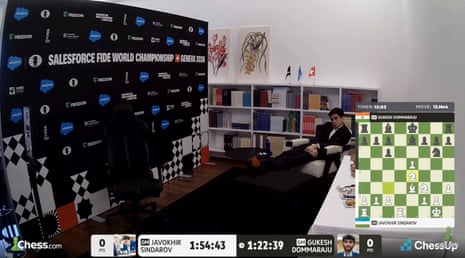
Gukesh has developed his dark-squared bishop and Sindarov has centralized his queenside knight (12 ... Be7 13 Ne4). The pace of play has slowed considerably as the players begin to grapple with the strategic subtleties of the Berlin. Both Stockfish and the Sesse supercomputer assess the position as dead even (0.00).
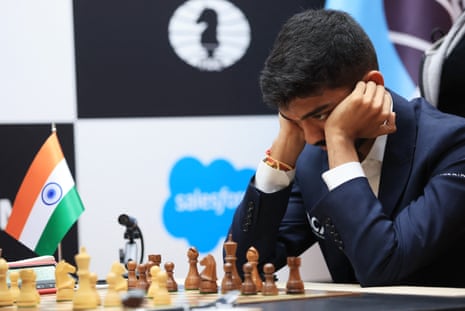
An email from the always welcome Gary Naylor, who sees parallels between the world chess championship and another of Europe’s great endurance events:
Given the location, the schedule, the fact that each leader has a team supporting him and, more than anything, the stamina required, this feels like the Tour de France. I suppose players have the ability to make stages – games – hard or easy by their strategies too.
Any sign of lycra?
No lycra to report, Gary, but there’s certainly something to the analogy. The ability to conserve energy over a three-week campaign, knowing when to attack and when to settle for a quiet day, is an underrated component of world championship matchplay.
Gukesh has been mulling his response to 12 Be3 for more than 10 minutes, after spending about eight minutes on his previous move.
“He still knows the position, but he is taking time to make sure he makes the right moves,” Russian grandmaster Peter Svidler says on the official Fide broadcast. “But Gukesh is already down almost 18 minutes on the clock. Considering he’s playing one of the most topical openings of the past 25 years, that’s some time expenditure.”
Gukesh has brought his knight to g6, putting pressure on the advanced white pawn on e5, and Sindarov has continued his development by bringing his bishop into play (11 ... Ng6 12 Be3).
Gukesh has returned his king to its original square and rerouted his knight (9 Rd1+ Ke8 10 Nc3 Ne7 11 h3). Sindarov’s last move prevents black’s light-squared bishop from coming to g4 and pinning the knight on f3, while giving his own king some breathing room.
“I think it’s important to highlight for our viewers that black is not playing for a draw,” the Hungarian grandmaster Judit Polgár says on Chess.com’s broadcast. “Black is just deciding to go into an endgame or a middlegame without queens, where it seems like only white has a slight edge. Black has doubled pawns on c6 and c7, black has the bishop pair, but basically black can go b6, develop the pieces properly.”
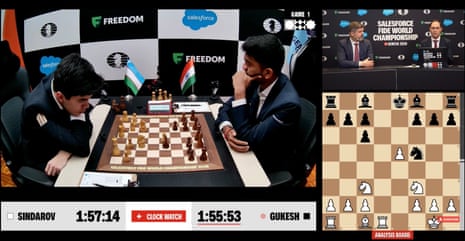
We’re heading straight into the famous Berlin endgame (4 O-O Nxe4 5 d4 Nd6 6 Bxc6 dxc6 7 dxe5 Nf5 8 Qxd8+ Kxd8). The queens are off the board after only eight moves, leaving white with a kingside pawn majority and black with the bishop pair but doubled c-pawns and a king that has forfeited the right to castle.
Don’t mistake the early exchange of queens for a lack of ambition. The resulting position is deceptively rich in strategic possibilities and has been the subject of decades of analysis at the highest level. Gukesh has continued with 9 Rd1+, and both players are still moving quickly.
Game 1 is under way!
The players have shaken hands and we’re off! We have a Berlin defense of the Ruy Lopez (1 e4 e5 2 Nf3 Nc6 3 Bb5 Nf6), one of the most thoroughly analyzed openings in modern chess.
The Berlin famously helped Vladimir Kramnik dethrone Garry Kasparov in their 2000 world title match in London and has been a staple of elite chess ever since, earning a reputation as one of black’s most reliable weapons against 1 e4.
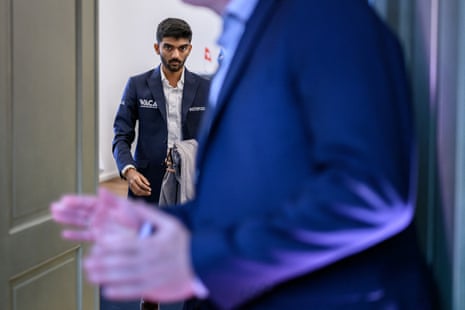
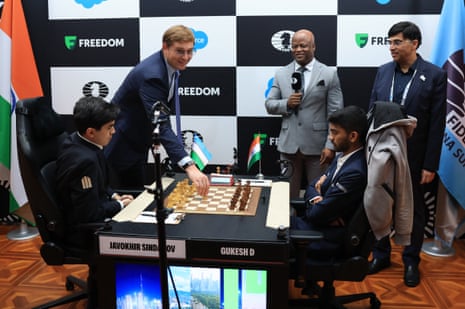
We’re eight minutes to the scheduled first move, but American grandmaster Maurice Ashley has started with his introduction of the players to the playing hall. Gukesh enters first and takes his seat behind the black pieces. Sindarov, playing as white after Sunday’s drawing of lots, enters second.
If you’re looking for some pre-match reading, the Guardian spoke exclusively with Javokhir Sindarov on Sunday about his meteoric rise, his love of Lionel Messi, his plans to play GTA VI once the match is over and why chess’s happy warrior believes there’s more to life than the game. A taste:
“I’m the guy who can’t play games just for fun,” Sindarov tells the Guardian less than 48 hours before Tuesday’s world championship opener in Geneva, smiling at the absurdity of it. “If I play something, I always try to learn, trying to become better.”
That means poring over Counter-Strike tactics and watching YouTube tutorials before joining in with his mates. There is, it appears, no such thing as a casual game in Sindarov’s world, much less a friendly. “I always like to beat my friends,” he says. “I watch some video lessons and then come and beat them after some tournaments. I think the best thing is to beat your friends in some game.”
It is a revealing admission from a young man who has acquired a reputation for being uncommonly relaxed at the chess board. While many of the world’s elite players seem to carry the weight of every position on their shoulders – the viral clip of Sergey Karjakin agonizing for 25 minutes over a move during the 2016 world title match remains a cult classic in chess circles – Sindarov frequently gives off the impression of someone who is simply enjoying himself. The easygoing mien of the sport’s happy warrior is a quality that has caught his opponent’s attention. “One thing I learned from Sindarov is that he seems to be so happy while playing chess,” Gukesh Dommaraju, the reigning world champion, said in an interview published last week.
We’ve gone through the 140-year history of the world championship and chosen 22 of the most memorable games. You can go move by move through each of them here. It’s the perfect timesuck in the final run-up to today’s first move.
From the middle of the 16th century, there have come down to us the names of chess players who have been widely regarded as the strongest of their time. The earliest of these was the Spanish priest Ruy López de Segura, after whom one of the most popular openings of modern times is named. Others who followed include the Calabrese Gioachino Greco, François-André Danican Philidor, Louis-Charles Mahé de La Bourdonnais, Alexander McDonnell, Howard Staunton, Adolf Anderssen, Mikhail Chigorin and Paul Morphy, each of whom are lionized for their contributions to the development of theory and strategy as well as their dominance over their board during their respective eras.
But not until Wilhelm Steinitz and Johannes Zukertort sat down in a small room at 80 Fifth Avenue in New York City on the afternoon of 11 January 1886 did a formal competition to determine the best player on the planet come to pass. Their first-to-10-wins encounter was held in three US cities over the next 78 days for a prize fund of $4,000. Since then, the world chess championship has provided the stage for countless unforgettable contests showcasing the precision, imagination and brilliance of the royal game at the highest level.
The legitimacy of the world championship, of course, remains a subject of lively debate. The absence of Magnus Carlsen continues to cast a long shadow over the sport’s showcase event. The 35-year-old Norwegian has held the world No 1 ranking for more than 15 consecutive years and was widely regarded as the game’s strongest player even before he defeated Vishy Anand for the world title in 2013. He only strengthened his claim as the greatest player of any era in 2021, when he crushed Ian Nepomniachtchi in Dubai in his fourth successful defense of the crown.
But Carlsen declined to defend his title for a fifth time in 2023, citing a lack of motivation to endure the months-long grind of preparation that championship matches demand. Only twice before had the chain of succession that stretches back to Wilhelm Steinitz in 1886 been broken: when Alexander Alekhine died as champion in 1946 and when Bobby Fischer forfeited the title in 1975.
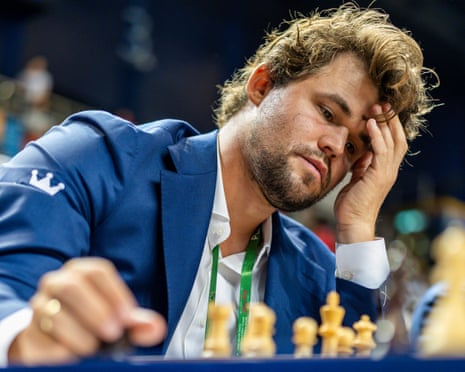
Ding Liren went on to defeat Nepomniachtchi for the vacant title before losing it to Gukesh Dommaraju in Singapore the following year. Now Gukesh faces Sindarov in a match between two 20-year-olds ranked No 26 and No 4 in the world respectively, while the planet’s top-ranked player remains on the sidelines – at a time when his No 1 ranking is looking more vulnerable than any time in anyone’s memory. The generational stakes are undeniable, but the question that has dogged the championship since Carlsen walked away remains unresolved: can the winner truly claim to be the best chess player in the world?
How do Gukesh and Sindarov match up?
For two elite players born in the same general part of the world barely six months apart, their competitive history is remarkably sparse: just three encounters in classical chess. Sindarov holds a 2½-½ advantage with two wins and one draw in their lifetime head-to-head, which dates back to their first encounter as tweens at the Moscow Open in 2018. Their most recent meeting happened in January at the prestigious Tata Steel tournament in Wijk aan Zee, where a tense positional struggle gave way to a wild, time-scrambled endgame before the pair settled for a draw after 78 moves. Sindarov also holds a 2-1 edge in their three rapid and blitz contests this year.
Allow content provided by a third party?
This article includes content hosted on lichess.org. We ask for your permission before anything is loaded, as the provider may be using cookies and other technologies. To view this content, click 'Allow and continue'.
Gukesh’s form has largely gone off the rails since reaching the summit 23 months ago in Singapore. After making it to No 3 in the world with a peak rating of 2794, the Indian suffered a prolonged run of disappointing results, including a joint-last finish at March’s Prague Chess Festival and last-place showings at Norway Chess and the Chennai Grand Masters. He subsequently withdrew from the classical portion of the Grand Chess Tour and had tumbled to No 32 in the rankings by September, when his live rating briefly dipped below the 2700 barrier for the first time in four years, although his performances improved at that month’s Chess Olympiad.
Many of the world’s top grandmasters have expressed deep pessimism about Gukesh’s chances in Geneva due to his lengthy slump and Sindarov’s sustained upward tick. So too have the bookmakers, who have installed the Uzbek as a clear frontrunner at roughly 1-3 odds despite Gukesh being the champion. Carlsen has described Sindarov as “a pretty significant favorite”, citing the Indian’s tendency to take excessive risks. “His evaluations are way too optimistic,” the world No 1 said recently. “That makes him take way more chances than he should. I think especially now his confidence hasn’t been too high, he just tries to do a little bit too much.”
Yet one factor in Gukesh’s favor is his firsthand experience in the cauldron of a world championship match, where the intense psychological and physical rigors of facing the same opponent for weeks on end can be as punishing as the chess itself. Caruana, the world No 3 and former world title challenger who pushed Carlsen to the brink in 2018, has cautioned against writing off the champion despite his struggles. “The kind of ability he had – or has, whatever you want to say – it doesn’t disappear overnight,” Caruana said in September. “So, in my opinion, it can reverse at any moment.”

The format
Here’s a review of the format for the world championship match. Gukesh and Sindarov will play up to 14 classical games with each player awarded one point for a win and a half-point for a draw. Whoever reaches seven and a half points first will be declared the champion (and no dead rubbers will be played).
The time control for each game is 120 minutes per side for the first 40 moves, then 30 minutes for the remainder of the game, with a 30-second increment per move starting with move 41. That means games can stretch beyond seven hours, testing both players’ concentration and endurance. Players are not permitted to agree to a draw before black’s 40th move, a rule designed to discourage short, uneventful games. A draw claim before then is only allowed in the case of threefold repetition or stalemate, subject to approval by the chief arbiter or deputy arbiter.
If the score is level after 14 games, a series of tiebreaks will be played on 12 December, starting with four rapid games at 15 minutes per player plus 10 seconds per move. If still tied, the players will contest two games at 10 minutes plus five seconds, followed if necessary by two blitz games at three minutes plus two seconds. Further single blitz games will be played until a winner emerges. Three of the past five world championship matches have been deadlocked after the classical portion and required tiebreaks: 2016, 2018 and 2023.
The complete official regulations can be found here.

Preamble
Hello and welcome to Geneva for day one of the World Chess Championship. Over the next three weeks, India’s defending champion Gukesh Dommaraju and Javokhir Sindarov of Uzbekistan will compete in a scheduled best-of-14-games match for the sport’s most prestigious title and a share of a $2.5m prize fund. The setting is the Fondation Martin Bodmer in Cologny, an affluent suburb overlooking Lake Geneva, where the two 20-year-olds will make history as the youngest pairing ever to contest a world championship match in the competition’s 140-year history.
Gukesh became the youngest undisputed world chess champion in history when he defeated China’s Ding Liren in Singapore in December 2024, aged just 18, shattering the record held by Garry Kasparov, who was 22 when he dethroned Anatoly Karpov in 1985. An aggressive player known for creating sharp, tactically complex positions aimed at unsettling opponents, the Chennai-born grandmaster has struggled badly for form since winning the crown, sliding from a career-high No 3 to No 26 in the world rankings and raising questions over his chances of retaining the title in his first defense.
Sindarov, meanwhile, has emerged as one of the most formidable talents of a new generation of Uzbek grandmasters. Born in Tashkent, he became a grandmaster at 12 years and 10 months, the second-youngest in history at the time, and secured his place in Geneva by winning the eight-man Candidates tournament earlier this year. A fearless, resourceful player in a rich vein of form, he enters his first world championship match ranked fourth in the world, up from No 25 last year and a remarkable 22 places above the reigning champion, and with a favorable head-to-head record against Gukesh in classical chess.
We’re roughly 80 minutes away from the ceremonial opening moves. Fide president Timur Turlov will do the honors for white, with five-time world champion and Fide deputy president Viswanathan Anand moving for black. Plenty more to come between now and then.
Everything you need to know about the World Chess Championship
India’s Gukesh Dommaraju is defending the world chess championship against fast-rising Uzbek grandmaster Javokhir Sindarov in the youngest title match in the competition’s 140-year history. The best-of-14-games contest is scheduled to take place from 24 November to 12 December at the Fondation Martin Bodmer outside Geneva, with an overall prize fund of $2.5m (£1.9m).
Game 1 starts at 3pm in Geneva, 2pm in London, 9am in New York and 7.30pm in India
Sindarov will have the white pieces for Game 1 and make the first move
Gukesh and Sindarov are both 20 years old, making this the youngest matchup in world championship’s 140-year history
Read the Guardian’s comprehensive watch guide for the Gukesh v Sindarov showdown
Go move by move through 22 of the most famous games in world championship history
Tale of the tape: Gukesh Dommaraju v Javokhir SindarovBryan will be here shortly. In the meantime here’s our watch guide for this year’s World Chess Championship,