3 weeks ago
Five Italian divers died during a deep-sea cave expedition in the Maldives after taking a wrong turn into a dead-end underwater chamber.
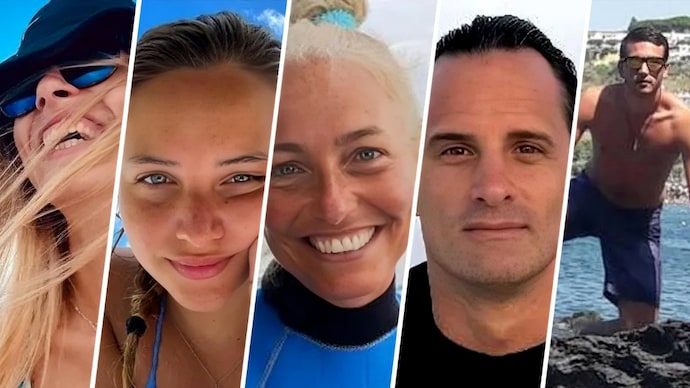
The grpup had entered an underwater cave around 50 metres below the surface and got trapped there.

New Delhi,UPDATED: May 22, 2026 09:00 IST
What began as an adventurous deep-sea expedition for five Italian divers in the Maldives earlier this month ended in tragedy after they failed to return from an underwater cave dive. All experienced divers, the group had hoped to complete the challenging expedition safely. But days later, after an extensive search operation, their bodies were recovered from a submerged cave system. Now, rescuers involved in the mission are shedding light on what may have gone wrong inside the underwater labyrinth, describing it as a "no-exit" scenario.
Fresh findings from recovery teams suggest the divers may have taken a wrong turn inside the complex cave network, triggering panic and ultimately causing them to run out of oxygen.
Bodies of the victims Monica Montefalcone (52), her daughter Giorgia Sommacal (20), Muriel Oddenino (31), Federico Gualtieri (31) and diving instructor Gianluca Benedetti (44) were found after a multi-day search near the third chamber of an underwater cave system in Vaavu Atoll, at a depth of nearly 50 metres.
According to officials associated with DAN Europe, a diving assistance and insurance organisation, the group may have mistakenly entered a terminal chamber with no viable exit route.
“There was no way out,” DAN Europe CEO Laura Marroni told the Italian daily La Repubblica, pointing to the likelihood that the divers became disoriented within the cave’s labyrinthine structure.
COMPLEX CAVE STRUCTURE
Investigators said the cave system consists of three chambers connected by narrow underwater corridors. A passage around 30 metres long links the first and second chambers. However, once divers move deeper into the cave, the entrance to that corridor becomes obscured by a sandbank, significantly reducing visibility and making navigation extremely difficult.
Just above the hidden entry point lies the opening to the third chamber, which is a dead-end pocket where the group became trapped.
Recovery teams found four of the victims near the entrance of this final chamber, while Benedetti’s body was located closer to the passageway, suggesting he may have attempted to guide the group back to safety.
PANIC AND OXYGEN DEPLETION
Experts noted that the divers were using standard 12-litre cylinders, which are generally unsuitable for prolonged dives at depths exceeding 30 metres. At depths of more than 50 metres, breathable air is consumed rapidly, leaving very little margin for error.
Marroni estimated that the group may have had "10 minutes, maybe even less" to react after realising they had entered the wrong chamber. Panic, she said, likely accelerated their breathing, causing oxygen supplies to deplete even faster.
"Realising that the road is not right, and having little air maybe after backing down, it terrifies you," she explained.
Despite all five being described as experienced divers, investigators are now examining why the group undertook such a technically demanding cave dive without specialised equipment or support systems typically required for extreme underwater exploration.
Authorities are analysing footage from GoPro cameras recovered at the site to reconstruct the divers’ final moments and determine whether procedural lapses or environmental factors played a decisive role in the tragedy.
RESCUE MISSION ALSO TURNS FATAL
The disaster was compounded by the death of Maldivian Defence Force diver Sergeant Major Mohamed Mahudhee, who died from decompression sickness while participating in the recovery operation.
Officials acknowledged that the mission was exceptionally dangerous because of the cave’s depth, confined spaces and unstable underwater conditions.
While some members of the group were associated with academic research, including Montefalcone, an ecology professor linked to the University of Genoa, officials clarified that the fatal dive was a private activity and not part of any formal scientific programme.
The Maldivian government has since suspended the licence of the expedition vessel involved, pending a full investigation.
Experts say cave diving remains one of the most dangerous forms of scuba diving because divers cannot make a direct ascent to the surface during emergencies. The risks become even greater in low-visibility environments, where disturbed sediment can quickly obscure exit routes.
- Ends
Published On:
May 22, 2026 09:00 IST