3 weeks ago
Monique Ryan moves to debate '1,000 days of inaction' on gambling reform
Over in the House, independent MP Monique Ryan has moved to suspend standing orders to debate gambling reform.
She, backed by fellow crossbencher Kate Chaney, notes that gambling advertising causes “significant health and financial harm to more than 3 million Australians”, and has criticised the government’s lack of public consultation on the draft gambling reform bill.
Her motion also notes the open letters from the crossbench and Liberal party members including former prime minister, John Howard, who have said the proposed bill doesn’t go far enough.
Speaking to the House, Ryan says that the public should “not be expected to accept opaque lawmaking and inadequate public and expert consultation”.
A thousand days of harm, a thousand days of inaction. After years of campaigning, from the crossbench and the opposition, the prime minister decided to take out the trash on the government’s gambling reform, right before the Easter long weekend. As journalists were heading out the door and as the public headed out on a well-earned break. That was a strategic play from the prime minister, he wanted to minimise media coverage, and he wanted to avoid public scrutiny and accountability.
Then, weeks later, while all the journalists and every MP in Canberra was cordoned off in the budget lockup, the prime minister tabled his government’s formal response to the Murphy review.
While the Greens had the support of the Coalition to move its suspension of standing orders in the Senate, the government has the numbers in the House and will very likely vote against Ryan’s motion.
Key events
Greens’ motion on NDIS fails in Senate
Debate has wrapped up in the Senate over the Greens motion on the government’s NDIS bill, calling for it to be withdrawn.
Greens senator, Nick McKim, was the last to speak on the motion, which was debated for two and a half hours:
These cuts will be the difference between a disabled person being able to leave their house or not being able to leave their house. These cuts will be the difference between a disabled person being able to have a shower or not being able to have a shower.
These cuts will be the difference between a disabled person being able to improve their verbal communication skills or to remain nonverbal, and unable to communicate verbally.
While the Coalition supported the Greens to bring on the debate, on the actual motion most of the Coalition abstained, with just a handful of opposition senators voting alongside the government.
Dan Jervis-Bardy
Miners and farmers launch campaign to protect fuel tax credit scheme
The peak bodies for miners and farmers are leading a campaign to safeguard the fuel tax credits scheme amid growing pressure on the Albanese government to wind it back.
The Minerals Council of Australia (MCA) and Farmers Federation (NFF) launched the “Hands off our Fuel” campaign on Monday to counter the “noisy activists” advocating for an overhaul of the rebates.
More than 300 Labor branches have joined unions, climate campaigners and mining billionaire Andrew Forrest in calling on the government to cap the scheme, which refunds miners, farmers and other industries the 52.6c a litre excise applied to petrol and diesel.
The MCA chief executive, Tania Constable, said the industry was fed up with the critics, who she claimed wanted to “diminish industries” such as mining. She said:
We’ve had enough over the last few months. A number of noisy activists have sought to either reduce, cap or remove the fuel tax credit from our businesses. Over 200,000 businesses across regional Australia rely on the field tax credit. They’re the farmers, the fishers. They are the construction industry, the freight industry.
Treasury last month forecast the scheme would cost the budget $47bn over the next four years, rising from $10bn in 2026-27 to $12.8bn in 2029-2030. More than $1bn a year goes to coalmine operators.
Guardian Australia reported coal companies could receive an extra $6.2bn in taxpayer refunds for the diesel they use if the Albanese government greenlights just half the mine developments up for approval.
Asked if miners believed that the scheme should remain uncapped, Constable rejected the characterisation of the rebate as a subsidy.
It is not a cost to the budget. It has never has been a cost to the budget. It was never intended to be a cost to the budget. It was purely an administrative way to collect excess and then rebate the industries that should not be paying a road tax because they are not using roads.
Monique Ryan moves to debate '1,000 days of inaction' on gambling reform
Over in the House, independent MP Monique Ryan has moved to suspend standing orders to debate gambling reform.
She, backed by fellow crossbencher Kate Chaney, notes that gambling advertising causes “significant health and financial harm to more than 3 million Australians”, and has criticised the government’s lack of public consultation on the draft gambling reform bill.
Her motion also notes the open letters from the crossbench and Liberal party members including former prime minister, John Howard, who have said the proposed bill doesn’t go far enough.
Speaking to the House, Ryan says that the public should “not be expected to accept opaque lawmaking and inadequate public and expert consultation”.
A thousand days of harm, a thousand days of inaction. After years of campaigning, from the crossbench and the opposition, the prime minister decided to take out the trash on the government’s gambling reform, right before the Easter long weekend. As journalists were heading out the door and as the public headed out on a well-earned break. That was a strategic play from the prime minister, he wanted to minimise media coverage, and he wanted to avoid public scrutiny and accountability.
Then, weeks later, while all the journalists and every MP in Canberra was cordoned off in the budget lockup, the prime minister tabled his government’s formal response to the Murphy review.
While the Greens had the support of the Coalition to move its suspension of standing orders in the Senate, the government has the numbers in the House and will very likely vote against Ryan’s motion.
Is the $2.5bn export deal with Canada all in response to Donald Trump’s America?
Marles is with Canada’s secretary of state, Stephen Fuhr, who says that his country will continue to work with the US, but that all its defence eggs should never lay in the one basket.
He says that the world has changed and Canada has to respond to its “new realities” which is why it’s come across the Pacific to engage in defence industry procurement.
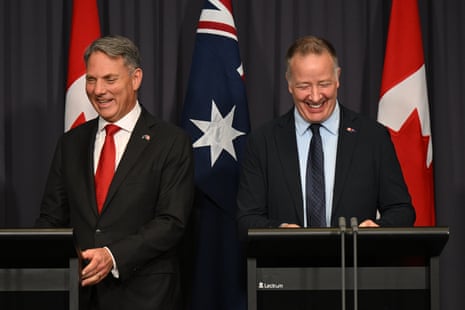
Marles says that historically there hasn’t been a significant strategic dimension to the relationship between the two countries but “that is really changing and it changed with Prime Minister Carney’s visit here in March”.
You might remember during Mark Carney’s visit the Canadian PM said it was up to middle powers like Canada and Australia to stand up and push back against dominant super powers.
They won’t explicitly say that it’s due to Donald Trump’s leadership, but Fuhr says Canada will “build relationships more broadly to make sure that we aren’t shocked by any particular partner doing any particular thing.”
Fuhr says:
We’ll continue to work with the Americans, that’s not going to change, but the relationship’s different and we have great partners in other places in the world, this being a very good example of it.
It would make no sense that we put all our resources into any one place, regardless where it is, so we are reacting to our new realities and rewiring ourselves to meet the moment
Marles says:
It is actually a time to double down with friends and it’s what we’re doing with Canada, but you see it in terms of the relationships that we’re building with other countries.
Marles lauds ‘biggest defence export in Australia’s history’
The deputy prime minister and defence minister, Richard Marles, has announced a $2.5bn deal with Canada to export a long-range radar.
Speaking with his Canadian counterpart at Parliament House, Marles says it’s a “historic moment for Australia’s defence industry”.
Marles says Canada will use the export to “engage in surveillance over the Arctic”.
This is a $2.5bn deal, and it is far and away the largest defence export we have ever done. The over-the-horizon radar began its life actually under the [Bob] Hawke government back in 1986 … since then it has formed the backbone of Australia’s long-range northern surveillance. And it is far and away the most advanced long-range radar in the world.

Josh Butler
Business groups warn Greens against ‘rush’ to pass tax changes
Business groups are making a final plea for the Greens to vote down Labor’s capital gains and negative gearing changes, urging the minor party not to “conform to the government’s timetable” on passing the tax reforms this week.
There are growing expectations that the Greens will agree to a deal on the tax changes this week, potentially in exchange for a longer inquiry on the NDIS changes. We’re told that, at this stage, those discussions are ongoing.
The Australian Chamber of Commerce and Industry (ACCI), which represents employers and business groups, is writing to all MPs and senators asking them to oppose the changes and warning of what CEO Andrew McKellar said would “damage business investment, damage the Australian economy”.
“You can oppose this bill. You can decline to give it passage. At the very least, you can make significant amendments to ensure that it does not cause damage to the Australian economy in the years ahead,” he said at a press conference today in Parliament House.
“We are urging the Senate to go through that process, we are still very concerned that the changes that the government has foreshadowed last week don’t go far enough.”
McKellar, asked about the likelihood of a deal with the Greens, said he had been seeking to convince the minor party against backing the government.
“Take the time, you don’t have to conform to the government’s timetable on this. Take the time, get it right … we would urge them to take account of that,” he said.
McKellar said senators should not “rush this through”, raising concern that “there hasn’t been proper scrutiny of this legislation.”
“Everybody knows the Senate inquiry process was a whitewash. It hasn’t been handled in the manner that you would expect,” he claimed.
Listen: Greg Jericho on the economic forces pushing Australia towards populism – Full Story podcast
Last week, the Reserve Bank kept interest rates on hold but the decision was followed by a warning that a future rate rise was on the table because prices are still rising too fast. It came as the US and Iran signed an initial agreement to end more than three months of war, which had sent global supply chains into chaos. Meanwhile, Australians are feeling the pinch and deepening economic disaffection has coincided with rising support for Pauline Hanson’s rightwing One Nation party.
Nour Haydar speaks with Greg Jericho about why so many Australians are feeling pessimistic about the economy.


Tom McIlroy
Poll shows Coalition support at lowest level since 2025 election
A new DemosAU poll out this morning shows the Coalition’s public support has collapsed to its lowest level since the 2025 election, the worst result for either Angus Taylor or former leader Sussan Ley.
Published in Capital Brief this morning, the results leave the opposition closer to the Greens than One Nation. Pauline Hanson’s party is on track to become the official opposition on these new numbers, winning between 54 and 63 seats if an election were held today.
The Coalition’s primary vote has slumped five percentage points in just a month to 18%. Labor’s primary moved up a point to 27%, while One Nation’s moved to 30%.
Based on the results, Labor would win between 71 and 81 seats, with the Coalition winning between 4 and 11, and the Greens 0 to 4 seats.
“On these numbers, One Nation would likely fall short of forming government, even with Coalition support, but a further improvement in support, or a further drop for Labor, could change the equation,” DemosAU head of research George Hasanakos said.
PM convenes national cabinet meeting on fuel security
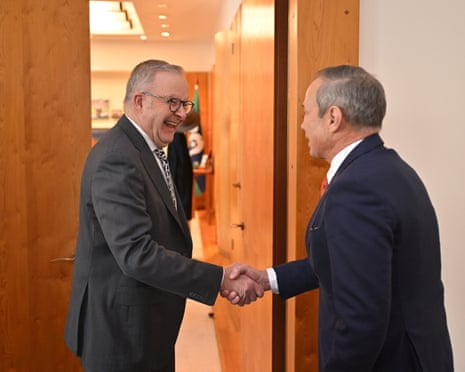
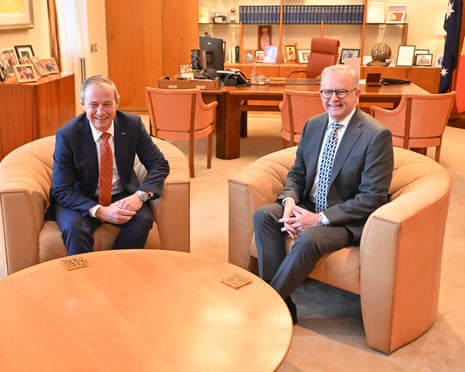
Anthony Albanese has convened a virtual national cabinet meeting this morning, but one premier is joining the PM in Canberra.
Albanese has been spotted by our eagle eyed press gallery photographers with WA premier Roger Cook ahead of the meeting.

Andrew Messenger
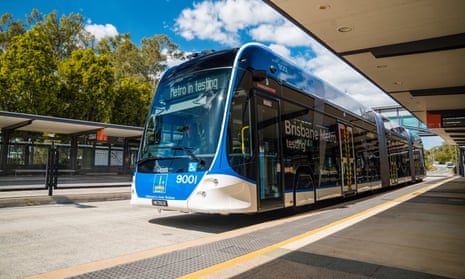
Queensland government announces ‘metro bus’ project to replace Gold Coast light rail extension
A bus will replace the cancelled fourth stage of the Gold Coast’s light rail line, ending a 30-year dream on the “glitter strip”.
First proposed in 1996, the Gold Coast light rail line project was designed to link the entire city in a single system, travelling about 40 kilometres from Helensvale train station in the north to the airport in the south.
The first two stages were finished in 2014 and 2017, with the third currently being tested and commissioned.
The LNP government killed Stage 4 in September 2025, after opposition by some residents of the southern Gold Coast.
The premier, David Crisafulli, announced on Monday that the project will be replaced by a bus route branded “the Surfer”, using larger tram-sized vehicles similar to Brisbane’s “metro” bus service.
It’s not clear whether it will get its own lane, segregated from traffic, as the light rail line does.
The announcement means that riders will need to transfer to travel from one end of the glitter strip to the other. It will operate every 10 minutes, compared with the light rail’s 7.5 minutes.
Crisafulli said they will build a small spur line from the northern section of the existing system to connect to a shopping centre.
‘It’s a silly question’: Wilson won’t weigh in on whether house prices should go up or down
Tim Wilson doesn’t want to say whether house prices should rise or fall, and calls it a “silly question”.
The shadow treasurer tells Sky News the conversation around prices going up and down is “misleading” and that we do still want to see Australians invest in housing, and building more housing.
It’s really a silly question, I mean everybody wants house prices to go down until they’ve bought their first home and then they want them to go up.
What we have at the moment, is a lack of confidence, we have a lack of confidence where the govt is actively undermining incomes, wages, and of course house prices through Jim Chalmers’ active inflation agenda.
There’s a few chunks of data out this morning – we’ve seen auction clearance rates dropping now below 50% across the country, and at the same time polling in Nine newspapers shows 54% of Australians support lower house prices.