1 month ago
The landmark test was conducted on a 400-meter experimental track and demonstrated not only ultra-rapid acceleration but also precise and safe braking.
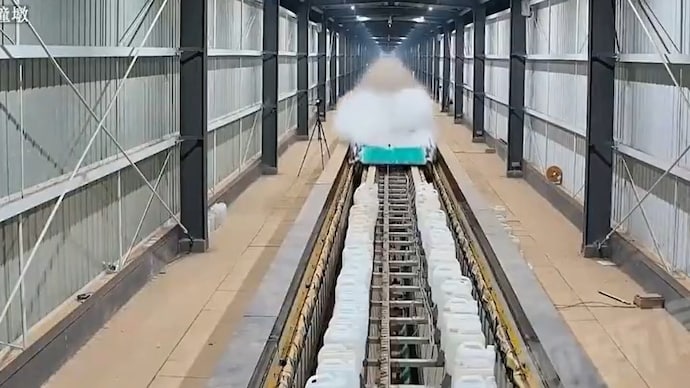
Footage aired by China’s state broadcaster CCTV showed the test vehicle—appearing as a streamlined chassis—racing along the track at high speed, briefly visible as a blur and leaving smoke in its wake. (Screengrab/X@ChinaDaily))

New Delhi,UPDATED: Dec 27, 2025 21:33 IST
China has achieved a major milestone in high-speed transportation research by setting a new world record in superconducting magnetic levitation (maglev) technology. Scientists at the University of Defense Technology (NUDT) successfully accelerated a 1.1-ton experimental maglev vehicle to a speed of 700 km/h in just two seconds, marking the fastest acceleration and peak speed ever recorded for a superconducting maglev system.
The landmark test was conducted on a 400-meter experimental track and demonstrated not only ultra-rapid acceleration but also precise and safe braking.
According to NUDT researchers, the vehicle was smoothly brought to a stop after reaching its maximum speed, underscoring the system’s control and reliability at extreme performance levels.
Footage aired by China’s state broadcaster CCTV showed the test vehicle—appearing as a streamlined chassis—racing along the track at high speed, briefly visible as a blur and leaving smoke in its wake.
Researchers confirmed that the trial broke previous global records in both acceleration and speed for maglev platforms.
The breakthrough reflects progress across several critical engineering areas.The test validated ultra-high-speed electromagnetic propulsionStable electric suspension and guidance systemsHigh-power energy storage solutionsThe use of high-field superconducting magnetsTogether, these technologies allow the vehicle to levitate several centimeters above the track, eliminating wheel-rail friction and enabling extreme speeds with reduced noise and vibration.
Professor Li Jie of NUDT said the success represents a major step forward for China’s ultra-high-speed ground transportation ambitions.
He noted that superconducting maglev systems are not limited to passenger trains but could support next-generation transport concepts and aerospace applications.
HOW MAGLEV TRAINS ARE DIFFERENT
Maglev trains differ fundamentally from conventional rail systems.
Maglev systems do not use wheels; movement is achieved through magnetic forcesPowerful electromagnets are installed both on the vehicle and along the trackLike magnetic poles repel each other, causing the vehicle to levitate above the guidewayThe train floats a few centimeters above the track, eliminating physical contactAlternating magnetic fields along the guideway propel the vehicle forwardThe absence of wheel–rail contact greatly reduces mechanical wear and tearLower wear results in reduced maintenance requirements over timeElectric propulsion improves overall energy efficiency and supports cleaner operationBeyond rail transport, experts see broader implications. Superconducting maglev technology could underpin hyperloop-style systems operating in low-pressure or vacuum tubes, where speeds approaching or exceeding 1,000 km/h are theoretically possible.
The same technology may also be used to provide initial acceleration for rockets or aircraft, potentially saving fuel and reducing emissions.
NUDT has been involved in maglev research for more than 30 years, having built China’s first manned maglev test system decades ago.
The team previously reached 648 km/h earlier in 2025, while Shanghai’s maglev line remains the world’s only commercial maglev service, operating at speeds of up to 430 km/h.
NUMBER GAME
Top speed achieved: 700 km/hAcceleration time: 2 secondsVehicle weight: 1.1 tonsTest track length: 400 metersPrevious record: 648 km/h (July 2025)Commercial maglev speed (Shanghai): 430 km/hWith this new record, China has reinforced its position as a global leader in advanced maglev research, with further large-scale tests expected in the coming years.
- Ends
Published On:
Dec 27, 2025