1 month ago
There will be no trust in diplomacy as Russia 'continues to kill, destroy infrastructure', Zelenskyy says
Ukrainian president Volodymyr Zelenskyy has warned that “as long as Russia continues to kill people and destroy our infrastructure, there will not be sufficient public trust in active diplomacy.”
“This is important for all of Ukraine’s partners – in the United States and Europe – to understand,” he said.
He said that “security issues are the key priority right now,” as Ukraine faces continuing attacks, including on civilian population and energy infrastructure.
“Everything else must be addressed only in conjunction with truly guaranteed security,” he stressed.
Zelenskyy also offered a bit more detail on the overnight Russian attack on Kharkiv region (10:17), which killed four: three small children and their father. He said the children’s mother is in hospital.
Key events 4m ago Arctic, High North 'increasingly important for collective security,' Rutte insists as Nato launches mission to respond to Trump's concerns 8m ago Putin 'trying to break people of Ukraine,' but they will not be broken, Nato's Rutte says 17m ago Denmark says will 'substantially' contribute to new Nato Arctic mission 47m ago Trilateral talks with US, Russia expected to resume next week with focus on territory, Zelenskyy says 2h ago There will be no trust in diplomacy as Russia 'continues to kill, destroy infrastructure', Zelenskyy says 2h ago UK to double British troops deployed to Norway to protect Arctic, High North over next three years 2h ago Nato's Arctic Sentry mission begins to secure Arctic, High North after Trump's complaints 2h ago Germany faces waves of industrial action with Lufthansa strike set to cause disruption on Thursday 3h ago Merz and Meloni team up to influence EU's thinking on competitiveness reforms 4h ago EU proposes plan to counter drone threats after months of sightings causing disruptions at major airports 4h ago Russia will take 'countermeasures, including military ones' if west increases footprint on Greenland 5h ago Norway defence chief says Russia could invade to protect nuclear assets 5h ago Four dead after Russian strikes on Ukraine overnight amid reported US pressure on Ukraine to end war 5h ago Morning opening: Ms von der Leyen, tear down these barriers Show key events only Please turn on JavaScript to use this feature
Rutte also gets asked about the absence of a senior US minister, with undersecretary Elbridge A. Colby attending instead of Pete Hegseth.
But he insists that does not mean anything in terms of US involvement in Nato, as he says that with global interests, US ministers “not always can be here.”
He says Colby is “a very important guy,” and the two have worked closely over the last year or so, and he says it is “very positive” to see him take part in tomorrow’s meeting.
Arctic, High North 'increasingly important for collective security,' Rutte insists as Nato launches mission to respond to Trump's concerns
Turning to Arctic and the High North, Rutte says the region is “increasingly important for our collective security.”
He says Nato members “regularly conduct exercsies in the Arctic, ensure we are ready to fight and operation in all conditions.”
But picking up some of Trump’s concerns expressed over Greenland, he says that “in the face of Russia’s increased military activity and China’s growing interest in the High North, it was crucial that we do more.”
He says the new Arctic Sentry mission (13:11) will bring together existing exercises and logistics to show the alliance’s “clear our commitment to ensuring Arctic security and indeed the security of the whole Alliance together.”
He says that the new mission will also help allies to map “potential challenges” so “any gaps can be quickly and effectively addressed.”
He rejects a suggestion it’s just a branding exercise, and says the mission will “bring everything we do in the Arctic together under one command” in the same way Nato has changed its way of operating on the eastern flank.
“This is really big. This is a huge thing, and there’s never happened before,” he says.
Putin 'trying to break people of Ukraine,' but they will not be broken, Nato's Rutte says
Nato’s Rutte is here now.
He talks about Nato’s push to increase its defence spending, hailing some progress in this area.
Turning to Ukraine, he says he was there last week and saw first-hand the impact of Russia’s “relentless attacks.”
“President Putin is trying to break the people of Ukraine, hoping to weaken their resolve. But Ukraine and the Ukrainian people have shown time and again that they will not be broken.”
But he says Ukraine “cannot sustain this fight or secure the peace alone,” and stresses the importance of allied support through Nato.
Ukraine’s defence minister Mykhailo Fedorov will join tomorrow’s Nato ministerial for talks on “how allies can enhance their support and also how they can make it more effective.”
Denmark says will 'substantially' contribute to new Nato Arctic mission
Meanwhile, Denmark has (unsurprisingly) also pledged to “substantially” contribute to a newly launched Nato mission in the Arctic, the Arctic Sentry (13:11).
“We will substantially contribute, and we will maintain momentum to ensure that the Arctic is reflected in Nato’s plans and exercise activities in the long term,” defence minister Troels Lund Poulsen said in comments reported by AFP.
He added that the details of the support would be determined in coordination with Nato allies.
Nato’s secretary general Mark Rutte is due to speak with reporters any moment now, so expect more details from him. I will bring you all the latest here.
Trilateral talks with US, Russia expected to resume next week with focus on territory, Zelenskyy says
Separately, Zelenskyy told Bloomberg (£) that the next round of talks with US and Russia is set to focus on the thorny issue of territorial concessions demanded by Moscow.
He said the talks are expected to take place on Tuesday or Wednesday next week, but it was still unclear if Russia would agree to talks taking place in the US, Bloomberg reported.
Zelenskyy also said that “neither the Russians, nor us” were keen on the US compromise idea of establishing a free economic zone in the eastern region of Donbas.
“If it is our territory – and it is our territory – then the country whose territory it is should govern it,” he said.
There will be no trust in diplomacy as Russia 'continues to kill, destroy infrastructure', Zelenskyy says
Ukrainian president Volodymyr Zelenskyy has warned that “as long as Russia continues to kill people and destroy our infrastructure, there will not be sufficient public trust in active diplomacy.”
“This is important for all of Ukraine’s partners – in the United States and Europe – to understand,” he said.
He said that “security issues are the key priority right now,” as Ukraine faces continuing attacks, including on civilian population and energy infrastructure.
“Everything else must be addressed only in conjunction with truly guaranteed security,” he stressed.
Zelenskyy also offered a bit more detail on the overnight Russian attack on Kharkiv region (10:17), which killed four: three small children and their father. He said the children’s mother is in hospital.
UK to double British troops deployed to Norway to protect Arctic, High North over next three years
As part of the increased focus on Arctic and High North, UK defence secretary John Healey is expected to confirm today that the number of British troops deployed to Norway will double over three years from 1,000 to 2,000 personnel.
“Demands on defence are rising, and Russia poses the greatest threat to Arctic and High North security that we have seen since the cold war. We see Putin rapidly re-establishing military presence in the region, including reopening old cold war bases,” Healey warned in a government statement published overnight.
The UK minister will also take part in tomorrow’s Nato ministerial in Brussels.
Nato's Arctic Sentry mission begins to secure Arctic, High North after Trump's complaints
Nato’s Arctic Sentry mission to strengthen the alliance’s presence and the regional security in the Arctic has now formally begun, Reuters reported.
The mission will seek to “leverage Nato’s strength to protect out territory and ensure the Arctic and High North remain secure,” the alliance said in a press statement.
“Arctic Sentry underscores the Alliance’s commitment to safeguard its members and maintain stability in one of the world’s most strategically significant and environmentally challenging areas,” said US Air Force Gen Alexus G. Grynkewich, Nato’s Supreme Allied Commander Europe.
Obviously, the mission comes in the context – or as a direct result - of repeated US complaints on how Denmark handled the Arctic security on Greenland, and the continuing pressure to take control of the semi-autonomous territory.
We will no doubt here more on all of this from Nato’s secretary general Mark Rutte when he addresses reporters later this afternoon.
Germany faces waves of industrial action with Lufthansa strike set to cause disruption on Thursday

Deborah Cole
in Berlin
Germany is facing waves of industrial action as the country struggles to extend an anaemic recovery after two years of economic contraction.
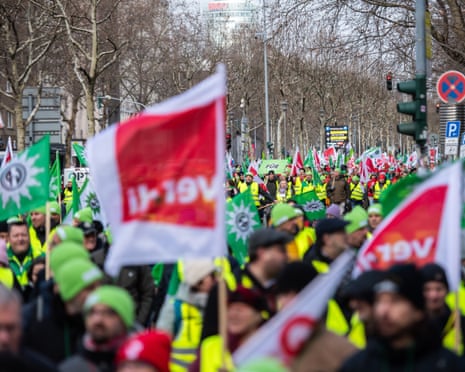
Giant services union Ver.di is staging rolling strikes across the country targeting the public sector, with employees of the federal states walking out to gain a better wage deal.
Daycare centres, university hospitals and public transport have been brought to a near halt in recent weeks and on Thursday, dozens of facilities in Berlin and the surrounding Brandenburg region were hit.
Ver.di is demanding a 7% monthly salary hike at fresh negotiations with state governments in Potsdam on behalf of 900,000 employees as well as, by default, 1.3 million civil servants, as their salary deal usually respects the same accord.
The employer side, a federation of 15 states with the exception of Hesse, has dismissed this as excessive and said a 5% increase stretched over 29 months is the best they can do. After two unsuccessful rounds, the talks are set to run until Friday.
Apart from causing inconvenience to average Germans, employers say the strikes set an unfair precedent that is souring the country’s traditional spirit of collaboration in industrial relations.
“Germany urgently needs a law on fairness rules for strikes,” the head of the Confederation of German Employers’ Associations, Steffen Kampeter, told newspaper Bild, calling Ver.di’s tactics “irresponsible”.
“To strike first then negotiate -- that destroys trust,” he said.
Ver.di says employers have failed to address their demands to “keep pace with income developments in the public sector” and that it is “fighting for working conditions that make the jobs attractive” given labour shortages in areas including the judiciary, road construction, administration, healthcare and child care.
The dispute comes as major disruptions loom in German air traffic on Thursday after calls by two unions for strikes by Lufthansa pilots and cabin crew.

The 24-hour work stoppage for pilots centres around a conflict over pensions that has been raging since September.
The industrial action is expected to ground all flights scheduled to depart from German airports, pilots’ union Vereinigung Cockpit said, as well as many cargo flights.
Simultaneously, the UFO union of flight attendants called on its members to strike over the planned shutdown of operations at its short-haul carrier CityLine and “the employer’s continued refusal to negotiate a collective social plan”.
UFO president Andreas Pinheiro said staff “would have very much liked to avoid an escalation”.
He said the planned closure of CityLine and a scheme to spin off its employees to a new subsidiary were unacceptable.
Lufthansa reacted angrily to the unions’ announcements, saying they were “extremely short-notice” and “disproportionate”, leaving passengers to bear the brunt.
“Strikes must always remain a last resort,” company spokesperson Marc Baron said. “We therefore call on the unions to resume talks with us. We are ready to do so at any time.”
Lufthansa pilots are agitating for better retirement benefits as the airline scrambles to cut costs to manage its debt amid relatively weak profitability compared to European rivals.
The company said last year it planned to slash 4,000 jobs, amounting to nearly 4% of its workforce.
However, Germany’s Merz also has some problems brewing at home, as the country gets hit by waves of strikes, with the latest on Thursday set to affect the national airline, Lufthansa.
Let’s go to Deborah Cole in Berlin for more.
Merz and Meloni team up to influence EU's thinking on competitiveness reforms
Ahead of the competitiveness marathon over the next 24 to 48 hours, there is a growing focus on Germany’s Friedrich Merz and Italy’s Giorgia Meloni seemingly joining forces to shape the EU agenda – and which AFP notes risks sidelining French president Emmanuel Macron.
The agency said it is the latest sign of the growing cooperation between Rome and Berlin, which is putting a question mark on the traditional France-Germany axis.
The pair held major governmental talks in Rome last month, with Meloni joining that “some observers say that 2026 will be the year of Italy and Germany.”
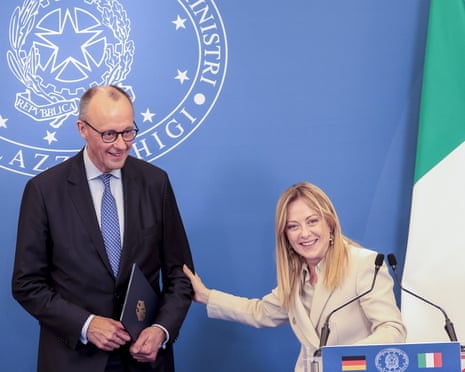
The two leaders have long shared a tough approach to migration, but agreed to expand their cooperation on everything from trade policy to defence at the Rome summit.
AFP noted that despite her initial reluctance, Meloni eventually backed the EU’s trade agreement with South America’s Mercosur bloc, as advocated by Germany. France, Berlin’s traditional ally, unsuccessfully tried to block the deal over concerns for its farmers.
The pair is now hosting a pre-summit ahead of tomorrow’s main summit on competitiveness, hoping to get other leaders to sign up to their thinking.
EU proposes plan to counter drone threats after months of sightings causing disruptions at major airports
Meanwhile, the European Commission has outlined its plan to counter drone threats after months of disruptions caused by drones and meteorological balloons causing chaos on major airports across the EU.
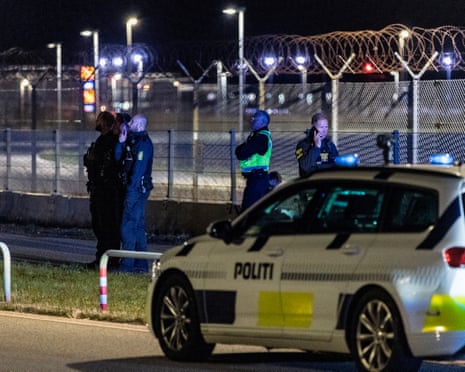
The plan sets out proposals to rapidly increase technological development and industrial production of anti-drone technologies, and their testing through a new EU Counter-Drone Centre of Excellence.
The bloc also wants to review the current rules on civilian drones, warning that some member states currently have no regulation in place, and adds new provisions on geographical zones with restrictions and exclusions.
The EU also wants member states to review their “active mitigation measures” and how they can effectively respond to drone threats after it emerged to be an major issue during repeated drone sightings at airport in Copenhagen, Munich and Brussels.
“We have seen that anything can be used as a weapon against us,” EU’s tech commissioner Henna Virkkunen said, adding that “we are taking a major step toward enhancing security and developing these capabilities together with our member states.”
Defence commissioner Andrius Kubilius said that the proposals were turning “the concept of a Drone Wall from a political vision into an industrial reality,” as he stressed that the EU needed “a sophisticated, multi-layered shield that can detect and neutralise any threat in real-time.”
Russia will take 'countermeasures, including military ones' if west increases footprint on Greenland
Meanwhile, Russia’s foreign minister Sergei Lavrov warned that Moscow would take military “countermeasures” if the west boosts its own military footprint on Greenland.
“Of course, in the event of the militarisation of Greenland and the creation of military capabilities aimed at Russia, we will take adequate countermeasures, including military-technical ones,” Lavrov said in a speech to Russian lawmakers, AFP reported.
Norway defence chief says Russia could invade to protect nuclear assets

Shaun Walker
in Bergen
Meanwhile, Norway’s army chief has said Oslo cannot exclude the possibility of a future Russian invasion of the country, suggesting Moscow could move on Norway to protect its nuclear assets stationed in the far north.
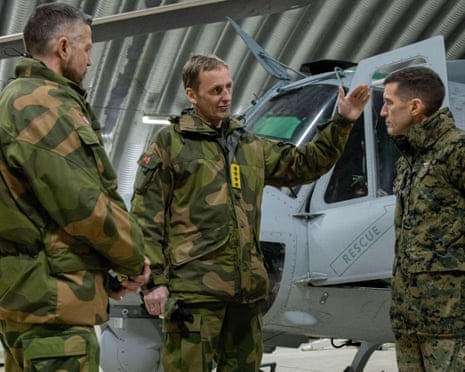
“We don’t exclude a land grab from Russia as part of their plan to protect their own nuclear capabilities, which is the only thing they have left that actually threatens the United States,” said Gen Eirik Kristoffersen, Norway’s chief of defence.
He conceded that Russia did not have conquest goals in Norway in the same way as it had in Ukraine or other former Soviet territories, but said much of Russia’s nuclear arsenal was located on the Kola peninsula, a short distance from the Norwegian border, including nuclear submarines, land-based missiles and nuclear-capable aircraft. These would be crucial if Russia came into conflict with Nato elsewhere.
Map of High North“We don’t take that off the table, because it’s still an option for Russia to do that in order to make sure that their nuclear capabilities, their second strike capabilities, are protected. That’s sort of the scenario in the high north that we plan for,” he said.
Kristoffersen said that while Norway was keeping the threat of a traditional Russian invasion in mind, the current Russian tactics were more diffuse.
“If you prepare for the worst, there is nothing that prevents you from also being able to counter sabotage and more hybrid threats,” he said.
He added, however, that Norway and Russia still maintained some direct contact over search and rescue missions in the Barents Sea, and that there were regular meetings at the border between representatives of the two militaries.
He has recommended setting up a military hotline between the two capitals to have a channel of communication to avoid escalation based on misunderstanding. He said Russian actions in the far north had generally been less aggressive than those in the Baltic Sea.
Four dead after Russian strikes on Ukraine overnight amid reported US pressure on Ukraine to end war
At least four people died in overnight Russian strikes on Ukraine, as Moscow shows no signs of compromise just two weeks before the fourth anniversary of the full-scale aggression.
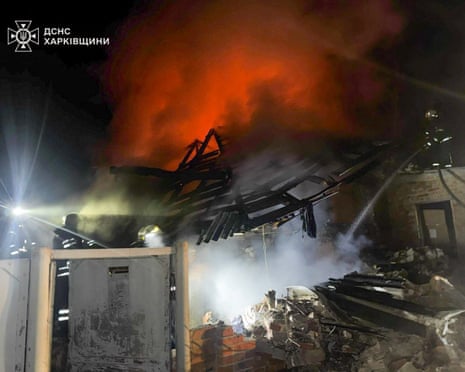
129 Russian drones were identified overnight, the Ukrainian air force said, adding that of these 112 were shot down or neutralised, Reuters reported.
There are now growing hints of US pressure on Ukraine to end the war as soon as possible and preferably before the summer, even at the cost of accepting far-reaching concessions.
On Monday, Matthew Whitaker rejected Ukraine’s claims that the US set a deadline to end the war by June, saying “I don’t think that is anything that the United States has put out there” (Europe Live, Monday).
But Financial Times reported (£) overnight that Ukraine is working on holding presidential elections and a referendum on peace deal, potentially as early as in May, with Washington pressing Kyiv to move as quickly as possible or risk losing critical security guarantees.
The paper pointed out that holding the election would be a major departure from Volodymyr Zelenskyy’s previously repeated suggestions that it was impossible, or at least impractical, to do it during an active war, with many voters either displaced or in active service struggling to take part.
FT suggested that Zelenskyy could announce the plan as early as on 24 February, the fourth anniversary of the full-scale aggression, but its actual implementation would still be conditional on the progress made in talks with Russia, with Moscow not showing signs of dropping its maximalist demands.
Morning opening: Ms von der Leyen, tear down these barriers

Jakub Krupa
European Commission president Ursula von der Leyen insisted this morning that the EU needs to “tear down” the economic barriers that prevent it from becoming “a global giant” and deepen its internal market, as she kicked off 48 hours of intensive discussions on the bloc’s economy.
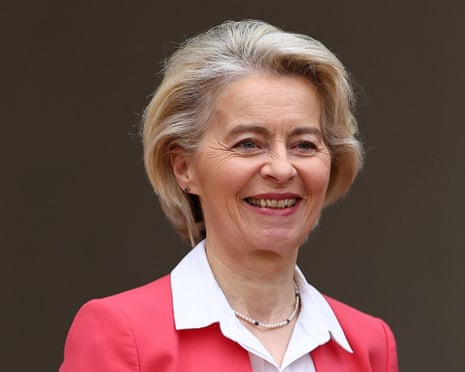
A number of EU leaders will meet today at an industry event in Antwerp, before they meet again tomorrow morning for a pre-summit discussion ahead of an informal summit proper later that tonight.
Addressing a largely empty hemisphere of the European Parliament in Strasbourg, von der Leyen said the bloc needed “to tear down the barriers that prevent us from being a true global giant,” as she warned that the current system amounts to “fragmentation on steroids” with many different, and potentially conflicting, legal regimes.
“We have the second largest economy in the world, but we are driving it with the handbrake on, and the good news is this can be fixed, but we need single minded focus on the single market, and we need to tear down barriers one by one,” she said.
Von der Leyen warned that “competitiveness is not just the foundation of our prosperity, but of our security, and ultimately, of our democracies too.”
The European Commission is planning to move forward a number of proposals, including its “EU Inc.” regime, which would allow people to register a company in any member state within 48 hours, fully online, and help with crossborder operations.
“This is the speed we need, and this is Europe made easy,” she said.
The commission wants a plan to be agreed by March and implemented by the end of next year.
But it’s fair to say that other leaders have some competing ideas, with a particularly strong anti-bureaucracy coalition forming around German chancellor Friedrich Merz and Italian prime minister Giorgia Meloni, so expect their voices to feature prominently in this debate. French president Emmanuel Macron also outlined his thoughts on this yesterday (Europe Live, Tuesday).
I will follow this closely for you.
Separately, I will bring you the latest on Ukraine, with EU defence ministers meeting in Brussels to discuss the situation in the country ahead of tomorrow’s separate Nato meeting, and more news from across the continent.
It’s Wednesday, 11 February 2026, it’s Jakub Krupa here, and this is Europe Live.
Good morning.