1 month ago
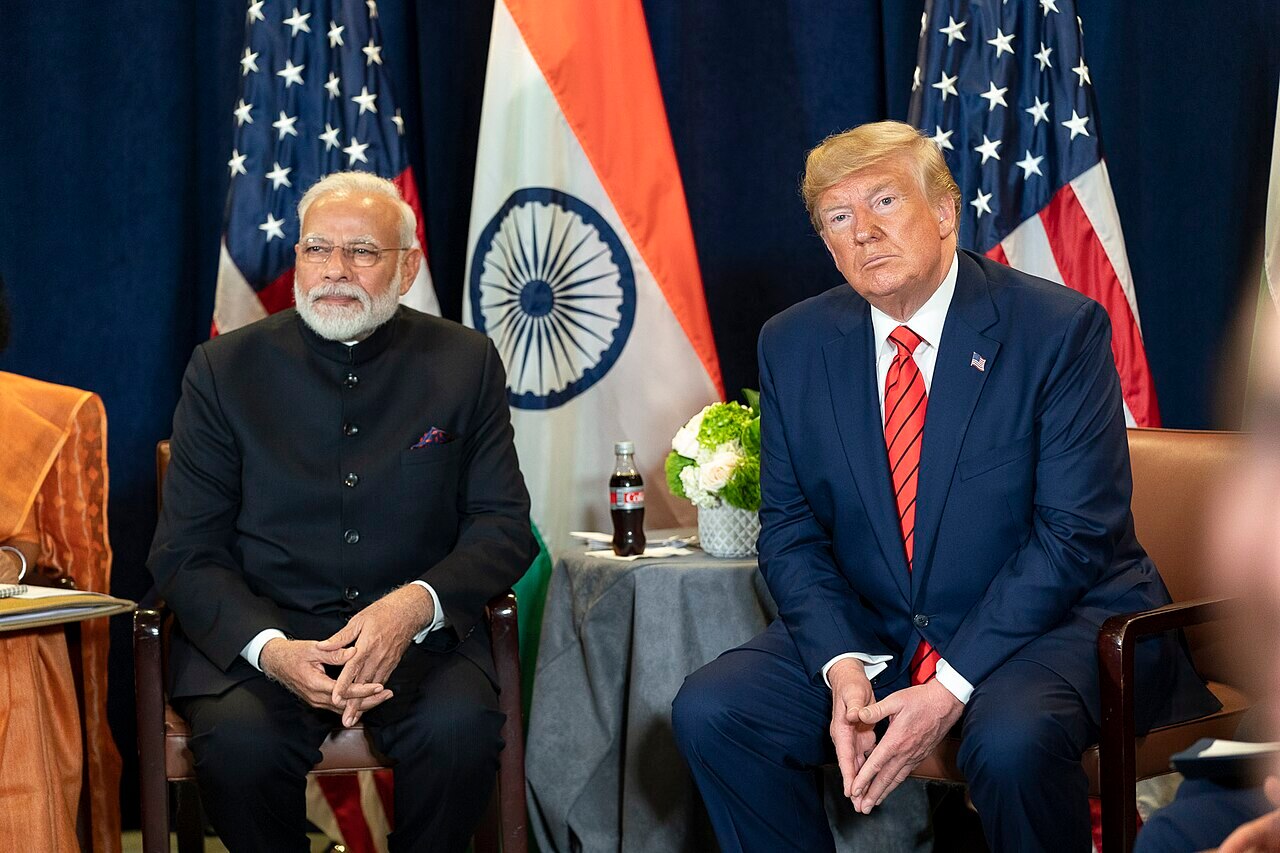
Amid Trump's confrontational diplomacy and hostile trade policies, Europe and Canada have pivoted towards India, a more reliable and stable partner, to diversify their exports. Here's a look at how a number of countries are now thumbing their nose at the mercurial Trump.
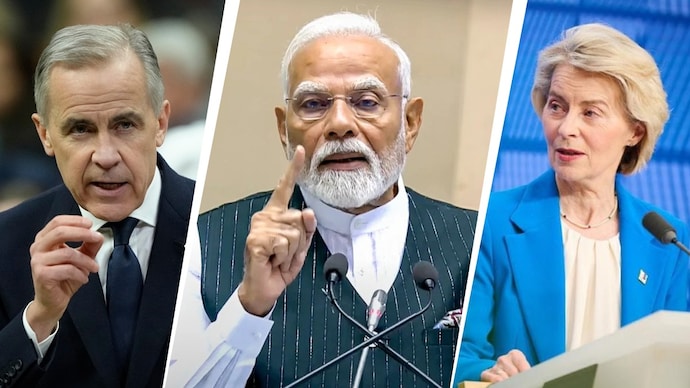
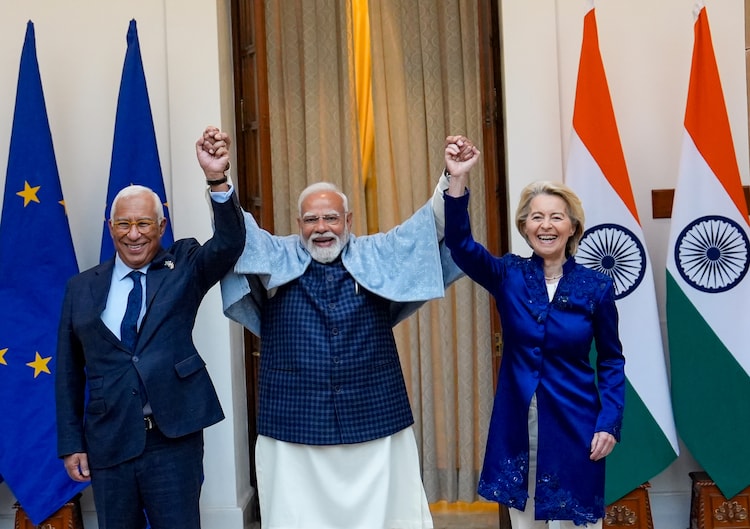
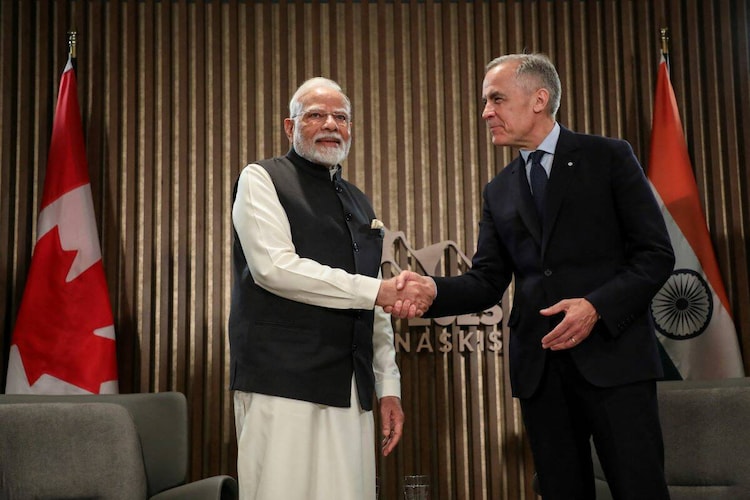
Canada's Mark Carney, PM Modi and EU chief Ursula von der Leyen
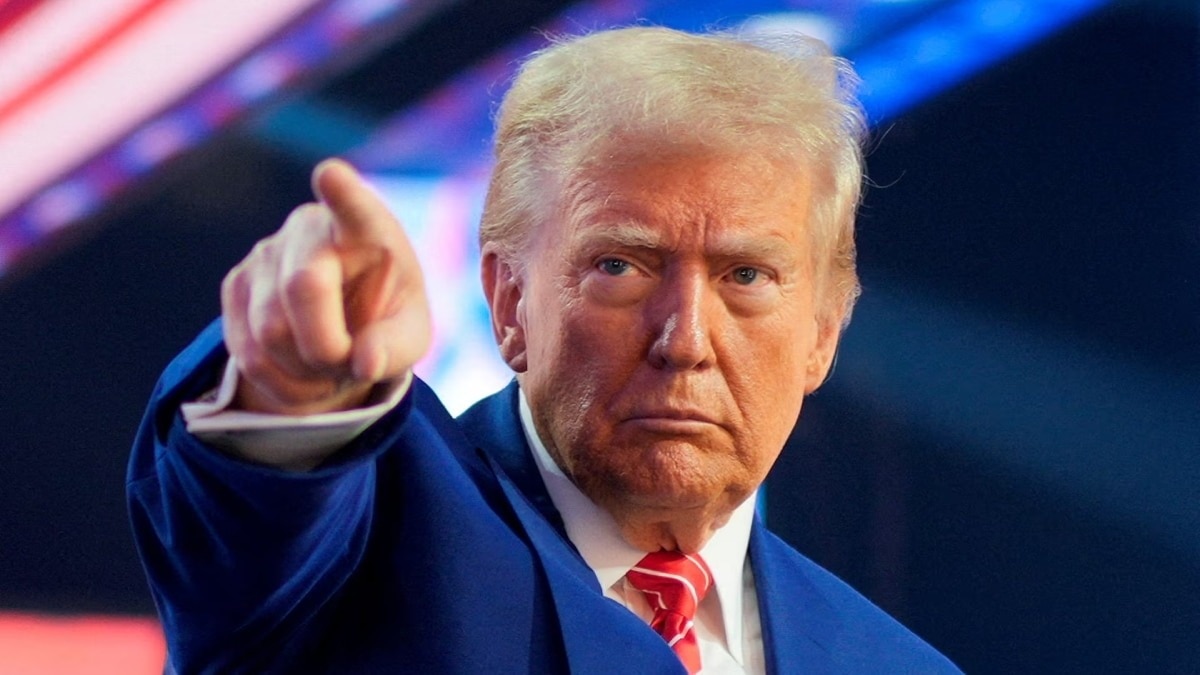
How can countries whose economies have depended on the US for decades cope with an increasingly unreliable and hostile Trump in the White House? This has been the billion-dollar question for many amid the turmoil brought upon by Trump, whose confrontational diplomacy and tactics of weaponising tariffs have alienated allies. The perfect answer, or should we say rebuff, was given by Europe and Canada this week as both pivoted towards a more reliable and stable partner to diversify their exports. Their port of call was India.
Trump, who has been dealt a tight slap by the European Union (EU) as it signed the "mother of all trade deals" with India, must realise the bitter truth. His strong-arm trade tactics and punitive tariffs have painted the US into an uneasy corner as global economic alliances undergo a swift recalibration.
TRUMP FACTOR BEHIND INDIA-EU DEAL?
In fact, remarks by US Treasury Secretary Scott Bessent on the India-EU free trade agreement (FTA) indicate how the US was now feeling increasingly isolated. There was no chest-thumping rhetoric, just disappointment.
"I find the Europeans very disappointing. The Europeans were unwilling to join us... because they wanted to do this trade deal," Bessent said in an interview with CNBC. The top Trump aide also accused Europe of placing trade interests above the war in Ukraine, referring to India's close ties with Russia and purchase of its oil.
However, Bessent does not appear to have taken into account the grim reality. No one likes to be bullied and depend on an unpredictable partner. This mistrust and Trump's threats over the Greenland takeover issue appear to have been a major catalyst for the EU to seal the trade deal with India, which has been under negotiation for nearly two decades.
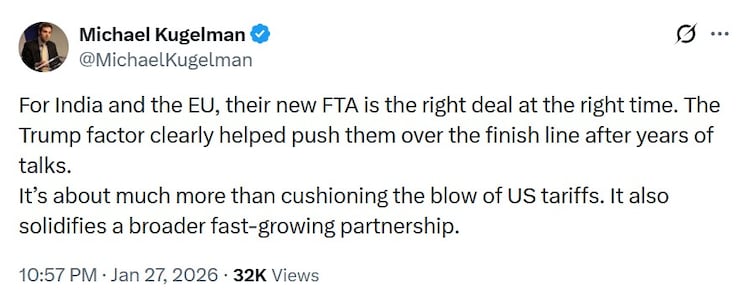
"The Trump factor clearly helped push them over the finish line after years of talks. It's about much more than cushioning the blow of US tariffs. It also solidifies a broader, fast-growing partnership," tweeted South Asian geopolitical expert Michael Kugelman.
WHAT IT MEANS FOR INDIA?
That the India-EU FTA has been dubbed the "mother of all deals" is not mere rhetoric. They represent 25% of global GDP and account for nearly one-third of world trade.
The deal, which will likely be signed early next year, will give India an edge in exporting labour-intensive goods hit hard by Trump's sky-high 50% tariffs, including textiles, gems, jewellery and footwear. The EU, meanwhile, will see India eliminating or cutting tariffs on 96.6% of the 27-member bloc's exports.
The EU has kept India's dairy and agriculture areas largely out of the deal, respecting New Delhi's red lines over the politically-sensitive sectors.
This signals that the India-EU deal was not transactional and wrapped in respect. It sent a clear message to Trump -- that global powers have now started to diversify and de-risk their economies amid the volatility of US trade policy.
It is here that India has made hay, quickly sealing trade pacts with the United Kingdom, New Zealand and Oman. Countries are now increasingly seeing India as a reliable, stable and indispensable trading partner. The image of a "dead economy" and "tariff king" that Trump sought to paint of India has failed to hold water.
CANADA COMES TO THE PARTY
However, much water has flown across the Atlantic. Canada has also now come to the India party after being threatened over oil and energy by Trump for most of last year.
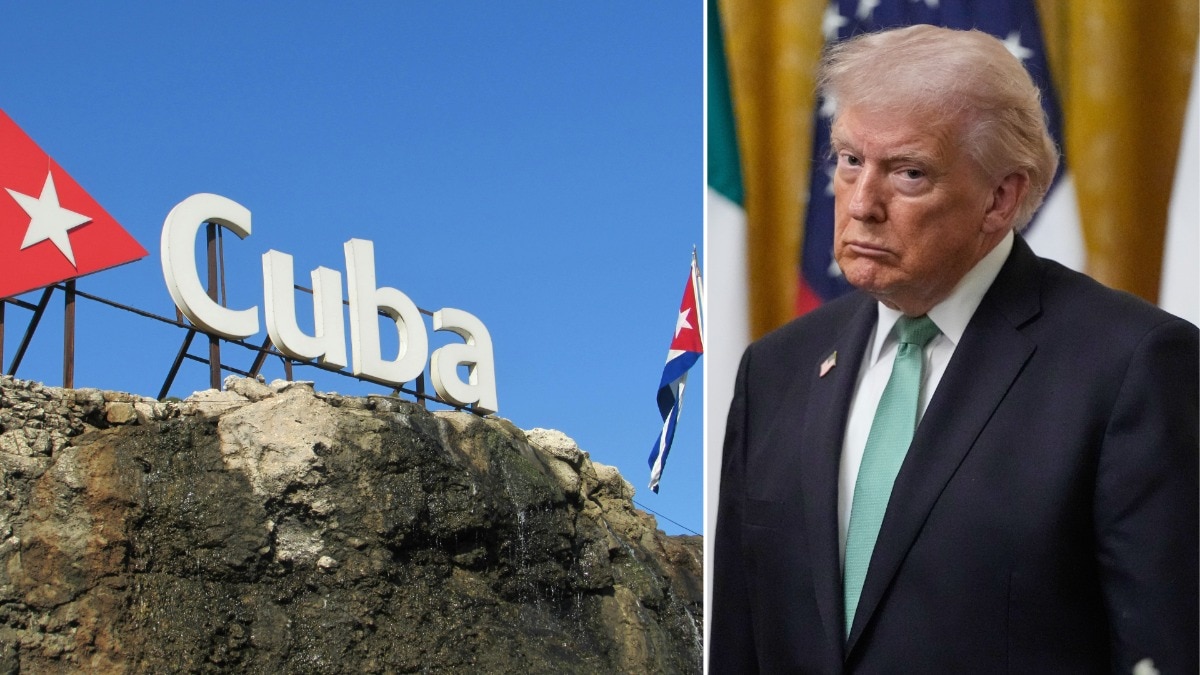
Amid his rhetoric to make Canada the 51st American state, Trump poignantly asserted last year that the US doesn't need Ottawa's oil and gas. "We don't need them to make our cars, we make a lot of them... we don't need their oil and gas, we have more than anybody," Trump had said. This, despite Canada being the largest supplier of energy to the US.
Well, it seems Canada did not forget. It will now ship more crude oil, LNG and liquefied petroleum gas to India, among the top consumers and importers of crude oil.
On the other hand, India will send more refined petroleum products to Canada. This was decided on Tuesday at a meeting between Union Minister Hardeep Singh Puri and Canadian Energy Minister Tim Hodgson, who emphasised the need to reject "hegemons who use tariffs as leverage".
This comes as Canada, under Mark Carney, reboots its ties with India, which was on a free fall after former Prime Minister Justin Trudeau suggested that New Delhi was involved in the murder of Khalistani terrorist Hardeep Nijjar in 2022.
Here too, an increasingly hostile Trump seems to have pushed Canada to mend its ties with India and diversify its export market.
Trump amplified his pressure on Canada after Carney, in a heroic speech at Davos, took a swipe at the US president for the "rupture" in the world order. Trump returned the fire, saying that "Canada lives because of the US".
More recently, Carney's trip to China, where he and President Xi Jinping agreed to reduce tariff barriers, seems to have further irked Trump. It spurred him to threaten a 100% tariff on Canada if Carney secured a trade deal with China. It prompted Carney to walk back.
But it didn't deter him from speaking the truth in Parliament. "Washington has changed. There's almost nothing normal in the United States. That's the truth," Carney said.
With this thought in mind, Carney is set to visit India in the coming weeks with a baggage of agreements spanning uranium supply, nuclear cooperation, energy, and critical minerals.
In between, Brazilian President Lula da Silva will also visit India from February 19-21 and meet business leaders.
The climate of unpredictability has also pushed the UK to mend ties with China. In fact, UK PM Keir Starmer is on a three-day visit to Beijing, marking the first time a British leader has visited China in eight years.
The common thread weaving these diplomatic moves has been the hostile tariff and trade policies by a mercurial Trump. It won't be surprising to see more such countries warming up to India by thumbing their nose at the eccentric President.
- Ends
Published By:
Abhishek De
Published On:
Jan 29, 2026