1 month ago
Ukraine started pumping oil through Druzhba with deliveries to Slovakia expected to resume on Thursday, minister says
Slovak economy minister Denisa Saková just said that the Ukrainian operator Ukrtransnafta confirmed it has started the “pressurisation and filling” of the Druzhba pipeline, with deliveries to Slovakia expected to resume on Thursday morning.
Key events Show key events only Please turn on JavaScript to use this feature
EU to relax state aid rules, offer measures to help consumers face cost of living spike amid Iran war disruptions

Lisa O’Carroll
The EU is to waive its state aid rules to allow member states to step in and help consumers weather the current cost of living crisis caused by the Iran war.
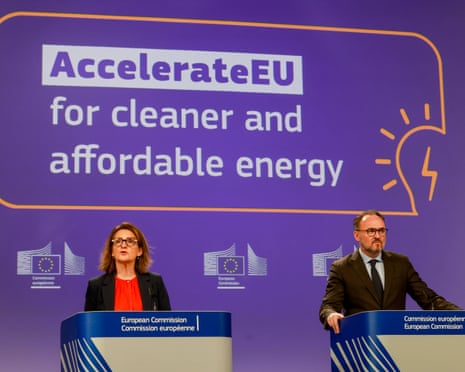
It will allow governments to issue energy vouchers, temporarily allow the reduction of excise duties for vulnerable households.
It will also allow emergency measures at state level to help industries facing existential threats because of the huge spike in the price of oil.
EU energy commissioner Dan Jørgensen said: “This must be a wake up call and a turning point.”
He cited initiatives in Austria where the government is supporting the removal of gas boilers and while Belgium and Germany are offering reduced VAT and low electricity prices respectively, to boost the installation of heat pumps.
France, which has seen a 50% increase in the sale of electric cars will relaunch its social leasing program for EVs.
But the other measures are aimed at accelerating green infrastructure for both consumers and industry.
They include enhancement of the bloc-wide grid with a legislative proposal on charges and taxes that are favourable to wind farms and renewable plants including hydropower.
It will also facilitate collaboration between the private and public sector at a clean energy investment summit to speed up renewable energy production.
“In the current crisis, speed and impact are paramount,” the European Commission said in a statement.
“When Europe steps away from fossil fuel dependence and steps toward clean energy autonomy. Because now it is more obvious than ever. Clean energy means security. It means affordability. It means independence,” said Jørgensen.
EU looks at measures to ease pressures on consumers in face of oil crisis caused by Iran war
Lisa O’Carroll
Meanwhile, the EU is about to announce measures to ease the pressure on consumers in the face of the oil crisis caused by the Iran war.
Environment commissioner Teresa Ribera starts by announcing that green energy production has reached record levels. She doesn’t say it, but her native Spain is taking the lead.
“Renewable energy generation in Europe reached a new record high in the first quarter of this year, 15% higher than in the first quarter of 2025,” she said.
But the European Commission want to protect “social fairness” in the current crisis with five sets of actions.
The Commission said the measures – announced in a package called ‘AccelerateEU’ – included optimising the distribution of jet fuel between EU countries, in order to avoid shortages.
“The choices we make today will shape our ability to face the challenges of today and the crises of tomorrow. Our AccelerateEU strategy will bring both immediate and more structural relief measures to European citizens and businesses,” said European Commission president Ursula von der Leyen.
'We live in dangerous world,' Nato's Rutte warns, as he calls for ramp up in defence production
Elsewhere, Nato’s secretary general, Mark Rutte, spoke in Turkey in the last hour, delivering his usual spiel about how Europe needs to step up its defence production.
He said:
“We live … in a more dangerous world, and that means we need strong defences to protect our security. We need the best capabilities. We need to incorporate the latest technology.”
He explained that the alliance needed to gear up as it faces a number of challenges given “Russia’s war against Ukraine rages on, China’s military modernisation and nuclear expansion … continue … and Iran is spreading terror and chaos.”
His trip to Turkey is part of industry engagement ahead of Nato’s summit in Ankara in July.
Hungary confirms Druzhba pipeline is ready to resume oil deliveries
And we are getting a similar line from the Hungarian oil group MOL.
The company said it received a notification that “repair works on the Druzhba Pipeline have been completed and that the force majeure conditions in effect since 27 January 2026 ceased as of 6 pm on 21 April 2026.”
“According to the notification, JSC Ukrtransnafta is ready to resume crude oil transit to Hungary and Slovakia,” it added.
Ukraine started pumping oil through Druzhba with deliveries to Slovakia expected to resume on Thursday, minister says
Slovak economy minister Denisa Saková just said that the Ukrainian operator Ukrtransnafta confirmed it has started the “pressurisation and filling” of the Druzhba pipeline, with deliveries to Slovakia expected to resume on Thursday morning.
For what it’s worth, AFP is reporting a senior Kyiv official as telling the agency that Ukraine will restart the oil flows through the Druzhba pipeline “within a few hours.”
Let’s see if the EU’s decision can be made before then, or if Hungary will hold out until the oil is actually flowing.
Morning opening: EU close to signing off on €90bn loan for Ukraine
After four months of very public disagreements between Ukraine and Hungary, today could be the day when the EU finally signs off (for the second time) on the critical €90bn loan for Kyiv.
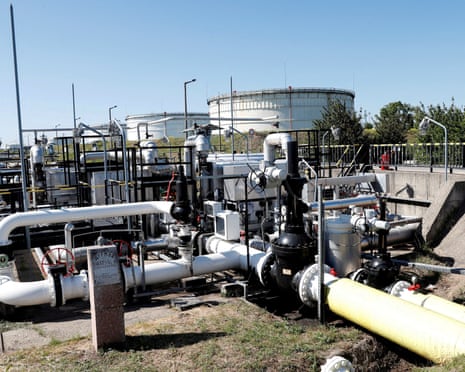
Ukraine’s president Volodymyr Zelenskyy confirmed yesterday that the Druzhba pipeline, carrying Russian oil imports to Hungary and Slovakia, has been repaired and is ready to be used again. EU’s top diplomat, Kaja Kallas, said yesterday she expected “a positive decision” within the next 24 hours.
Ambassadors from the 27 member states are meeting this morning to discuss the disbursement of the loan, which has been held up until now by Hungary’s outgoing prime minister, Viktor Orbán.
The loan had been originally agreed at the European Council in December, but after the pipeline was struck by a Russian missile and damaged, causing the oil flows to stop, Hungary decided to block the payments until deliveries are restored.
For all we know, the oil is not quite flowing yet, but it could flow any time now, so it’s just a matter of both sides agreeing to move on this issue. Crucially, the incoming Hungarian government of Péter Magyar has maintained the view the previous administration’s stance: deliveries must restart before Hungary will agree to the payout.
The payment could not come early enough for Ukraine as the country urgently needs that money to fund its continuing defence against Russia. Zelenskyy spoke about his priorities with several EU leaders last night.
I will bring you the key lines when we have more on this.
Separately, EU energy commissioner Dan Jørgensen is expected to give his take on how Europe could be affected by the Middle East crisis today. I will bring you his words when he speaks later this morning.
It’s Wednesday, 22 April 2026, it’s Jakub Krupa here, and this is Europe Live.
Good morning.