1 month ago
In a landmark decision, the US Supreme Court struck down Trump's worldwide tariffs, holding that wartime-style emergency powers cannot be used to bypass Congress on trade and taxation matters.
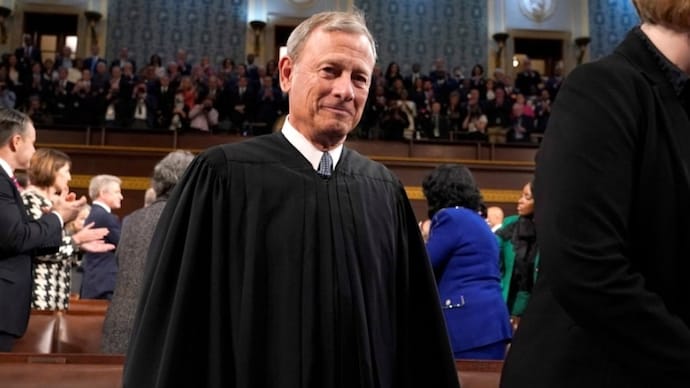
Chief Justice John Roberts (Reuters Photo)

UPDATED: Feb 20, 2026 23:46 IST
In a sharp rebuke to presidential power, the US Supreme Court ruled that emergency wartime authority cannot be stretched to justify sweeping tariffs on global trade partners.
“The United States, after all, is not at war with every nation in the world,” Chief Justice John Roberts wrote, underlining the constitutional limits on executive power in a landmark 6-3 decision that struck down former President Donald Trump’s tariff regime.
At the heart of the dispute was the Emergency Economic Powers Act (IEEPA), a 1977 law traditionally used to freeze assets or impose sanctions during national emergencies. Trump had relied on the statute to impose tariffs on nearly every US trading partner without seeking approval from Congress.
The majority made clear that the law does not authorise such action.
“Our task today is to decide only whether the power to ‘regulate importation,’ as granted to the president in IEEPA, embraces the power to impose tariffs. It does not,” Roberts wrote.
The opinion stressed that IEEPA contains no reference to tariffs or duties. No statute, the court noted, uses the word “regulate” to authorise taxation. Until now, no president had interpreted the law as granting tariff powers.
NO INHERENT PEACETIME AUTHORITY
The court went further, stating that the president has no inherent peacetime authority to impose tariffs. For actions of “vast economic and political significance,” the president must “point to clear congressional authorization,” Roberts wrote. “He cannot.”
Invoking the “major questions” doctrine, the majority said allowing unilateral tariffs of this scale would intrude on Congress’s constitutional authority over taxation and trade. The Constitution vests that power squarely in Congress.
The ruling marks the first time a president’s attempt to use IEEPA for tariffs has been rejected by the court. Trump had become the first to invoke the law in that manner after returning to office in January 2025.
DISSENT WARNS OF FALLOUT
Justice Brett Kavanaugh dissented, joined by Justices Clarence Thomas and Samuel Alito. He argued that tariffs are a traditional tool to regulate imports and said the text, history and precedent of IEEPA supported the administration’s position.
Kavanaugh warned of significant practical consequences, including the potential refund of billions of dollars collected under the tariffs and uncertainty surrounding trade agreements negotiated during their enforcement.
WHO JOINED THE MAJORITY
Joining Roberts in the majority were Justices Neil Gorsuch, Amy Coney Barrett, Sonia Sotomayor, Elena Kagan and Ketanji Brown Jackson. The liberal justices did not join the portion of the opinion invoking the major questions doctrine.
The case was brought by businesses affected by the tariffs along with 12 US states, most led by Democrats.
With this ruling, the Supreme Court has drawn a clear constitutional line: emergency powers are not a blank cheque. And as Roberts reminded the nation, the United States is not in a state of permanent war with the world.
- Ends
Published By:
Akshat Trivedi
Published On:
Feb 20, 2026