1 month ago
Stargate was to be the world’s biggest AI investment: a $500bn infrastructure project to “secure American leadership in AI”. Never shy of hyperbole, its key backer, the ChatGPT-maker OpenAI, promised “massive economic benefit for the entire world” with facilities to help people “use AI to elevate humanity”.
Now, OpenAI appears to be dropping out of a part of the deal – the expansion of a flagship datacentre stretching across a swathe of land in Abilene, Texas, which has become one of the most visible manifestations of a frenzy of investment in the chips and power plants required to build and run AI. There has been a breakdown in negotiations over project financing, as well as the timeline of when the expanded capacity might come online.
This may be fine for OpenAI; it can presumably find other datacentres. It is less fine for OpenAI’s partner on the project, Oracle, which has already spent billions on hardware for the site. It is one of a number of cracks appearing in the capital side of the AI economy that are making investors rather nervous.
Both companies have said the development will not derail their AI plans. They also said that a month ago, when a different $100bn deal melted down between OpenAI and Nvidia, the world’s biggest maker of the chips that train AI models and respond to the billions of questions people ask them daily.
The fate of such deals for the global economy is only increasing in importance. Future datacentre leases agreed by the largest cloud computing companies (including Amazon, Oracle and Microsoft) are up nearly 340% in two years and now top $700bn, according to Bloomberg. It is a lot of money if the technology does not start delivering on its promise to supercharge economic productivity. On Friday, more than three years since the launch of ChatGPT unleashed the AI hype, the UK reported zero GDP growth for January.

On Monday, the Guardian exposed another fissure in the AI edifice. An investigation found the UK’s flagship AI deals, many announced with great fanfare during Donald Trump’s state visit last September, are not as they were described in government and corporate press releases. Key projects are delayed or improbable, crucial “investments” are in fact vague agreements between mostly US tech companies, desperately being spun by ministers as an engine for economic growth.
If the cracks in this datacentre boom widen, consequences range from Britain ending up without the AI infrastructure it needs to keep up in the global economy to the more grave risk that the entire AI bubble bursts in a replay of the 2001 dotcom crash that could knock the world economy sideways.
“There has been a lot of blind optimism around the buildout of AI infrastructure,” said Andy Lawrence, the executive director of research at the Uptime Institute, which inspects and rates datacentres. “While there is an incredible boom under way, with construction at a scale that’s never been seen before – it has also been apparent for quite a while that many projects would either not go ahead, or would take a lot longer to build and begin operating than many of the claims suggested. Because of the high stakes and high rewards in AI, it has attracted speculators who promise investment but have little experience in the sector.”
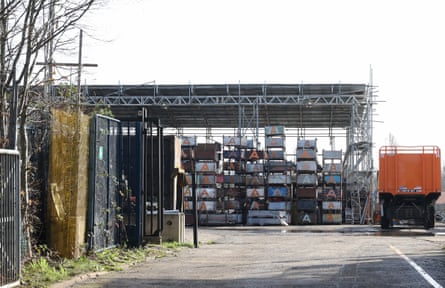
Most emblematically, the Guardian’s investigation featured a site in Loughton, Essex, that the government said would host “the largest UK sovereign AI datacentre” by the end of 2026. The then technology secretary, Peter Kyle, called it “a fresh start for our economy and for working people”. A year later it was still being used as a scaffolding yard with almost zero chance of being open when billed. After the Guardian’s investigation, Nscale confirmed it had bought the land on which the computer is to be built – eight months after it said it did in January 2025. It still does not have planning permission but said on Friday it was planning to start construction before July and would switch on the datacentre between April and July 2027.
The rickety AI deals have come amid a tightening embrace between US tech corporations and senior politicians in the US and UK. Donald Trump’s top AI advisers include David Sacks and Sriram Krishnan, both with recent histories as tech investors. In London, OpenAI hired the former chancellor George Osborne; Anthropic and Microsoft employed the former prime minister Rishi Sunak; Peter Mandelson was an owner of a consultancy that lobbied for Palantir; and the Tony Blair Institute has received funding from the foundation of Oracle’s billionaire owner Larry Ellison.
These figures have helped create an AI policy in which the UK has essentially agreed to be a staging ground for US-designed hardware being rented mostly to US tech companies. The UK government says it is creating “sovereign AI infrastructure”, which has a contested definition ranging from hardware and data owned by the UK so it retains control of a piece of critical national infrastructure in a world of unstable international alliances, to the AI minister Kanishka Narayan’s more flexible definition as “strategic leverage” so the UK “can ensure ongoing access to critical inputs”.
In the UK that means relying on the US. As Jensen Huang, the chief executive of Nvidia, said during Trump’s state visit last September: “America must lead across the entire AI technology stack.”
The former deputy prime minister Nick Clegg put it more bluntly that week, calling the UK a “vassal state technologically”. Clegg this week became a board director at Nscale, the UK company involved in the Loughton AI deal, where its client is Microsoft – part of the US tech hegemony whose power he lamented six months ago.
On BBC Radio 4’s Today programme this week, Nscale’s senior vice-president, Imran Shafi, was asked if its Essex datacentre would be live by “Q4 of 2026” as promised. He replied: “The time that it will be live will be the time we have approved with our customer.”
Narayan, meanwhile, defended the broader pace of progress. “What we are saying is that we’re making concerted progress,” the minister told CityAM. “We have live datacentres in Lanarkshire already. We have spades in the ground in parts of the north-east.”

Narayan might consider the example of the current meltdown in Texas. Billions were promised, construction began, billions of dollars worth of equipment were bought, and then OpenAI walked out, leaving its partners in the unenviable position of having to find another giant AI company to work with.
OpenAI, it was reported, wanted a newer chip model: and by the time construction in Texas finishes, the hardware that Oracle bought may no longer be cutting-edge. It was like buying a job lot of iPhones just before a far more powerful model was about to be launched. The pace with which chips go out of date casts a further shadow over the UK government’s claims of massive AI investment. It is describing in cash terms “investments” that are mostly computer chips. Chips are not money – they depreciate, possibly even faster than most tech companies say they will.
This means it matters when a datacentre in Essex or an AI hub in Lanarkshire is meant to be online. By the time they are ready and the extra electricity has been sourced, will leaps in the design of AI systems mean that running 2025 chips is like owning a propeller plane in the jet age? Or if the deals announced relate to future chips, will they be available? Iranian drone strikes have already affected supplies of helium from Qatar, which chip manufacturers need. What happens if China disrupts supplies from Taiwan?
“Datacentres, especially the big high-density AI ones, are very complex engineering projects,” said Lawrence at the Uptime Institute. “Few go live in less than two years, and usually it takes much longer. It is not uncommon for some projects to be delayed for years or be indefinitely postponed.”
The final component here is the banks. Nscale’s chips, and those of other datacentre companies, are leveraged. These operators have secured billions of dollars in loans on the basis of their graphics processing units (GPUs). At least in Nscale’s case, this debt will go to financing its UK buildout, but when does that debt come due? If it cannot be paid, what happens to Nscale or to the financial institutions that are left looking to find a buyer for potentially out of date chips?
A spokesperson for Nscale said it “works with established financial counterparties and maintains disciplined governance around financing decisions. We take a conservative approach to our financing, aligned to long-term infrastructure buildouts.”
Alvin Nguyen, an analyst at Forrester, said: “The people who are loaning the money, the financial institutions, they’re taking on so much more risk because there is a lifespan to the chips.”
The datacentre investment boom represents one of the biggest infrastructure gambles of this or any era. Whether that scaffolding yard in Loughton ends up becoming a real AI factory could tell us a lot about who will win and who will lose.