 1 month ago
As Trump and Xi meet in Beijing, the summit will revolve around familiar fault lines: Iran, trade, rare earths, AI, and Taiwan. While neither side enters with a decisive upper hand, China appears to hold slightly greater leverage on some of the most immediate economic and geopolitical pressures shaping the talks.
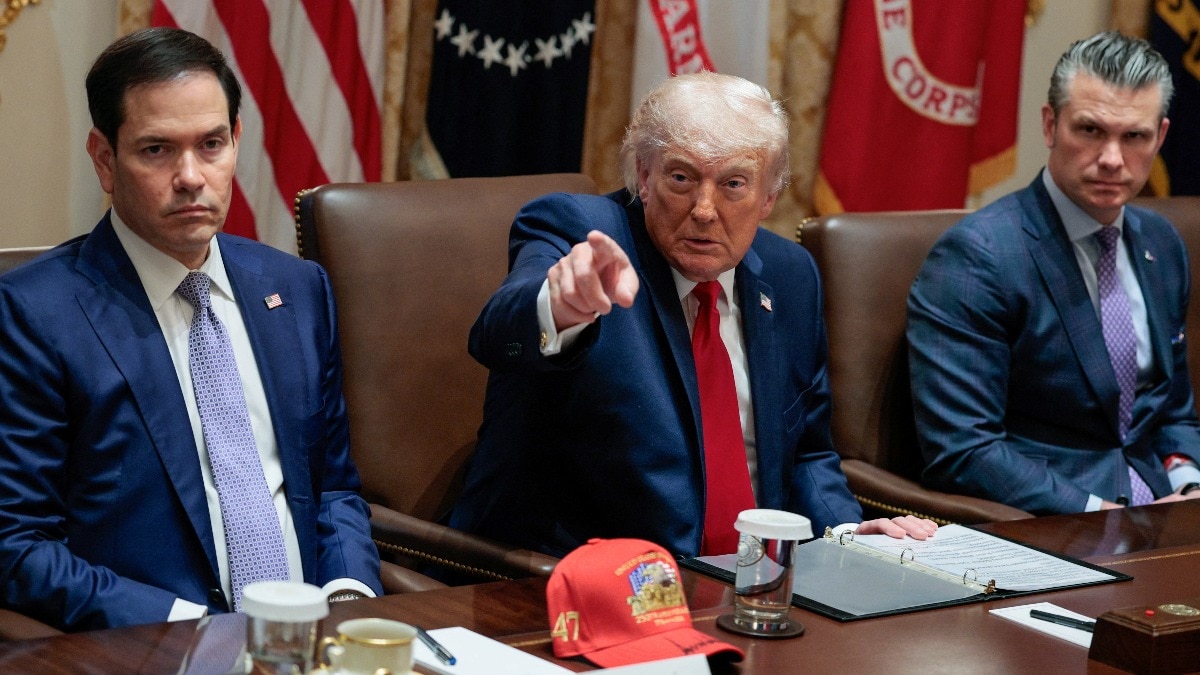
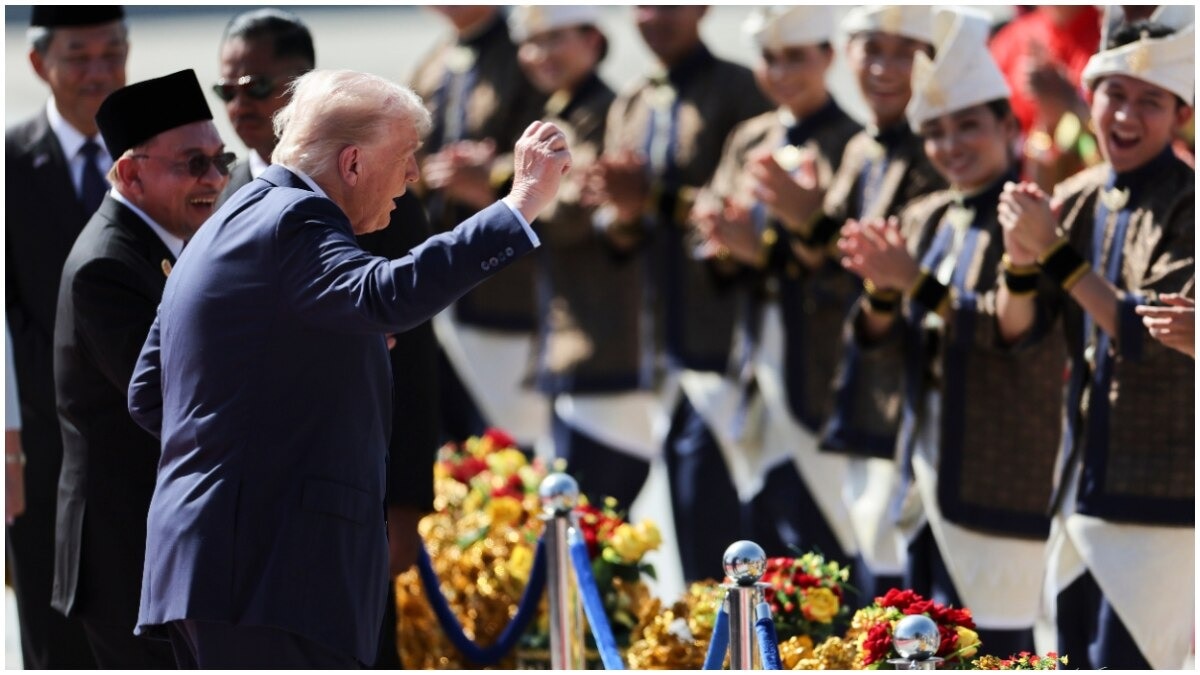
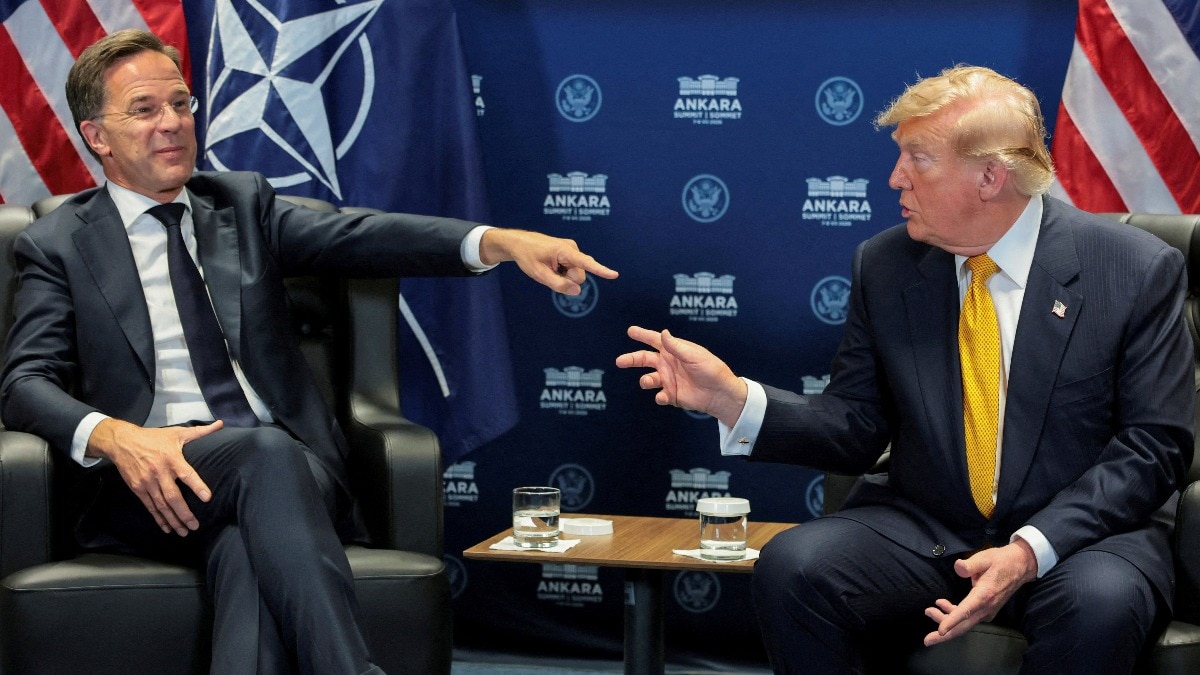
Amid a volatile ceasefire in West Asia and with no agreement with Iran in sight, US President Donald Trump will head to Beijing this week for a state visit at the invitation of his Chinese counterpart, Xi Jinping, from May 13 to 15. A meeting that always captures global attention is now unfolding at a time when the world is increasingly asking: when Trump and Xi finally sit across the table, who will truly hold the upper hand, and what exactly will dominate the discussions?
The summit comes at a time when the foundations of the US-China relationship are being tested simultaneously by war, economic uncertainty, technological rivalry, and strategic competition across Asia. From Iran and trade to AI, rare earths, and Taiwan, nearly every major fault line between the two powers is expected to surface in Beijing, making this one of the most consequential Trump-Xi meetings in years.
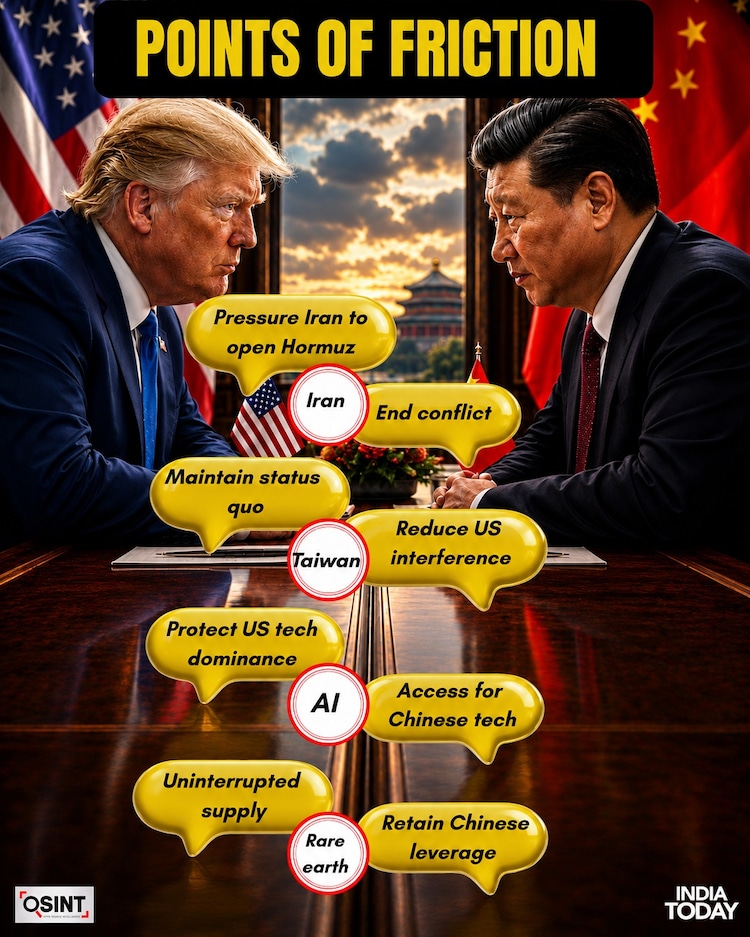
India Today’s Open Source Intelligence (OSINT) team, drawing on IMF forecasts, think tank studies, and the broader history of US-China ties, attempts to understand the issues expected to dominate the Trump-Xi summit in Beijing and assess which leader may enter the meeting with greater leverage.
Core issues expected to be discussed in Beijing
The upcoming Trump-Xi meeting is expected to revolve around the same unresolved tensions that have defined US-China ties for years, but with the Iran conflict now adding fresh urgency. Iran, AI restrictions, trade, Taiwan, and rare earth supply chains are all likely to feature prominently in the discussions. Washington is expected to push Beijing to use its influence over Tehran, while both sides will also try to preserve a fragile trade thaw through investment deals, Boeing aircraft purchases, and agricultural agreements.
Iran tops the agenda as Xi holds leverage
The Iran war has deepened global energy uncertainty, but China appears structurally better prepared than many major economies. Washington views this with both urgency and contradiction: it wants Beijing to use its leverage over Tehran to help secure a deal aligned with US objectives, while simultaneously accusing China of indirectly sustaining Iran through massive energy purchases.
US Treasury Secretary Scott Bessent, in a recent interview, said China was buying nearly 90% of Iran’s energy exports, adding that Beijing was “funding the largest state sponsor of terrorism.” “China, let’s see them step up with some diplomacy and get the Iranians to open the strait,” Bessent said.
According to the CSIS ChinaPower Project, around 36 percent of China’s total crude oil supply depended on the Strait of Hormuz in 2024, compared to significantly higher exposure levels among key US partners such as Japan at 93 percent, South Korea at 70 percent, and Taiwan at 58 percent.
Beijing has also built strategic petroleum reserves covering roughly 102 days of net crude imports and expanded overland pipeline connectivity with Russia and Central Asia, including the Power of Siberia pipeline.
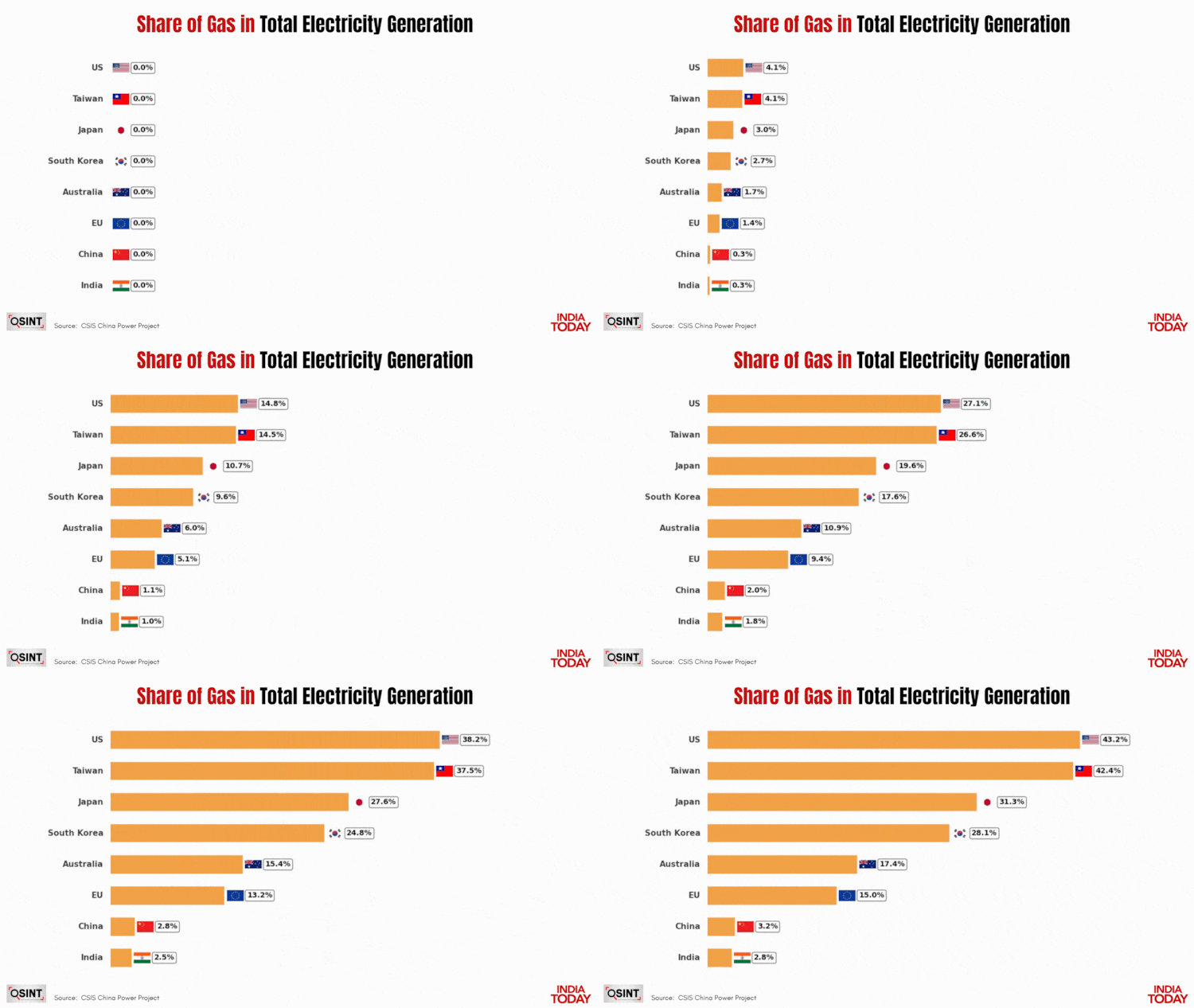
China’s rapid electrification drive has further reduced its vulnerability. As per a CSIS study, EV adoption alone cut China’s oil demand by nearly 1 million barrels per day in 2024 and could reduce another 2 million barrels per day by 2030. Oil and gas now account for only about 3 percent of China’s electricity generation, compared to roughly 34 percent in the United States and 44 percent in Taiwan. At the same time, China installed nearly half of the world’s new solar and wind capacity in 2024 and controls around 89 percent of global lithium-ion battery manufacturing capacity.
All this suggests that while China has certainly been hit by the Hormuz shock, it is unlikely to reach a point of desperation where Washington can easily squeeze concessions out of Beijing. Years of diversification, strategic reserves, electrification, and alternative supply routes have given China a stronger cushion than many expected.
However, Beijing is far from insulated. The real pressure point lies elsewhere: exports. China’s economy has once again become deeply dependent on overseas demand, with nearly one-third of its GDP growth in 2025 coming from net exports, the highest share since the late 1990s.
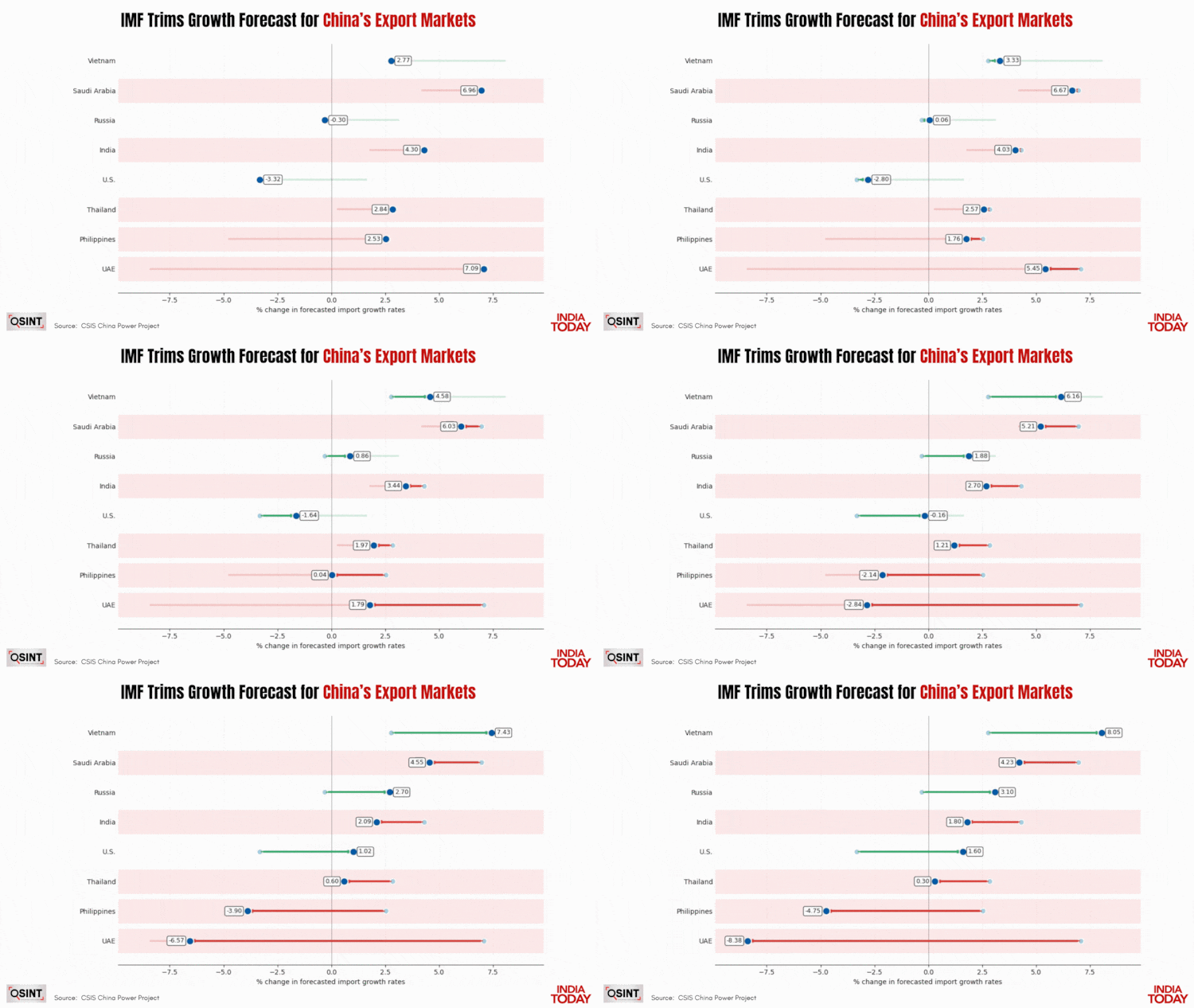
IMF forecast revisions released in April 2026 downgraded import growth expectations for several of China’s major export destinations after the Iran war, including India, Indonesia, Singapore, Saudi Arabia, and the United Arab Emirates. In one of the sharpest revisions, the UAE’s projected import growth shifted from positive 7.1 percent growth to a contraction of 8.4 percent.
Yet there is another side to the picture. Two of China’s biggest trade partners by volume, the United States and Vietnam, actually saw import growth forecasts move in a positive direction. If Beijing is eventually forced to give ground during negotiations, it is likely to happen more on the trade and export front than on the energy or Hormuz question itself.
Artificial Intelligence
Beyond Iran and trade, another strategic contest looms large: artificial intelligence.
Artificial Intelligence is emerging as one of the most consequential battlegrounds between Washington and Beijing. A Council on Foreign Relations analysis suggests the United States still maintains roughly an eight-month lead over China in frontier AI capabilities, a gap Washington appears determined to preserve through tighter export controls on advanced chips and computing technology.
For Beijing, however, AI is no longer merely an economic race but a strategic necessity tied to military capability, industrial competitiveness, and long-term technological independence. Chinese firms and officials have repeatedly argued that US chip restrictions are the single biggest obstacle to China’s AI ambitions. While both sides are reportedly exploring an AI safety dialogue, the underlying contest remains unchanged: Washington wants to slow China’s technological rise, while Beijing wants to accelerate self-reliance and close the gap as quickly as possible.
Trade, tariffs, and rare earth supply chains
Trade may ultimately emerge as the most sensitive issue at the Trump-Xi summit. While the Iran war exposed vulnerabilities in China’s export-driven economy, it also highlighted how deeply the United States and its allies remain dependent on Chinese-controlled rare earth and manufacturing supply chains.
In a CFR analysis, Heidi E. Crebo-Rediker argues that Washington now faces “deep vulnerabilities in supply chains tied to rare earth elements and permanent magnets,” particularly as conflicts in the Middle East and Ukraine increase demand for advanced weapons systems dependent on Chinese processed materials.
CFR further notes that Beijing entered the current phase of negotiations with stronger leverage than during earlier tariff wars, having previously countered Trump’s tariff escalation, including duties above 140 percent, through its dominance in rare earth minerals and magnets critical for defence and advanced manufacturing.
Against this backdrop, both sides are expected to discuss extending the trade truce signed last October, following what was effectively a tariff war.
Reuters, citing a US official overseeing Donald Trump’s Beijing visit, reported that discussions are also expected to include Chinese purchases of Boeing aircraft and American agricultural products, particularly soybeans, alongside efforts to stabilise trade ties, investment mechanisms, and maintain continued rare earth flows from China to the United States.
The Taiwan question
Taiwan is expected to remain the most politically sensitive issue at the Trump-Xi summit. Beijing views Taiwan as a core sovereignty issue and has repeatedly framed reunification as central to China’s national revival.
The United States adheres to the “One China Policy,” but its interpretation differs from Beijing’s “One China Principle,” under which China considers Taiwan an inseparable part of its territory. Washington’s Taiwan policy is guided by the Taiwan Relations Act of 1979, which commits the US to helping Taiwan defend itself and maintain the ability to resist any forced takeover.
US Secretary of State Marco Rubio acknowledged that Taiwan would inevitably feature in discussions during Trump’s China visit. “I’m sure Taiwan will be a topic of conversation; it always is,” Rubio said, adding that both sides understand the dangers of escalation. “It is in neither of our interests to see anything destabilizing happen in that part of the world,” he said.
The remarks underline that Washington is unlikely to soften its long-standing position. For the United States, Taiwan remains central to regional deterrence and the balance of power in Asia. Any perceived weakening of US support for Taiwan could reshape strategic calculations across East Asia, especially among American allies wary of China’s growing military assertiveness.
Trump's visit gets a “welcoming” buzz in China
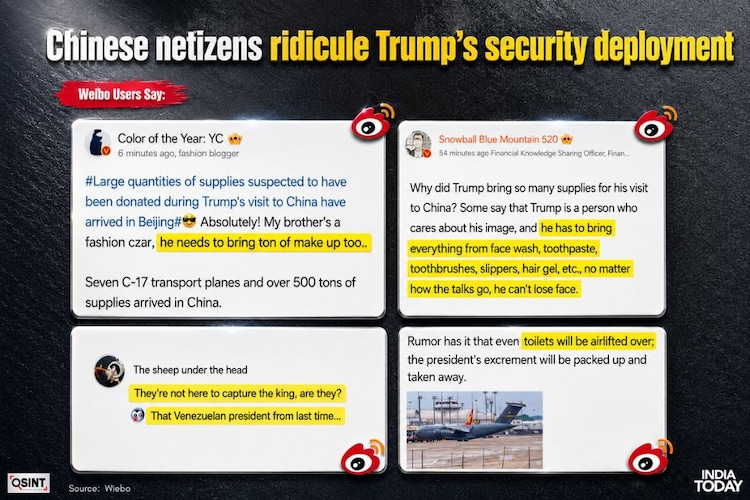
Even before Donald Trump lands in Beijing, his visit has already become a trending talking point across Chinese social media platforms. Since May 1, multiple C-17 military transport aircraft carrying armoured vehicles, Secret Service communications systems, and advance security teams have reportedly arrived in China ahead of the presidential visit.
Chinese users on Weibo quickly turned the massive logistics operation into a mocking trend under the hashtag #SuspectedLargeQuantityOfSuppliesForTrumpVisitToChinaArrivesInBeijing, which crossed 21 million views within 24 hours.
Posts mocked everything from Trump’s toiletries to his security arrangements. “Trump has gone into moving mode,” one user wrote. Another joked, “Even his excrement will probably be flown back.” Others sarcastically asked whether Trump was “coming to settle down permanently” in China.
- Ends
Published By:
bidisha saha
Published On:
May 11, 2026 22:38 IST