3 weeks ago
Israel says it will take 'control' of so-called 'security zone' up to Lebanon's Litani river
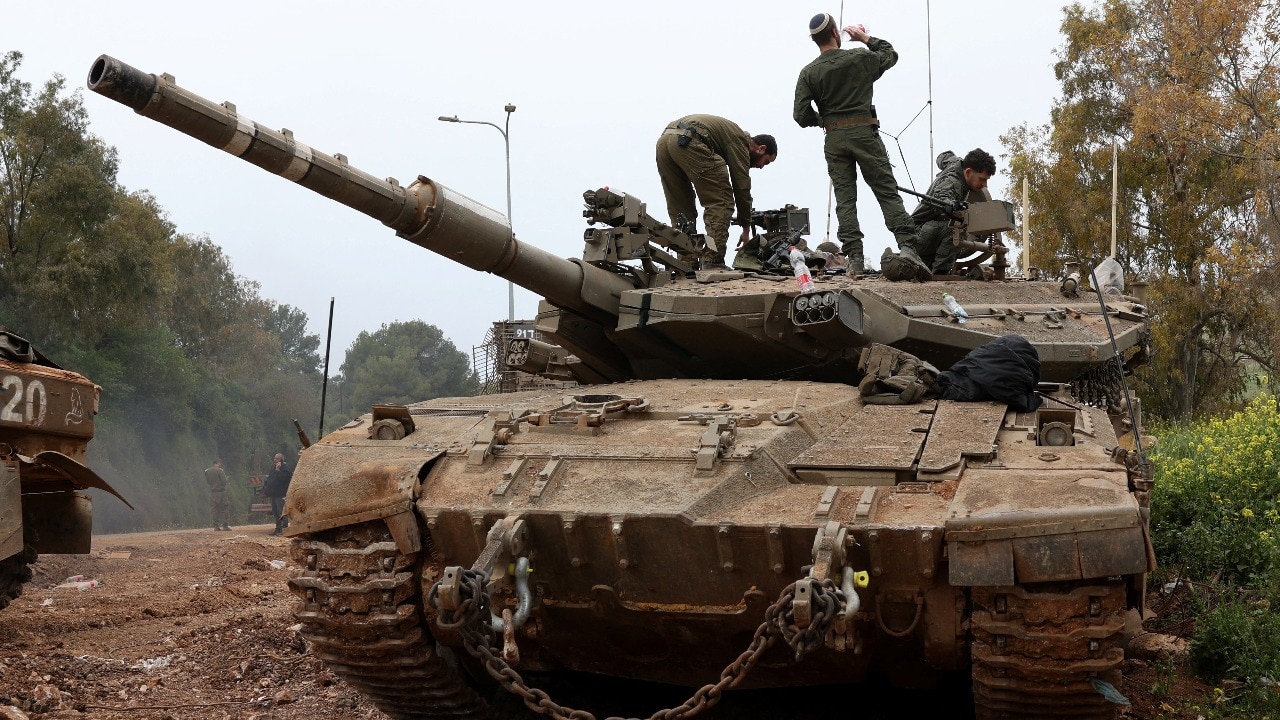
Israel’s defence minister, Israel Katz, has been quoted by the AFP news agency as saying that the military will take control of south Lebanon all the way to the Litani river, which is about 30km (19 miles) from the Lebanon-Israel border.
“All five bridges over the Litani that were used by Hezbollah for the passage of terrorists and weapons have been blown up, and the IDF (Israeli military) will control the rest of the bridges and the security zone up to the Litani,” Katz said during a visit to a military command centre in Israel. The IDF often refers to “terrorists” even though they regularly kill civilians and destroy civilian infrastructure in their attacks.
Katz said hundreds of thousands of south Lebanon residents who were displaced by the war this month “will not return south of the Litani River until security is guaranteed for the residents of the north” of Israel.
Israeli forces attacked the Qasmiyeh Bridge, a key crossing linking Lebanon’s south to the rest of the country, over the weekend, in what Lebanese President Joseph Aoun described as a “prelude to ground invasion”.
Many Lebanese people fear Israel is attempting to separate southern Lebanon from the rest of the country ahead of a large-scale invasion. This would mean many people displaced from their homes, following evacuation orders across large areas of southern Lebanon, would have nowhere to return to. Israel’s displacement of civilians in Lebanon is a possible war crime, according to Human Rights Watch.
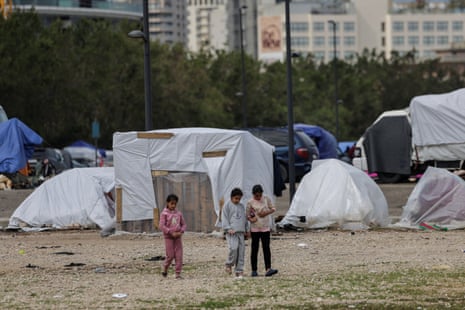
Over one million people have been displaced in Lebanon since Israel renewed its war on the country on 2 March, causing a multitude of humanitarian issues given the speed and the scale of the displacement. The Lebanese health ministry said at least 1,039 people, including 79 women and 118 children, have been killed in Israeli attacks since the latest war began.
The Rescue Committee said:
Thousands remain without adequate shelter – sleeping in the open, on the streets, in tents, or in their cars – while others are packed into overcrowded, under-equipped collective shelters with limited access to clean water, sanitation, and privacy. Local services are struggling to keep pace with rising demand.
Key events Show key events only Please turn on JavaScript to use this feature
JD Vance could lead Iran peace talks for US side in Pakistan if negotiations go ahead - sources
Pakistan’s military leadership has been attempting to broker negotiations between the US and Iran, after the White House confirmed that Pakistan’s army chief, Asim Munir, had a call with Donald Trump on Sunday to discuss the conflict.
Diplomatic sources said the US and Iran could meet for negotiations in Islamabad as early as this week to discuss an end to the war, which began almost a month ago.
It was emphasised that Islamabad had yet to be officially confirmed as the venue for any peace talks, which neither side has formally agreed to so far. Trump’s Middle East envoy, Steve Witkoff, is believed to be preparing to travel to Islamabad but there was no confirmation that anyone from the Iranian side would be in attendance.
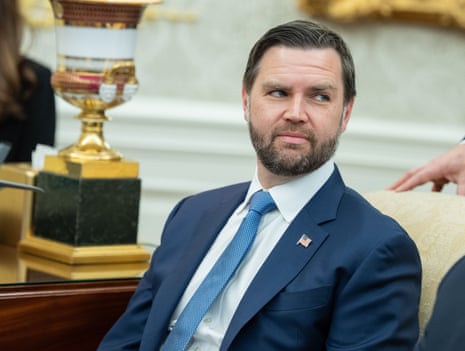
Pakistani sources said that the US vice-president, JD Vance, was being put forward as a probable chief negotiator from the US side if talks went ahead, rather than Witkoff or Trump’s son-in-law, Jared Kushner, who led the nuclear negotiations with Iran before the war. You can read more from my colleagues Hannah Ellis-Petersen and Shah Meer Baloch here:
Qatar says war caused breakdown in Gulf security system
Qatar’s foreign ministry spokesperson Majid al-Ansari has been speaking to the media about the US-Israeli war on Iran. Here are some of the key takeaways from what he said:
The regional security system in the Gulf has been broken during the war, Al Jazeera quoted al-Ansari as saying.
The “brotherly relationship” between residents of Qatar and Iran should take precedence “over any other political consideration”, he said.
There is no direct Qatari mediation between the US and Iran.
The US took the decision to go to war based on their assessment.
Qatar is working closely with the Trump administration to de-escalate the war and stop Iranian attacks on Qatar.
There have been no incoming missiles or drones from Iran aimed at Qatar since last Thursday. But “we are still in the eye of the storm,” the BBC quoted al-Ansari as saying.
“Our posture is defensive. We have had more than 200 drone attacks. We reserve the right to respond. No decision has yet been taken on whether to retaliate. Over 90% of attacks have been intercepted.”
Qatar offering to close the US al-Udeid air base – the largest US military base in the Middle East – has not been discussed at all.
US-Israeli war on Iran was a 'breach of international law', German president says
In unusually frank comments, German President Frank-Walter Steinmeier said the US-Israeli war on Iran was a “breach of international law”.
“The rift is too deep and the trust in American power politics has been lost, not only among our allies but... worldwide,” he said at an event to mark the 75th anniversary of the German foreign ministry.
Steinmeier, a former foreign minister who now holds a largely ceremonial role, added: “Our foreign policy does not become any more convincing simply because we do not call a breach of international law a breach of international law.”
“There is little doubt that, in any case, the justification of an imminent attack on the US does not hold water,” he said.
At the start of the war, the US administration formally invoked article 51 of the UN charter – the self-defence provision – arguing that Iran’s missile arsenal and nuclear ambitions posed a direct threat to American forces in the region.
Legal experts, however, widely agree that the war on Iran is illegal as there didn’t seem to be any evidence of an imminent threat by Iran when it was launched on 28 February.
Several experts cited Donald Trump’s claim to have obliterated Iran’s nuclear programme last year as evidence that directly countered the suggestion of an imminent threat.
German chancellor Friedrich Merz stuck close to Washington in the early days of the war, but has since shifted his stance, pointing to its destabilising impact on energy costs and “potential to trigger large-scale migration”.
But as the head of the governments, perhaps trying to toe a more diplomatic line, Merz’s comments have been a lot more reserved than Steinmeier’s were today. Merz has repeatedly said Germany shares “the objective that Iran should no longer pose a threat in future”, while also making clear his country would not enter the war.
Israel says it will take 'control' of so-called 'security zone' up to Lebanon's Litani river
Israel’s defence minister, Israel Katz, has been quoted by the AFP news agency as saying that the military will take control of south Lebanon all the way to the Litani river, which is about 30km (19 miles) from the Lebanon-Israel border.
“All five bridges over the Litani that were used by Hezbollah for the passage of terrorists and weapons have been blown up, and the IDF (Israeli military) will control the rest of the bridges and the security zone up to the Litani,” Katz said during a visit to a military command centre in Israel. The IDF often refers to “terrorists” even though they regularly kill civilians and destroy civilian infrastructure in their attacks.
Katz said hundreds of thousands of south Lebanon residents who were displaced by the war this month “will not return south of the Litani River until security is guaranteed for the residents of the north” of Israel.
Israeli forces attacked the Qasmiyeh Bridge, a key crossing linking Lebanon’s south to the rest of the country, over the weekend, in what Lebanese President Joseph Aoun described as a “prelude to ground invasion”.
Many Lebanese people fear Israel is attempting to separate southern Lebanon from the rest of the country ahead of a large-scale invasion. This would mean many people displaced from their homes, following evacuation orders across large areas of southern Lebanon, would have nowhere to return to. Israel’s displacement of civilians in Lebanon is a possible war crime, according to Human Rights Watch.
Over one million people have been displaced in Lebanon since Israel renewed its war on the country on 2 March, causing a multitude of humanitarian issues given the speed and the scale of the displacement. The Lebanese health ministry said at least 1,039 people, including 79 women and 118 children, have been killed in Israeli attacks since the latest war began.
The Rescue Committee said:
Thousands remain without adequate shelter – sleeping in the open, on the streets, in tents, or in their cars – while others are packed into overcrowded, under-equipped collective shelters with limited access to clean water, sanitation, and privacy. Local services are struggling to keep pace with rising demand.
Germany’s foreign minister, Johann Wadephul, told broadcaster MDR that he believed Donald Trump’s announcement about talks with Iran could mark a turning point in the US-Israeli war on Iran.
“Something is happening, and that’s a good thing in this time when there have been more risks of escalation than possibilities of bringing this conflict under control,” he said.
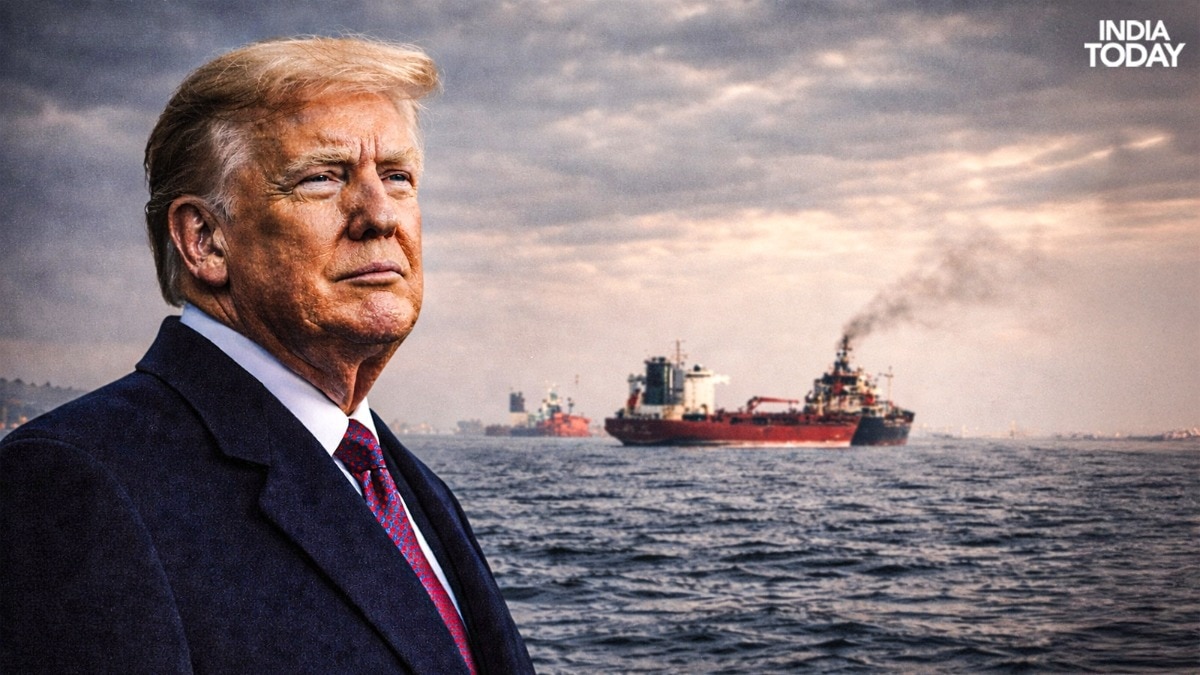
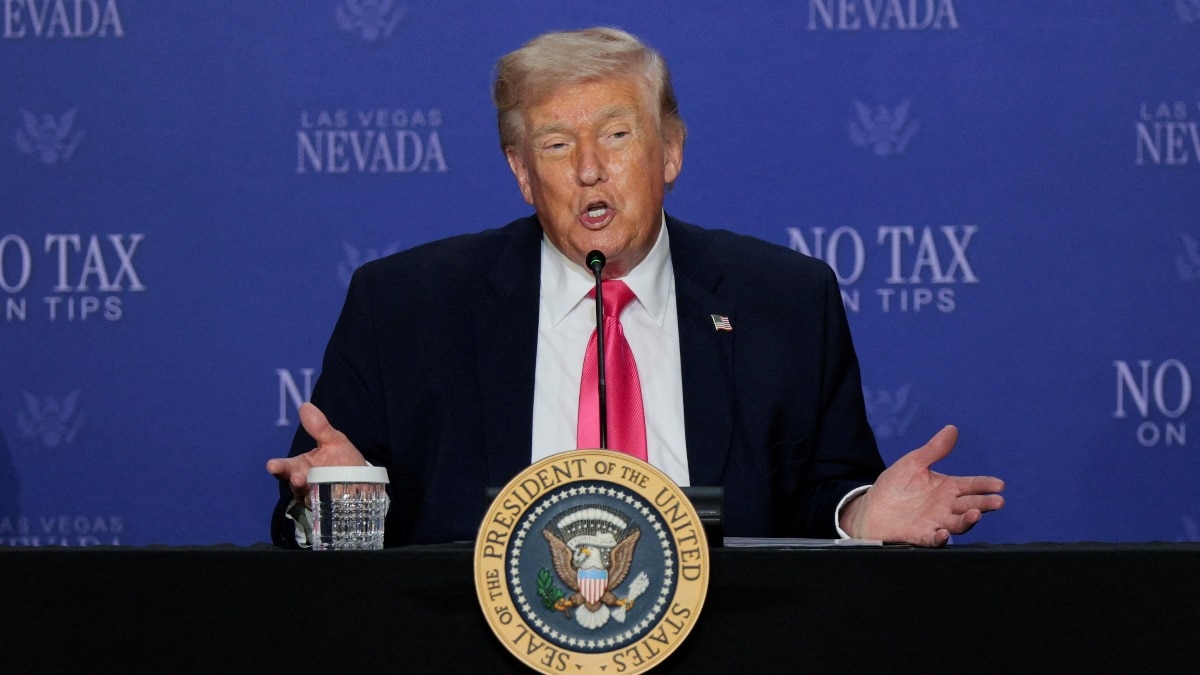
As a reminder, Trump yesterday said the threatened US strikes on Iranian power plants had been postponed after “very good and productive” discussions with Iran about a “complete and total resolution of our hostilities” in the Middle East. Iran, however, denied that any such talks took place, although countries, including Pakistan, Turkey and Egypt, are reportedly trying to reduce tension between Washington and Tehran.

Wadephul said he believed Trump did hold serious talks with Iran because “otherwise he wouldn’t have said it that way” and he would not have postponed his threatened attack on Iranian power plants.
“It’s a fragile beginning, but it’s a start nonetheless,” Wadephul said. “We should all strive to ensure that this progress flourishes and that there’s a way to control this conflict.”
Four people have been killed and four others injured by an Israeli airstrike on a house in the Lebanese town of Selaa, according to the country’s News Agency (NNA).
The injured people were transferred to hospitals in Tyre, a city in southern Lebanon where Israel has intensified its attacks.
The Lebanese border town of Naqoura and the outskirts of the border village Alma al-Shaab were hit by artillery shelling by Israeli forces at dawn, the NNA reported.
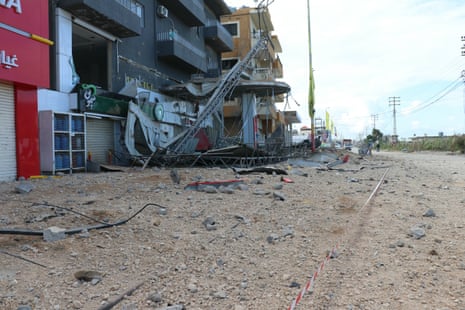
The renewed Israeli assault on Lebanon was launched on 2 March after Hezbollah – the Iranian-backed Lebanese militant group – fired rockets into northern Israel in response to the killing of the former Iranian supreme leader, Ali Khamenei, in joint US-Israeli airstrikes.
The IDF has ordered civilians in southern Lebanon to “move immediately to areas north of the Litani River”, in a sweeping order affecting hundreds of thousands of people.
Israel has sent ground troops into southern Lebanon in what many fear could lead to an occupation in the south of the country.
Israel says the aim of its war is to protect communities in northern Israel from Hezbollah attacks. However, many Lebanese civilians have been killed in Israeli airstrikes, which have gripped communities with fear as they have to flee their homes often with nowhere safe to go.
The Lebanese health ministry said in its latest update that at least 1,039 people, including 79 women and 118 children, have been killed in Israeli attacks on Lebanon since 2 March.
You can read how fuel shortages are already affecting people worldwide here:
Countries around the world are assuring their populations that there are sufficient energy supplies to meet domestic demand, despite fears of fuel shortages resulting from the US-Israeli war on Iran, which has driven up the cost of petrol and gas, among other things.
Over in the UK, Michael Shanks, an energy minister, has been speaking to journalists, taking questions ahead of Chancellor Rachel Reeves’s statement on how the government will respond to the soaring global energy prices caused by the war. Shanks stressed there is no need for drivers to worry about a fuel shortage, telling Times Radio:
[Drivers] should do everything as absolutely normal because there is no shortage of fuel anywhere in the country at the moment. We monitor this every single day, I look at the numbers personally. There’s no issue at all with that.
You can read more in our UK politics live blog here:
Lorenzo Tondo
A missile slammed into a street in central Tel Aviv on Tuesday, as Iran sustained its barrage against Israel and, increasingly, Gulf Arab states, even as the US president, Donald Trump, said Washington was engaged in talks with Tehran aimed at ending the war.
Trump’s announcement on Monday that he had extended by five days his deadline to strike Iran’s power plants, describing negotiations with the Islamic Republic as “productive”, had raised hopes among civilians of a possible lull in the fighting.
Although the US president had specified that only energy infrastructure would be spared from joint Israeli-American strikes, many interpreted the shift in tone as a sign of imminent de-escalation - even as Iran denied any such understanding. It did not materialise.
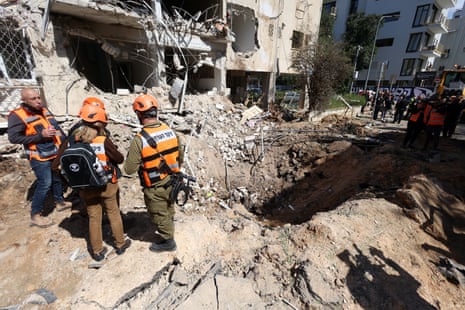
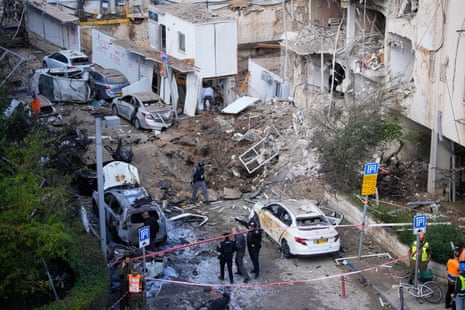
Police said a munition carrying a substantial explosive payload struck central Tel Aviv, causing widespread damage to buildings and vehicles. According to Haaretz, at least six people were lightly injured.
Several buildings were damaged across the city with emergency services reporting casualties at one of the impact sites. One building and the adjacent road were heavily affected, with cars set ablaze.
Fragments from intercepted missiles also fell in Rosh Haayin, causing minor damage but no reported injuries.
The strikes were the latest in a cycle of retaliation following Israeli operations announced on Monday. About 40 minutes after Trump said he would delay action against Iran’s power infrastructure, Israel said on X that it had begun another wave of strikes across Tehran.
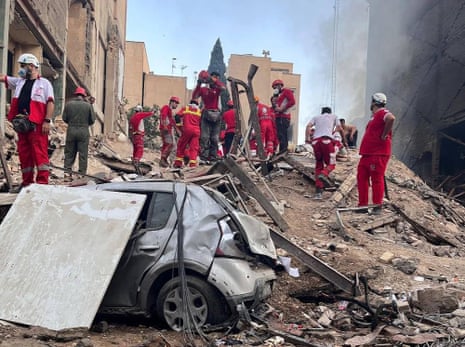
The Israel Defense Forces told the Guardian that energy facilities would be spared, suggesting that Israel may be aligning with Washington in suspending attacks on Iranian power plants and related sites. Yet witnesses in Tehran described Monday’s Israeli strikes as “unprecedented” in scale.
In recent weeks, Israel’s military claims to have eliminated more than 70% of Iran’s ballistic missile launchers, and says it has come close to establishing near-total control of Iranian airspace. Even so, Tehran has continued to penetrate Israel’s defences. The escalation has also spilled beyond Israel. On Monday, Iranian strikes extended into Gulf states.
Speaking at a briefing in Canberra on Tuesday, Australia’s prime minister, Anthony Albanese, condemned Iran’s continued effective closure of the strait of Hormuz, a vital pathway for the world’s oil flows.
“This is having an impact on the global economy,” Albanese said, alongside the European Commission president, Ursula von der Leyen, who was in Canberra to conclude talks on a free trade deal.
But Albanese did not directly answer a question about whether Australia could get drawn into securing the strait of Hormuz. Instead, according to the NY Times, he said Australia has provided support for the UAE, at its request, including moving an aircraft to the region along with advanced medium range air-to-air missiles – so-called AMRAAMs.
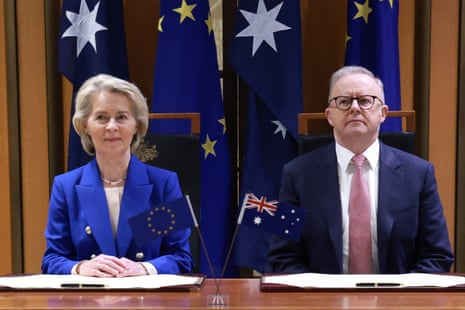
The UAE and the Albanese government signed a “strategic partnership” last year. It is Australia’s biggest weapons export market.
The US president, Donald Trump, said recently that he was “very surprised” Australia had not sent warships to aid in opening the strait of Hormuz.
Despite the surge in energy prices hitting their domestic economies, many US allies have rejected Trump’s request to help secure the strait because navigating the waterway under threat of attack from Iran is viewed as far too dangerous and could lead to them being directly dragged into the US-Israeli war.
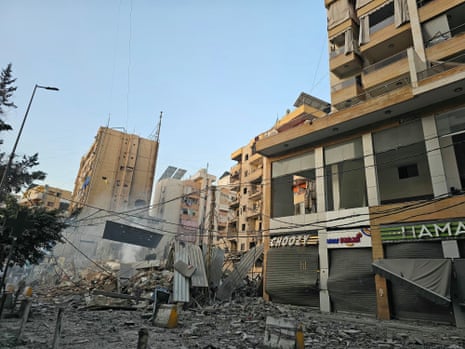
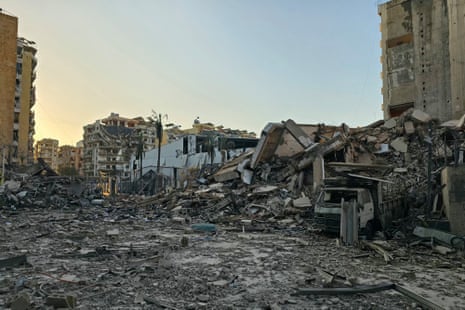
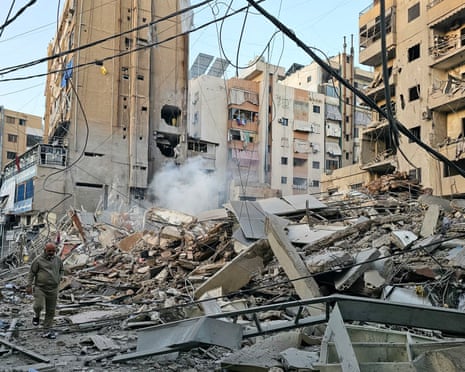
Here are some of the latest images being sent to us over the newswires from Tel Aviv and Beirut:
Airstrike in Iraq kills at least 15 fighters; US blamed for attack - report
Airstrikes targeting a site belonging to Iraq’s Shi’ite Popular Mobilization Forces in the country’s Anbar province killed at least 15 fighters, including the PMF’s Anbar operations commander, and injured 30 others, sources told the Reuters news agency.
The PMF confirmed the death of its Anbar commander, Saad al-Baiji, and 14 others. It accused the US of being behind the attack, saying an American airstrike targeted a command headquarters while personnel were on duty.
The PMF is an umbrella group of mostly Shi’ite paramilitary factions that was formally integrated into Iraq’s state security forces and includes several groups aligned with Iran. Iran-backed armed groups have launched attacks on US bases in Iraq since the outbreak of the US-Israeli war on Iran in late February. We have not been able to independently verify Reuter’s report yet.
Bahrain’s ministry of interior said this morning that the country’s Civil Defence extinguished a fire at a site of a company after an Iranian attack. There were no immediate reports of any injuries or casualties.
Bahrain’s defence force said yesterday that it had intercepted and destroyed 282 drones and 147 missiles since the war was triggered by the killing of the former Iranian supreme leader, Ali Khamenei, in joint US-Israeli airstrikes on 28 February, which then led to Iran responding with attacks across the Gulf region.
Interim summary
If you’re just joining us, here’s a snapshot of the latest key developments in week four of the US-Israel war on Iran.
At least six people have been injured in an Iranian missile attack in Tel Aviv on Tuesday, Israeli media is reporting.
Iran earlier launched a fresh wave of missiles against Israel just hours after Donald Trump hailed “very good” talks to end the war and gave a five-day extension to his deadline on Iran to reopen the strait of Hormuz shipping lane or see the US “obliterate” its power plants. Tehran denied any talks took place, with the parliamentary speaker calling it “fake news … used to manipulate the financial and oil markets”.
An Israeli strike south of Beirut killed two people on Tuesday, Lebanon’s health ministry said, while strikes on the capital’s southern suburbs continued throughout the night.
The US will continue striking Iran and the five-day pause applies only to attacks on the country’s energy sites during the US-Iran talks, Semafor reported, citing a US official.
European Commission president Ursula von der Leyen said it was time for negotiations with Iran to end the war, given the global energy situation was now “critical”.
A Pakistani official and a second source told Reuters that direct talks on ending the war could be held in Islamabad this week. The official said US vice-president JD Vance as well as Trump envoys Steve Witkoff and Jared Kushner were expected to meet Iranian officials in Islamabad this week, after a call between Trump and Pakistan’s army chief, Asim Munir.
Benjamin Netanyahu said he had spoken with Trump and that Israel would continue its strikes against Iran and Lebanon. Trump saw a chance of a deal with Iran to “preserve our vital interests”, the Israeli PM said.
Israel said it had launched “wide-scale” strikes on Iran on Monday, while Tehran continued to fire missiles at the UAE and Saudi Arabia. The Israeli military also claimed to have hit struck the main security headquarters of Iran’s Islamic Revolutionary Guard Corps as part of a wave of strikes in Tehran.
British destroyer HMS Dragon arrived in the eastern Mediterranean, three weeks after an Iranian-made drone hit the British base of RAF Akrotiri in Cyprus, the UK’s defence secretary said. The British government has faced criticism for the slowness to deploy a warship to the region, after moves by Greece and France to send extra naval support to Cyprus after the attack.
Slovenia became the first EU member state to introduce fuel rationing in a bid to tackle disruptions caused by the Middle East war.
We’re seeing images from the scene after an Iranian missile strike in Tel Aviv a short while ago.
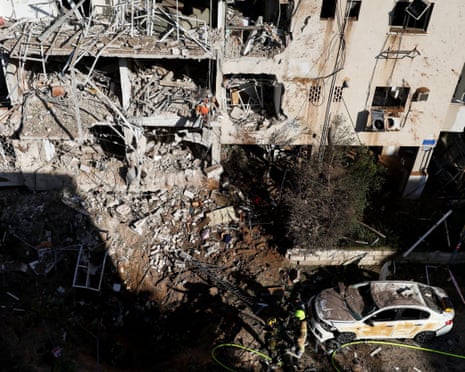
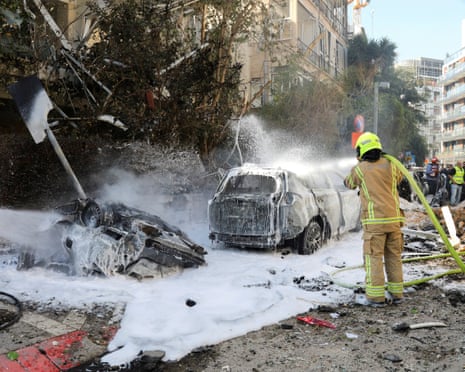
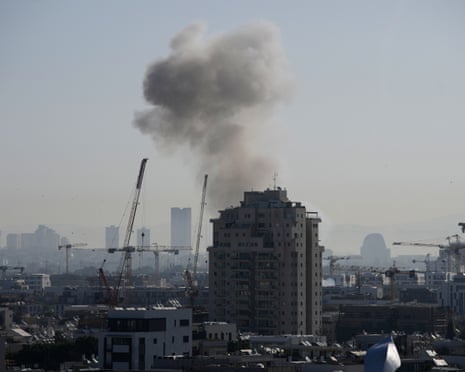
Police say a munition carrying some 100kg of explosives impacted in central Tel Aviv, leading to the widespread damage to buildings and vehicles, according to Israel’s Channel 12, cited by the Times of Israel.
At least six injured in Tel Aviv attack - reports
Haaretz has updated to six the number of people lightly hurt in the missile attack in Tel Aviv.
The Times of Israel and Ynet are also saying six people were hurt, while the Jerusalem Post is saying at least six.
Four in Tel Aviv wounded in Iranian missile attack - report
Four people have been wounded in an Iranian missile attack in Tel Aviv, Israel’s Haaretz is reporting.
The newspaper said several buildings in city were damaged, and that emergency services said the four people were lightly injured at one of the impact sites on Tuesday.
One building and its adjacent road were heavily damaged in central Tel Aviv, where cars caught fire, the report said.
Intercepted missile fragments also fell in Rosh HaAyin, causing minor damage. No casualties were reported there.
Haaretz also said rescue services were heading to the scene.
Earlier on Tuesday Iran fired three waves of missiles at Israel, with reports of an impact in the country’s north, the Israeli Home Front Command said.
Israeli strike outside Beirut kills two, says Lebanese ministry
An Israeli strike south of Beirut killed two people on Tuesday, Lebanon’s health ministry said, while strikes on the capital’s southern suburbs continued throughout the night.
“The Israeli enemy raid on the town of Bshamoun in the Aley district resulted, in a preliminary toll, in the martyrdom of two citizens and the injury of five others,” the ministry said in a statement cited by Agence France-Presse.
Bshamoun is in the mountainous, Druze-majority Aley district south-east of Beirut and is outside of Hezbollah’s traditional strongholds, the news agency says.