1 month ago
Donald Trump is pushing for a new political order in West Asia by asking Arab countries to join the Abraham Accords after the Iran war ends.
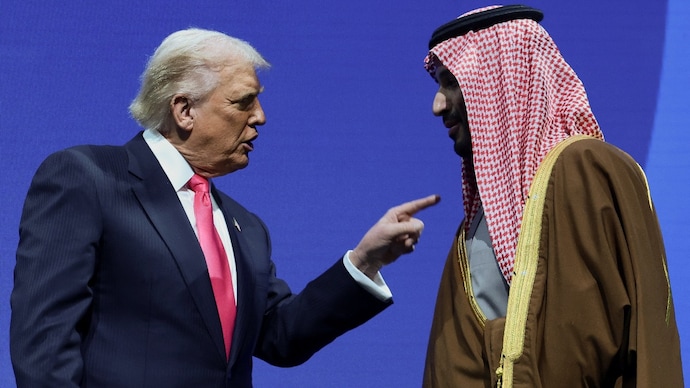
US President Donald Trump and Crown Prince and Prime Minister Mohammed bin Salman of Saudi Arabia in Washington, DC. (File Photo: Reuters)
As negotiations over a possible end to the Iran conflict gather pace, US President Donald Trump appears to be setting his sights on something much bigger than just a ceasefire. Behind closed doors, Trump is now trying to reshape the order of West Asia itself.
According to Axios, the US President told leaders from several Arab and Muslim-majority countries during a high-level conference call on Saturday that once the war with Iran ends, he wants more nations to recognise Israel and join the Abraham Accords.
The message reportedly caught several leaders off guard.
The phone call included leaders from Saudi Arabia, United Arab Emirates, Qatar, Pakistan, Turkey, Egypt, Jordan and Bahrain, as talks continued around a possible US-Iran peace agreement that could help calm months of instability across the region.
Trump told the leaders that after the Iran war ends, he expects countries that still do not recognise Israel to move towards normalisation. According to US officials quoted in the report, there was a moment of silence on the line after Trump raised the issue.
"One of the US officials said Trump joked and asked if they are still there," the report stated.
TRUMP EYES A NEW WEST ASIA ORDER
However, Trump's biggest obstacle is Saudi Arabia, which does not formally recognize Israel.
Saudi Crown Prince Mohammed bin Salman has previously shown openness towards ties with Israel, but the ongoing war in Gaza, tensions with Iran and growing anger across the Arab world have made it difficult.
Saudi Arabia remains adamant that any future ties with Israel must come with a clear and irreversible path towards the creation of a Palestinian state -- something Israel refuses to accept.
TRUMP'S BOLD NEW IDEA
Trump also floated one of his most controversial ideas again: could Iran join the Abraham Accords?
"I would like to thank, thus far, all of the countries of the Middle East for their support and cooperation, which will be further enhanced and strengthened by their joining the Nations of the historic Abraham Accords and, who knows, perhaps the Islamic Republic of Iran would like to join, as well!" Trump wrote on Truth Social.
This might be highly unrealistic under Iran's current regime. Tehran has refused for decades to recognise Israel and still calls it an occupying power.
Iranian Foreign Minister Abbas Araghchi rejected similar remarks last year.
"Iran will never recognise an occupied regime that has committed genocide and killed children," Araghchi said during an interview with Iranian state television in 2025.
Long before the Abraham Accords were signed, Iran had fiercely opposed Arab countries building ties with Israel.
WHAT THE ABRAHAM ACCORDS CHANGED
Brokered by the US in 2020, the Abraham Accords marked a historic paradigm shift in the Middle East by establishing formal ties between Israel and several Arab nations, including the United Arab Emirates, Bahrain and Morocco. For decades, most Arab countries had refused to recognise Israel until the Palestinian issue was resolved.
The agreements broke from that approach and instead focused on shared strategic interests, especially concerns over Iran, along with cooperation in trade, technology, defence and investment. The accords marked one of the biggest diplomatic shifts the region had seen in years and helped create a new US-backed regional alignment in West Asia.
MIXED SIGNALS OVER IRAN DEAL
Now, Trump may be talking about a Middle East reset, but the Iran agreement itself is still far from reach. On Sunday, he claimed that relations with Tehran were becoming "more professional and productive", but also warned that negotiations should not be rushed.
"The negotiations are proceeding in an orderly and constructive manner, and I have informed my representatives not to rush into a deal in that time is on our side," Trump wrote.
"The Blockade will remain in full force and effect until an agreement is reached, certified, and signed."
He again repeated what had been one of the major demands of his.
"They must understand, however, that they cannot develop or procure a Nuclear Weapon or Bomb," Trump wrote.
The proposed framework reportedly includes a possible 60-day ceasefire, reopening the Strait of Hormuz and future negotiations around Iran’s nuclear programme.
But major disagreements remain unresolved, particularly around sanctions relief, Iran's uranium stockpile and the release of frozen Iranian assets.
Despite Trump's push for a diplomatic breakthrough, the Middle East is politically fractured. Countries like the UAE and Bahrain already maintain formal ties with Israel under the Abraham Accords. Others, especially Saudi Arabia, Qatar and Pakistan, still face strong domestic and regional pressure over the Palestinian issue.
The timing also complicates matters for Israel itself.
Israel is heading towards elections later this year, with Prime Minister Benjamin Netanyahu under boiling pressure after months of war. His approval ratings have weakened amid criticism over the conflicts in Gaza, Lebanon and Iran.
The war with Iran may eventually end, but the battle over what the future of West Asia should look like appears to be only beginning.
- Ends
With inputs from agenies
Published By:
Satyam Singh
Published On:
May 25, 2026 03:26 IST