1 month ago
Last Updated:March 09, 2026, 16:08 IST
The war is not only about regime change in Iran, ending its nuclear ambition and ballistic missile programme, and permanently debilitating Israel’s arch-enemy


RTX makes the AMRAAM, AIM-9X, Patriot, SM-6 missile, Sidewinder, precision-guided bombs and nuclear-armed Long-Range Standoff missile.
The war is not meant to be won. It is meant to be continuous.
– George Orwell, 1984
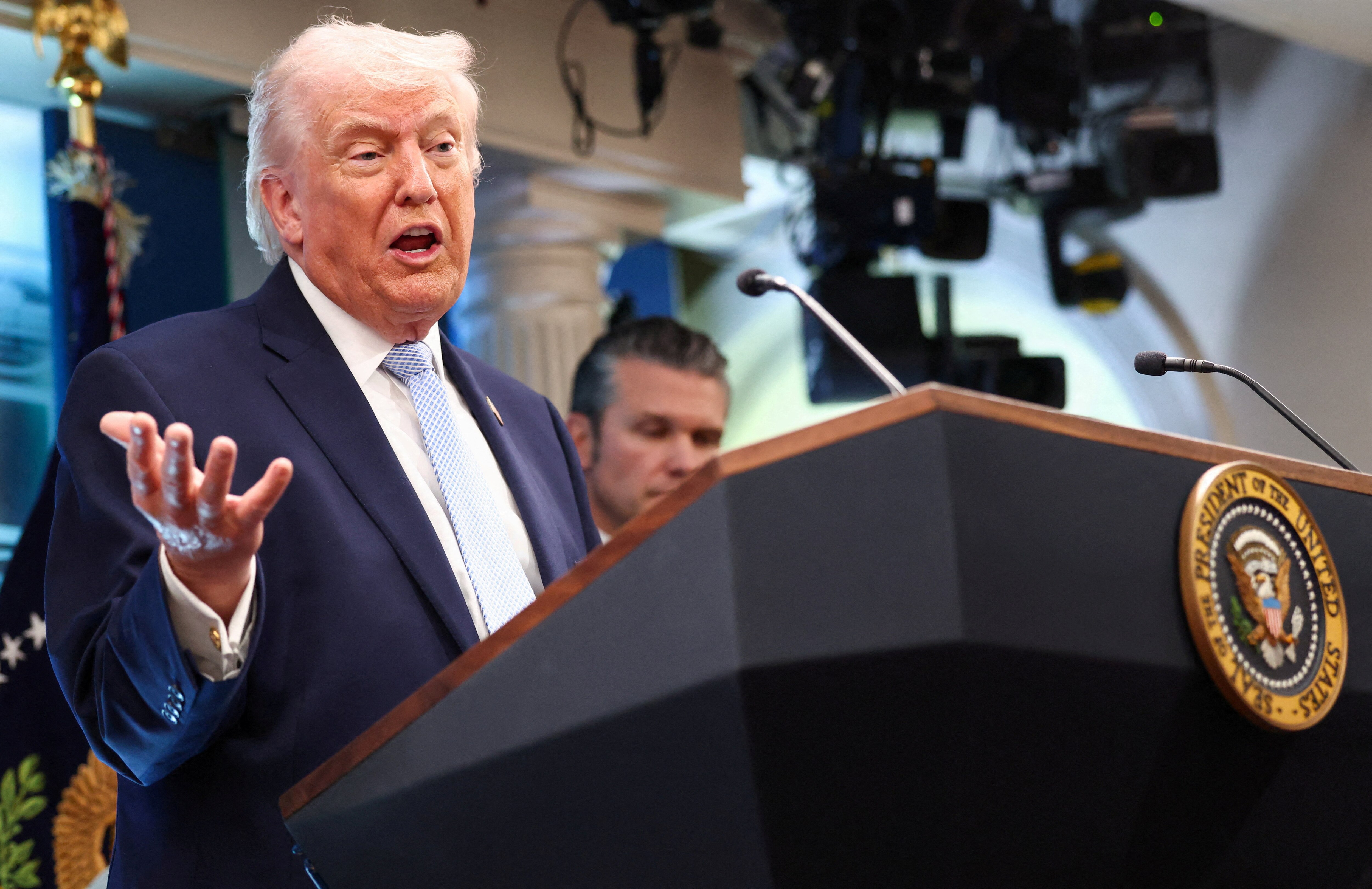
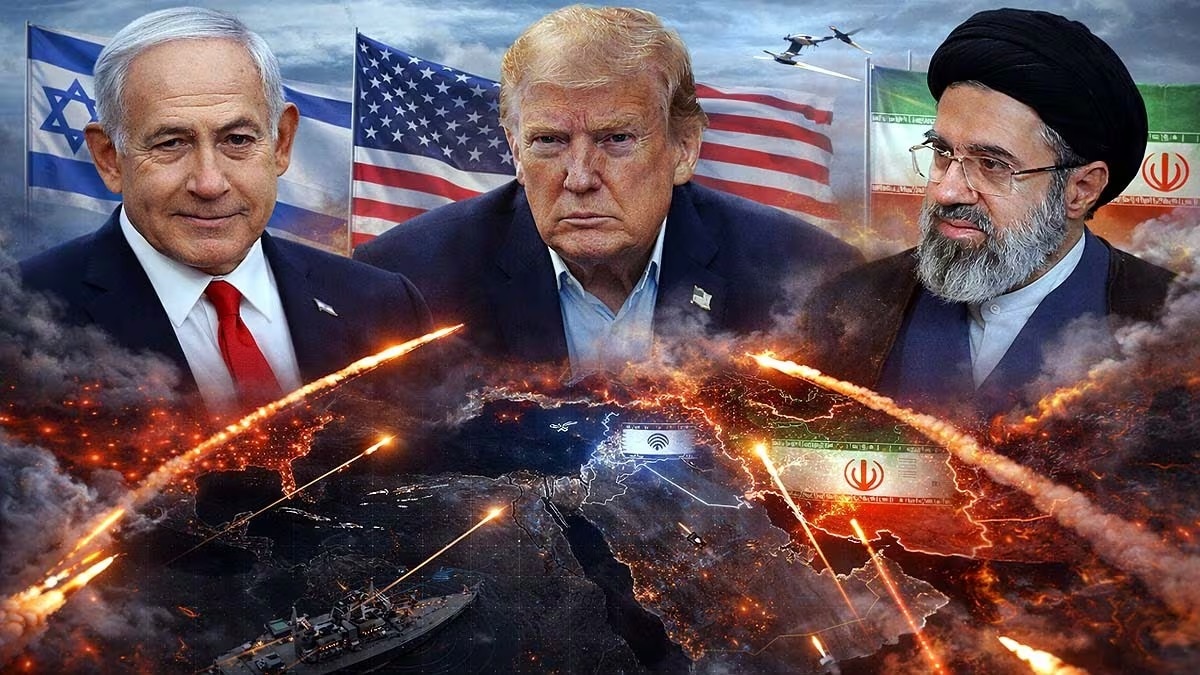
The massive American armada, the largest since the Iraq War, and warplanes in West Asian bases, in coordination with the Israeli military, launched a pre-emptive attack on Iran on February 28.
Iran’s Supreme Leader, Ayatollah Ali Khamenei, and several top officials were killed. A new Supreme Leader has just been named.
The second attack was inevitable considering how Donald Trump bought time while keeping Iran engaged in nuclear talks last June, yet attacking its three nuclear facilities. This time, too, the US president adopted the same tactic, using his envoy, Steve Witkoff.
The strikes could drag on, engulfing the region, with Trump saying that the operation could last for four weeks.
As expected, Iran retaliated with a volley of ballistic missiles and kamikaze drones against Israel and eight other nations hosting US bases.
Both Trump and Benjamin Netanyahu have stated that regime change in Iran is the goal. However, is this war only about regime change, ending Iran’s nuclear ambition and ballistic missile programme and permanently debilitating Israel’s arch-enemy?
Like the several prolonged wars the US started in the last few decades, the latest one might end up making Iran unstable if the regime falls.
The four most prominent examples of the American war machine dragging to failure are: Vietnam, Afghanistan, Iraq and Ukraine.
Iran could be next.
What pays the most and who profits from these American wars?
There are three aspects of the ever-enduring US war machine.
Civilian Casualties of US Wars
In a second, Zemari Ahmadi (43), his three children (aged 20, 16 and 10), cousin Naser (30), three of his brother Romal’s children (7, 6, and 2) and two other girls (both 3) turned into cauterised lumps of flesh strewn in the courtyard of his house in the Khaje Bughra neighbourhood of Kabul on August 29, 2021.
A technical engineer employed with the California-based NGO Nutrition and Education , Ahmadi had barely parked a water canisters-laden 1996 Toyota Corolla when an AGM-114 Hellfire missile launched from an MQ-9 Reaper drone turned the house into a graveyard.
The US was in the process of completely pulling out of Afghanistan after a 20-year catastrophic occupation as the Taliban swept back to power with lightning speed.
Three days earlier, an IS-KP suicide bombing at the Hamid Karzai Airport had killed 182 people, including 13 US military personnel.
An enraged US conducted two drone strikes (August 27 and 29) to target the IS-KP.
The Joe Biden administration lied to the media that Ahmadi was an IS-KP operative planning another attack at the airport.
However, Ahmadi turned out to be an EKIA (Enemy killed in action)—when someone other than the mark is killed in the drone glossary—not a JACKPOT, an eliminated target.
Ahmadi was another civilian casualty of the Reaper, which achieved its first kill against insurgents in Oruzgan province, Afghanistan, in October 2007 during the War on Terror.
It was poor intel, which, in all probability, mistook his cannisters laden with explosives.
According to The Bureau of Investigative Journalism (TBIJ), a London-based nonprofit news organisation, between January 2004 and February 2020, 4,126-10,076 Afghans, including 300-909 civilians, were killed in 13,072 military operations (by drones, jets, missiles and ground operations).
Of the 155 people killed in northeastern Afghanistan by US drones in May-September 2015, 90 per cent were EKIA, or wrong targets, according to The Drone Papers, a leak of classified Pentagon papers published by the award-winning news organisation The Intercept in October 2015.
“This means that almost 9 out of 10 people killed in these strikes were not the intended targets," The Intercept reported.
Between 2010 and 2020, US strikes killed 8,858-16,901 people, including 910-2,200 civilians (283-454 children) in 14,040 strikes in Pakistan, Afghanistan, Yemen and Somalia.
In Iraq, data compiled by the Iraq Body Count project and analysis by the Costs of War project put the number of civilians killed during 2003-13 at 134,000.
The latest US-Israeli attack has already started killing Iranian civilians.
According to the Human Rights Activists News Agency, more than 1,000 civilians have been killed, including 181 girls (165) and staff of Shajaba Tayyiba School, a primary school for girls 200 feet away from a military base in Minab county.
US Military-Industrial Complex Always Wins
Ahmadi’s case or the Iran War aren’t only about the killing of civilians by the US military.
The killings highlight two other aspects: the US military-industrial complex (MIC) and the testing/use of weapons on inferior or small nations.
The phrase, encompassing mega defence contractors, powerful Congressmen and the military, was introduced by President Dwight D Eisenhower in his farewell address to Congress and Americans on January 17, 1961.
“We must guard against the acquisition of unwarranted influence, whether sought or unsought, by the military-industrial complex. The potential for the disastrous rise of misplaced power exists and will persist," he said.
Neither MIC’s “unwarranted influence" nor its “misplaced power" waned.
The defence budget has jumped by billions and top defence contractors have an increasingly bigger share of the pie.
Annual US military spending galloped by 66 per cent from $507 billion in 2000 to $843 billion in 2025. Congress legislation last July added another $156 billion, increasing the 2025 military budget to $1.06 trillion—a massive 99 per cent jump since 2000.
From 2020 to 2024, private weapons manufacturers received 54 per cent of Pentagon contracts worth $2.4 trillion of the discretionary spending of $4.4 trillion.
Of the total amount, one-third, $771 billion, went in contracts to only the top five firms: Lockheed Martin ($313 billion), RTX (formerly Raytheon, $145 billion), Boeing ($115 billion), General Dynamics ($116 billion) and Northrop Grumman ($81 billion).
Each of the five manufacturers specialises in churning out specific killing machines.
Lockheed Martin manufactures the F-35, SLBM Trident, tactical missiles Hellfire and Javelin, cruise missile JASSM, Paveway bombs and missile defence systems.
RTX makes the AMRAAM, AIM-9X, Patriot, SM-6 missile, Sidewinder, precision-guided bombs and nuclear-armed Long-Range Standoff missile.
Northrop Grumman manufactures the new ICBM Sentinel, strategic bomber B-21, missile tracking systems and ammunition of all calibres.
Boeing rolls out the F-15, F-15X, F-18, A-6 and Joint Direct Attack Munitions.
General Dynamics makes ballistic missile submarines (Columbia class), destroyers, M-1A2 Abram, bombs and guided munitions.
The US has either lost these wars or they ended in a stalemate.
Only the MIC always wins regardless of the outcome of these wars.
“The US is the leading force of violence and instability. The military industrial complex plays the central role in shaping American foreign policy," says Abby Martin, an American investigative journalist and TV presenter.
“The MIC doesn’t care about winning wars. The US doesn’t care about winning the Afghanistan War," says Martin, who launched The Empire Files, an investigative documentary and interview series.
The US wants wars to continue—against communism, terrorism, China or Russia or for the so-called restoration of democracy.
From late 2001 to 2022, the US spent an estimated $8 trillion on post-9/11 wars. From 2001 to 2019, $2 trillion was spent on the Afghanistan War. From 2003 to 2023, $2.89 trillion was spent on the wars in Iraq and Syria.
The War on Terror was supposed to have ended after the Afghanistan withdrawal in 2021.
However, the US defence budget jumped in the coming years—$877 billion in 2022, $916 billion in 2023 and $997 billion in 2024.
Last month, Congress passed the Defence Appropriations Bill, totalling $839 billion, $8 billion above the Pentagon’s request, for FY26.
The value of stocks of major defence contractors jumps after major spending announcements and every attack by the US or anticipation of an attack.
In January, after Trump said the FY27 defence budget should be $1.5 trillion, the stock value of top defence contractors increased.
On January 8, Northrop Grumman rose 8.3 per cent, Lockheed Martin 6.4 per cent, RTX 3.7 per cent and General Dynamics 3 per cent.
In 2025, RTX jumped 61.8 per cent, L3Harris 52.6 per cent, General Dynamics 33.1 per cent, Northrop Grumman 27.6 per cent and Lockheed Martin 7.1 per cent.
After the US bombing of Iran’s three nuclear facilities, the stocks of the three top defence contractors rose. Lockheed Martin rose 0.4 per cent, Northrop Grumman 0.3 per cent and General Dynamics 1.3 per cent.
Around a week before the latest strikes against Iran, the top three defence contractors closed at a 52-week high (February 19) with record order backlogs and in anticipation of the attack as Trump continued to send lethal weapons to bolster the armada.
Lockheed Martin surged to $666.51, 34.1 per cent year to date, Northrop Grumman $736.87 (25.8 per cent) and RTX $205.41 (9.7 per cent).
RTX reported a record backlog of $268 billion, up 23 per cent YoY with $107 billion in defence awards.
Lockheed Martin ended 2025 with “unprecedented demand" and a record backlog of $194 billion, around 2.5 times annual sales.
Northrop Grumman has a $95 billion backlog, a new record driven by $46 billion in net awards.
Predictably, defence stocks jumped after the latest Iran strikes despite the S&P 500 falling 1.1 per cent, Nasdaq 100 futures 1.5 per cent and futures on the Dow Jones Industrial Average 1.2 per cent.
Lockheed Martin and RTX rose 6.5 per cent, Northrop Grumman 5 per cent and General Dynamics 2 per cent.
The war machine is perpetually moving—even if it doesn’t involve the US directly, like a proxy war (Ukraine) or support for an ally (Israel) involved in a conflict.
Since the February 2022 invasion of Ukraine, the US has provided around $66.9 billion in military assistance to the war-torn nation. US defence contractors supplied 45 per cent of the weapons provided to Ukraine in 2020-24 (9.3 per cent of America’s total arms exports during this period).
The four years were a boom time for American arms manufacturers.
The monthly production output for selected weapons and munitions used increasingly by Ukraine in 2022-24, according to the US Congressional Research Service, shot up.
The monthly production of 155mm projectile increased from 14,400 to 40,000 (178 per cent); 155mm propelling charge 14,494 to 18,000 (24 per cent); Guided Multiple Launch Rocket System (GMLRS) 8,333 to 1,167 (40 per cent); Javelin anti-tank missile 175 to 200 (14 per cent); PAC-3 Patriot missile 21 to 42 (100 per cent); and the High Mobility Artillery Rocket System 5 to 8 (60 per cent).
General Dynamics makes the 155mm projectile and the propelling charge and the rest are manufactured by Lockheed Martin with the Javelin jointly produced with RTX.
Consequently, the market cap of these arms manufacturers increased substantially from 2021 to 2024, according to S&P data.
The m-cap of General Dynamics increased from $57.87 billion to $73.18 (26.46 per cent); RTX, $128.81 billion to $155.35 billion (20.6 per cent); and Lockheed Martin from $96.31 billion to $115.9 billion (20.34 per cent). Other top producers also became richer. Boeing’s m-cap jumped from $118.56 billion to $135.21 billion (14.04 per cent) and Northrop Grumman from $60.49 billion to $68.67 billion (13.52 per cent).
America’s top defence contractors profit in two other ways.
First, increasing US arms exports.
According to SIPRI, America’s share of global arms exports jumped from 35 per cent in 2015–19 to 43 per cent in 2020–24 with supplies to 107 nations in 2020–24 (trebling by 233 per cent to Europe). Ukraine, the UK, the Netherlands and Norway were among the top 10 largest recipients of US arms exports in 2020–24.
In 2020–24, the US supplied 45 per cent of all exports of long-range land-attack missiles (250 km-plus range) by delivering them to seven states.
Among selected major arms on order or preselected for future orders from the 10 largest arms exporters for delivery after 2024, the US tops the list in combat jets (996) and helicopter gunships (342).
Second, American military aid is tied to the recipient spending that amount on US weapons.
A prime example is Israel.
From 1946 to 2024, the US provided $300 billion in total aid to Israel, of which $244 billion was military assistance. In 2024, US military aid to Israel galloped to its highest level in decades, $16.3 billion, because of the Gaza War.
The US also provisionally agreed via an MoU to provide $3.8 billion annually to Israel through 2028, including joint research, development and production of the Iron Dome, David’s Sling, Arrow, Arrow II, Arrow III and Iron Beam.
Most of the aid to Israel is granted under the Foreign Military Financing programme, which funds countries that purchase American military equipment and services through the Foreign Military Sales (FMS). In April 2025, Israel had 751 active FMS cases with the US worth around $39 billion.
Despite not being the third importer of US weapons from 1950 to 2024, American aid reportedly comprised roughly 20 per cent of Israel’s defence budget in the years before the Hamas attack—78 per cent of Israel’s arms imports have been from the US since 2000.
Therefore, even if Israel is not fighting a war, top American arms producers will continue to mint money.
According to a Wall Street Journal (WSJ) analysis of State Department disclosures last November, major defence contractors earned in billions after the Gaza War.
Boeing was No. 1 with the US approving the sale of F-15s worth $18.8 billion starting in 2029. In 2025, Boeing-led partnerships sold guided bombs and associated kits worth $7.9 billion. Lockheed Martin recorded a 13 per cent rise in revenue from missile sales to $12.7 billion.
Trump’s second term has been a boon for the defence companies.
Under the Prioritized Ukraine Requirements List, a mechanism developed by the US, other Nato members and Ukraine, European members would purchase US weapons, like Patriot missiles, GMLRS and 155mm artillery shells, worth $10 billion and transfer them to Ukraine.
In February, Trump established the radical America First Arms Transfer Strategy via an Executive Order to boost the defence industrial base by literally forcing importing nations to buy what the US wants to sell or produce, not what they want for themselves.
The secretaries of state, war and commerce will create a catalogue of weapons and platforms that the US would encourage its partners to purchase from American defence contractors.
Testing Ground for American weapons
These deadly weapons, radars and military transport aircraft are useless unless they are tested, their strengths and weaknesses proven and modifications and innovations made.
The US hasn’t fought a conventional war with a major military power since World War II.
The conflicts were either proxy wars during the Cold War, like the Vietnam War, Korean War or the Soviet Afghan War, the Panama invasion, Kosovo and Libya bombings, counter-insurgency operations against Afghanistan, Iraq, Somalia or Yemen, the bombing of the three nuclear facilities and the ongoing attack against Iran.
Therefore, what could be a better testing ground than a militarily small or inferior nation like Iraq, Afghanistan, Libya, Syria or Yemen?
Though the deployment of these new weapons isn’t characterised as “testing", it tests their effectiveness and lethality and also demonstrates America’s military superiority.
Even if the weapons have been tested before, they need to be deployed repeatedly to test how they fare against the enemy’s weapons or counter-tactics.
The US has been “testing" new weapons in combat zones for decades.
In the Korean War, the nuclear-capable F-86 Sabre fighter jet, the F-80 Shooting Star fighter and the F-84 Thunderjet fighter-bomber were used for the first time.
Similarly, the M20 3.5-inch “Super Bazooka", M27 105mm recoilless rifles and the M46 Patton Tank also debuted.
During the Vietnam War, in which around 2 million civilians were killed, the US again used an array of weapons for the first time.
The 5.56 mm calibre M16A1 rifle and its compact version, CAR-15, were used. So were the 7.62 mm M60 machine gun and the 40x46mm M79 grenade launcher.
The B-52 Stratofortress and F-14 Tomcat also debuted. The Bell UH-1 Iroquois (better known as Huey) was a lethal multirole utility and combat copter. The AC-47 Spooky gunship was also used.
The Vietnam War also saw the first use of precision-guided munitions. The BOLT-117 (750 lb) was the world’s first laser-guided bomb. The Pave (precision avionics vectoring equipment) series of bombs, GBU-10 (2,000 lb) and GBU-12 (500 lb), were also used.
In Operation El Dorado Canyon, the bombing of Libya, the F/A-18 Hornet was used for the first time.
In Operation Just Cause (Panama), the F-117 Nighthawk, the world’s first stealth attack jet, made its combat debut.
In the Gulf War, the F-16, F-15, M1A1 Abrams tank, Patriot missile defence system, Tomahawk cruise missile and MGM-140 Army Tactical Missile System (ATACMS) debuted.
The B-1B Lancer debuted in Operation Desert Fox (Iraq).
The B-2 Spirit was used for the first time during the bombing of the undivided Yugoslavia.
The MQ-1 Predator drone saw action for the first time in Afghanistan in 2001.
The F/A-18E/F Super Hornet saw combat for the first time during Operation Southern Watch (the period between the Gulf War and the Iraq invasion).
The M142 High Mobility Artillery Rocket System and the Long Range Acoustic Device, which causes splitting headaches, pain, panic and hearing loss by delivering a shrill 145-decibel tone, were used in the Iraq War.
The F-22 Raptor was used for the first time against the Islamic State in Syria.
The F-35B Lightning II, the Marine Corps variant, and the Switchblade kamikaze drone debuted against the Afghan Taliban.
The loitering drone Phoenix Ghost and the Ground-Launched Small Diameter Bomb were used in Ukraine for the first time. Ukraine could also get the USAF’s Rusty Dagger, one of the two new Extended Range Attack Munitions under development.
The US used the THAAD missile system against the Houthis in Israel in 2024.
Similarly, the 14 GBU-57 Massive Ordnance Penetrators (“bunker buster" bombs each weighing 30,000 pounds) were used for the first time to strike the Iranian nuclear facilities of Natanz and Fordow.
During the attack on Venezuela, the US used AI for the first time in combat. Claude, a large language model created by new AI star Anthropic, was probably used to process intelligence, analyse communications, plan and decide the operation and capture Nicolas Maduro.
The US also used a sonic weapon against Maduro’s bodyguards that was called “discombobulator" by Trump.
A security guard who survived the operation posted on X: “Suddenly, I felt like my head was exploding from the inside. We all started bleeding from the nose. Some were vomiting blood. We fell to the ground, unable to move."
Iran new lab for American Arsenal
Under Operation Epic Fury, the US has deployed the largest military assets against Iran since the Iraq invasion.
The US has deployed the USS Abraham Lincoln and USS Gerald R. Ford Carrier Strike Groups (CSGs), each having an aircraft carrier with several warplanes and attack helicopters, guided-missile destroyers and a submarine.
The Lincoln CSG has four destroyers, F/A-18E Super Hornets, EA-18G Growlers, E-2 Hawkeyes, MH-60S Sea Hawks, MH-60R Sea Hawks and F-35C Lightning IIs.
The Ford CSG has three destroyers, the same jets, except for the F-35, and copters.
Three additional destroyers and three littoral combat ships are also deployed.
Besides, F-15s, F-16s, F-22s, A-10 Warthogs, B-2s, B-1s and B-52 Stratofortresses have been deployed.
The Low-Cost Uncrewed Combat Attack System (LUCAS), a clone of the Iranian Shahed-136 kamikaze drone, was used for the first time.
The Precision Strike Missile (PrSM), the SRBM version, which will replace the ATACMS due to its longer range and expanded target area, also debuted.
With US AI assistance, Israeli jets dropped bunker busters to kill Khamenei, his 13 top officials and around 12 family members within 60 seconds—death by algorithm.
In the first extensive use of algorithm assassination of a state’s head, three AI tools were used.
Palantir’s Gotham data operations platform integrated massive amounts of data from satellites, sensors and human intelligence using a technology called Ontology to make them intelligible and understandable entities.
Claude, deployed on Gotham, processed and analysed the data. It was used for “intelligence assessments, target identification and simulating battle scenarios", according to WSJ.
Anduril’s Lattice took data from disparate and distributed sensors, feeds and systems, moved them into a single integration layer and filtered high-value information before generating targeting scenarios. In Iran’s case, Lattice helped autonomous drone swarms to coordinate and adapt to threats in real time during the strike.
After Maduro’s capture, Venezuela’s defence minister Vladimir Padrino Lopez rightly said that the US used his country as a “weapons laboratory" for “advanced military technologies".
(The writer is a freelance journalist with more than two decades of experience and comments primarily on foreign affairs. He tweets as @FightTheBigots. Views expressed in the above piece are personal and solely those of the writer. They do not necessarily reflect News18’s views.)
First Published:
March 09, 2026, 16:08 IST
News world Opinion | Iran War: US Playbook Of Military-Industrial Complex, Civilian Killings And Lethal Arms
Disclaimer: Comments reflect users’ views, not News18’s. Please keep discussions respectful and constructive. Abusive, defamatory, or illegal comments will be removed. News18 may disable any comment at its discretion. By posting, you agree to our Terms of Use and Privacy Policy.
Read More