1 month ago
Last Updated:December 29, 2025, 09:21 IST
For families of Fakir Colony & Waseem Layout, caught between bulldozers and politics, the larger ideological battle offers little immediate comfort as their homes remain flattened

The demolition drive, carried out in the early hours of December 20, flattened over 200 houses in Fakir Colony and Waseem Layout in Kogilu village near Yelahanka. (News18)
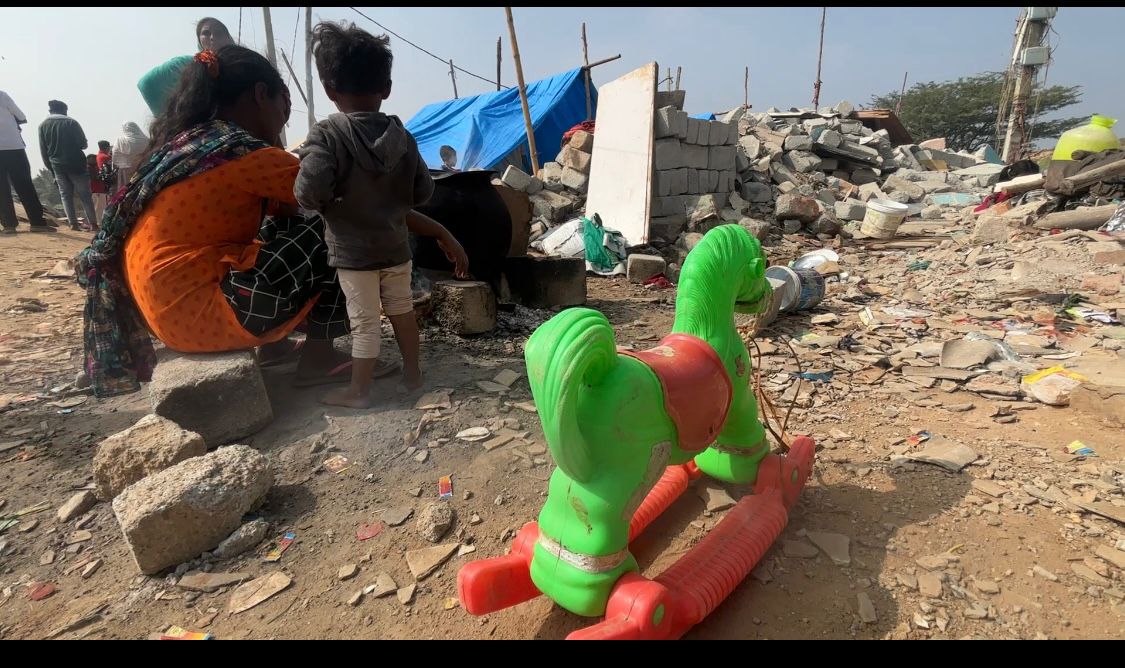
As you enter Fakir Colony and Waseem Layout in North Bengaluru, there is little to suggest that hundreds of families lived here until a few days ago. What once stood on cemented stone foundations are now piles of broken bricks, twisted tin sheets, shattered furniture and clothes buried under debris. The lanes are unrecognisable. The smell of dust still hangs in the air.
Children sit on the rubble that was once their home. Women sift through the remains, hoping to retrieve schoolbooks, utensils or documents. Men stand in small clusters, speaking in hushed voices, watching every movement of officials with suspicion.
The demolition drive, carried out in the early hours of December 20, flattened over 200 houses in Fakir Colony and Waseem Layout in Kogilu village near Yelahanka. The Bengaluru Solid Waste Management Limited (BSWML), under the Greater Bengaluru Authority (GBA), claimed the land was illegally encroached upon and earmarked for a solid waste processing unit.
Residents insist they were living here for decades and no written notice was served before the bulldozers arrived.
For the families sitting amid the rubble, the questions are simpler—where will they sleep tonight, and will the promises made in the heat of political combat, whether by politicians from Karnataka or Kerala, translate into a roof over their heads? The families, who await food to be served by social organisations, want to be moved to a safe home with a roof and not made to suffer.
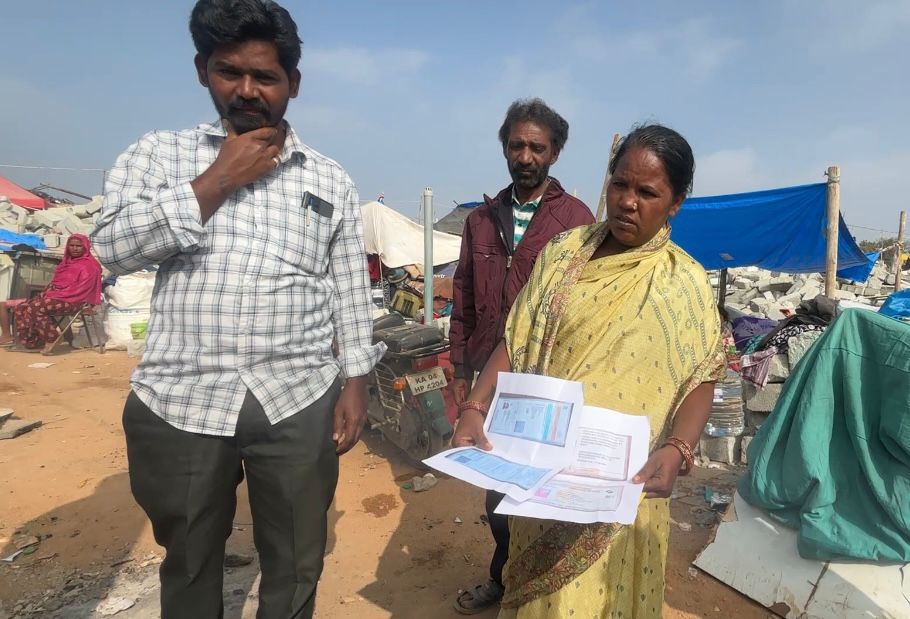
Salima and Fakrudeen, who make small dholaks and sell them at traffic signals and on MG Road, say they spent over 20 years saving every rupee to build a modest house.
“We are poor people. We saved every penny so we could live under a roof," Fakrudeen said. “At around 6.30 in the morning, they came, told us to remove our LPG cylinders and then brought in the JCBs. Our children did not even get time to pick up their books or clothes."
A few metres away, Hussain, a young auto driver, has taken the lead in organising the residents. He is collecting Aadhaar cards and documents to submit to state housing minister BZ Zameer Ahmed Khan.
“He has assured us that we will be given houses. We are hopeful the government will keep its promise," Hussain said, pointing to the rubble where his house once stood.
Sharief, a fabricator, says he has every document—voter ID, gas connection and electricity bills. “We have voted in local elections. MLAs and MPs have come here asking for votes. How are we illegal now?" he asked.
For many women, the fear is immediate and personal. Rameeza Begum and Samira, both domestic workers, moved here after marriage.
“My husband died in a road accident. I work in houses to take care of my two sons," Rameeza said. “They study in a nearby school. I was told this land was allotted earlier. Now they are asking for papers. We are searching for them in a house that has been reduced to dust."
Bilkis and her sister Shaheena moved from Barabanki in Uttar Pradesh to Bengaluru in 2008. Both are married here; their husbands work as masons. “They didn’t just break our house, they crushed our lives," Bilkis said, tears rolling down her cheeks. “They could have just run the vehicle over us. What have we done to deserve this?"
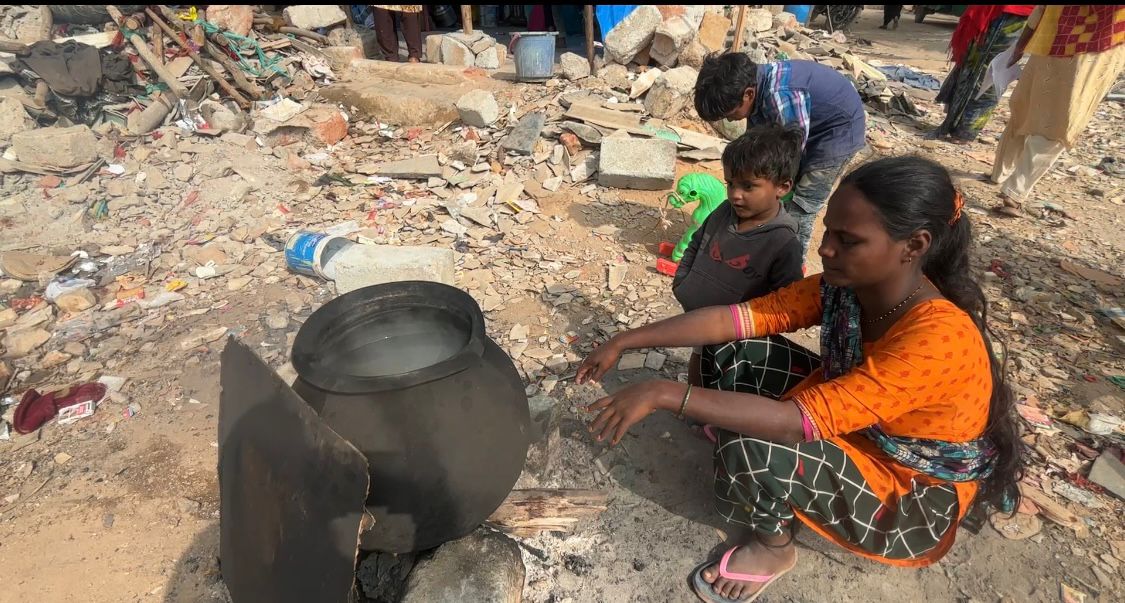
In another corner, Nafisa adjusts her specially-abled daughter’s dress as cameras gather. She says they have not eaten since morning.
“The nights are cold and the days are hot. My neighbour Syed is wheelchair-bound. They showed no mercy. They asked us to move away and used the JCB to claw into our house," she said.
Residents say those affected include newborns, pregnant women and senior citizens. Some also claim animals died during the demolition.
The area predominantly housed poor Dalit, Muslim and Fakir families. The scale, timing and manner of the demolition have fuelled allegations of selective action and lack of due process.
Beyond the rubble, the story has taken on a larger political meaning. Within hours, the issue spilled beyond Karnataka’s borders.
Political Flashpoint As Kerala Enters The Fray
What began as a demolition drive to clear alleged encroachments has now grown into a cross-border political confrontation, drawing in chief ministers of Kerala and Karnataka.
Neighbouring Kerala’s ruling LDF waded into the controversy, triggering a political clash between the Congress government in Karnataka and the Left government in Kerala.
Kerala Chief Minister Pinarayi Vijayan accused Karnataka of importing Uttar Pradesh-style “bulldozer justice" into South India. “The destruction of Fakir Colony and Waseem Layout, where Muslim families have lived for years in Bengaluru, is shocking and painful," Vijayan said in a Facebook post, calling it an example of “anti-minority aggressive politics".
Critics in Karnataka allege that the CPI(M)’s sharp attack is also rooted in Kerala politics. The Muslim community’s support for the Congress-led UDF in recent elections has been a sore point for the Left, and the Kogilu demolitions offered an opportunity to portray the Congress as no different from the BJP on minority issues.
Kerala MPs and MLAs soon visited the demolition site, amplifying the confrontation. The intervention did not go down well with the Karnataka Congress, which accused Vijayan of interference and political opportunism.
Kerala’s LDF Leader Speaks To News18
Former Kerala minister and CPI(M) MLA KT Jaleel, who visited the site, told News18 in an exclusive interview that the issue transcends party lines.
“All over the country, the BJP is introducing ‘bulldozer raj’. Such activity has happened in Karnataka as well," Jaleel said. “The issue is not whether it is BJP or Congress. The issue is that houses of the poor are being demolished—homes of poor people and minorities."
Stating that citizens have the right to speak up and he has come there to raise his voice for the oppressed and the ones who have faced injustice under Congress’s “bulldozer" governance, Jaleel said: “Every citizen has the right to visit such places and raise their voice for oppressed communities. This is not for votes. There is no election here."
He added: “If the Karnataka government does not do enough for the people, the people of Kerala will rise to the occasion and help the displaced."
Jaleel also accused the Karnataka Congress of hypocrisy. “Under the Congress in Karnataka, such activities are going on and must be exposed. Congress claims it is secular, but those being evicted are minorities, Muslims."
When asked if the outrage was due to minority politics, Jaleel was quick to issue a denial. “Certainly not," he told News18. Calling the demolition “cruel and inhuman", he added that notices should have been issued. “If the Karnataka government had looked into the matter and halted it, we would not have come here. This is not about votes or politics."
Why Is Kerala Intervening?
The sharp reaction from Kerala has less to do with Karnataka alone and more to do with politics back home, say critics. With local body elections in which minority outreach had become a central plank in Kerala’s political battle between the CPI(M)-led Left Democratic Front (LDF) and the Congress-led United Democratic Front (UDF), the support given by the minorities to the UDF seems to have hurt the ruling LDF. Political analysts say the Muslim community’s drift towards the UDF in recent elections has been a concern for the Left.
The Kogilu demolitions somehow offered an opening—a chance to project the Congress as indistinguishable from the BJP when it comes to demolitions affecting minorities and targeting them.
Protests And Pressure Within Karnataka
The demolitions had earlier triggered protests in front of revenue minister Krishna Byre Gowda’s residence in Sahakar Nagar last week, seeking respite from the bulldozing exercise. Over 200 residents demanded alternative housing and temporary shelters. Gowda, who represents the Byatarayanapura constituency, is said to have assured discussions with the affected families.
The Karnataka BJP also weighed in, accusing the Congress government of acting under the dictates of the party high command and mishandling the issue.
The “bulldozing" has clearly put the Congress government on the back foot. Embarrassed by the developments in Bengaluru, the party high command finally stepped in.
Congress general secretary KC Venugopal spoke to chief minister Siddaramaiah and deputy chief minister DK Shivakumar, conveying the party’s “serious concern" over the demolition.
In a post on X, Venugopal said the actions should have been undertaken with “far greater caution, sensitivity and compassion, keeping the human impact at the centre". He said the Karnataka leadership assured him that they would personally engage with affected families, put in place a grievance redressal mechanism and ensure rehabilitation and relief.
The intervention indicated the discomfort within the Congress over the optics of the demolition, especially as the party seeks to position itself nationally as a counter to the BJP’s bulldozer politics.
Karnataka Government Hits Back
Meanwhile, Siddaramaiah and Shivakumar have firmly defended the demolition, insisting it was a lawful removal of illegal encroachments.
Siddaramaiah said several people had erected make-shift shelters at a waste-disposal site unfit for human habitation. “Despite issuing notices on multiple occasions directing families to relocate, they failed to comply. Under these circumstances, it became unavoidable to clear the encroachment," he said.
Rejecting the “bulldozer justice" label, he called Vijayan’s criticism politically motivated.
Shivakumar echoed the sentiment, urging the Kerala chief minister not to interfere without knowing the facts. “The land was a solid waste pit with serious health hazards. We gave people an opportunity to move. Karnataka does not have a bulldozer culture," he said, alleging the role of land mafia in setting up slums to encroach upon government land.
He said eligible residents would be given houses under the Rajiv Gandhi housing scheme.
A Humanitarian Crisis Amid Political Posturing
Back in Kogilu, politics feels distant to families sleeping under tarpaulin sheets on cleared land. Many have refused to leave, fearing that authorities may fence off the area once it is vacated.
“We refuse to leave this place and go to the allotted shelter as they will fence this area and remove us permanently. We need to see what other location is being provided to us. We do not need temporary shelters or camps," said Harish, a cobbler.
Residents allege that no basic facilities have been provided. Food and water are being arranged by social and religious organisations, but they have no space for daily needs.
A food and gruel centre set up three kilometres away remains largely unused, with families unwilling to abandon the site.
Former Union minister CM Ibrahim timed his visit around the same time as Jaleel’s. Ibrahim demanded either houses on the same land or compensation of Rs 5 lakh per family. He also questioned leaders who seek votes and disappear in times of crisis.
For the families of Fakir Colony and Waseem Layout, caught between bulldozers and ballot-box politics, the larger ideological battle offers little immediate comfort—even as their homes remain flattened and their futures uncertain.
First Published:
December 29, 2025, 09:21 IST
News india Rubble, Resistance And Political Sabre-Rattling: Inside Bengaluru’s Kogilu Demolitions
Disclaimer: Comments reflect users’ views, not News18’s. Please keep discussions respectful and constructive. Abusive, defamatory, or illegal comments will be removed. News18 may disable any comment at its discretion. By posting, you agree to our Terms of Use and Privacy Policy.
Read More