1 month ago
Since 2016, the UK will be seeing a seventh prime minister check into 10, Downing Street. As Keir Starmer leaves in less than 2 years, here's why recent British PMs fail to remain in office.
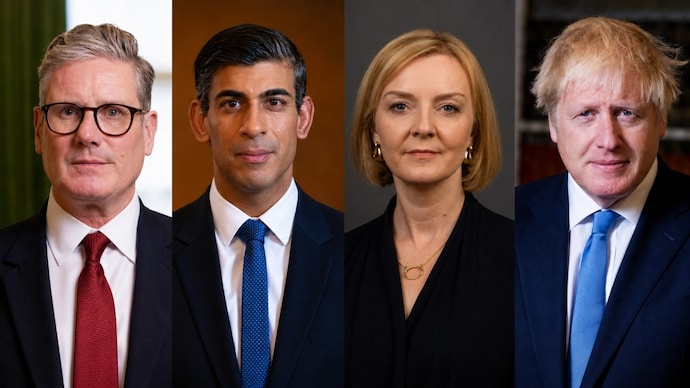
Together, British PMs (Left to Right) Keir Starmer, Rishi Sunak, Liz Truss and Boris Johnson have occupied 10 Downing Street for nearly seven years.
In London's 10 Downing Street, stability, it seems, comes not on two legs, but on four. Appointed as the Chief Mouser of the Cabinet Office back in 2011, domestic tabby cat Larry has dutifully served His Majesty's Government for 15 years, locating and hunting down rodent intruders. The same stability, however, cannot be said for his two-legged bosses, the Prime Ministers of the UK, who occupy the PM's official residence. In his 15 years of dispatching rats at 10, Downing Street, Larry has seen six PMs come and go and is set to see the seventh PM move in.
On Monday, PM Kier Starmer announced his resignation prior to the completion of his five-year term as the head of the country's Labour government. The announcement came amid intense internal pressure from his party, poor by-election and local results, and widespread backlash over issues like immigration, energy policy, and pension cuts. Starmer is likely to be replaced by Labour leader Andy Burnham, known as the "King of the North".
Starmer is hardly the first UK PM in recent years to resign early. Since 2016, under the watchful eyes of Larry the Cat, at least six PM's came and went, none of them able to complete a full term of five years. The last four PMs have gone in four years. The churn of the last 10 years marks the highest leadership turnover in nearly two centuries. So, why have British PMs failed to keep their jobs?
A variety of reasons explain why the entrance to London's 10, Downing Street might be like a revolving door, with recent PMs failing to complete their terms. On one hand, that party that ruled for eight of those 10 years, the Conservatives (2016-2024), saw five PMs. The 2016 Brexit under PM David Cameron, left the Conservatives divided and prone to rebellions because of the polarising EU exit.
At the same time, the Labour Party, which came to power in 2024, has also seen its fair share of falling outs, with party leaders rallying against outgoing PM Kier Starmer, forcing his exit.
Compounding the deep divisions within Britain's two major parties is the fact that internal party rules—particularly within the Conservatives—allow incumbent prime ministers to be replaced without a general election. Leadership challenges, confidence votes, and waves of ministerial resignations can quickly render a PM's position untenable. Combined with Brexit, political scandals, and recurring economic crises, these mechanisms helped plunge the UK into one of the longest periods of political instability in its modern history.
The last British PM to have completed his five-year term was David Cameron. However, Cameron couldn't complete his second term, resigning in 2016 after the Brexit referendum, in which the UK decided to move out of the European Union (EU).
| PRIME MINISTERS | PARTIES | LENGTHS OF TENURE |
| David Cameron | Conservative Party | 1 year and 2 months (second term) |
| Theresa May | Conservative Party | 3 years, 11 days |
| Boris Johnson | Conservative Party | 3 years, 44 days |
| Liz Truss | Conservative Party | 49 days |
| Rishi Sunak | Conservative Party | 1 year, 253 days |
| Kier Starmer | Labour Party | 2 years |
HOW INTERNAL PARTY MECHANISMS CUT SHORT TENURES OF UK PMs
A key reason many British prime ministers have failed to complete their terms since 2016 is the ease with which governing parties can replace their leaders.
The Conservative Party's rules are particularly unforgiving. Party members have the option to resort to a confidence vote that is triggered when 15% of Conservative MPs submit letters of no confidence to the chair of the 1922 Committee. It's a small and powerful group of Conservative MPs who exercise influence over the nomination of leaders, according to the Institute for Government, a UK-based think tank.
If the leader loses the resulting secret ballot, they are removed and a leadership contest begins. Crucially, if this mechanism is used to remove an incumbent prime minister, there is no requirement to hold a fresh general election. Instead, the governing party can simply choose a new leader, who then assumes the premiership.
This MP-driven system, meant to promote internal democracy, has repeatedly destabilised Conservative governments, contributing to the departures of leaders like PM Boris Johnson.
Labour's rules are more protective, requiring a challenger to secure nominations from 20% of Labour MPs before a leadership contest can begin, with the wider party membership ultimately choosing the winner. As Labour leader Jeremy Corbyn's survival of a 2016 no-confidence vote demonstrated, opposition from MPs alone is not enough to remove a Labour leader.
However, as made evident by the resignation of individuals like Theresa May, Liz Truss, and Kier Starmer, sometimes, internal pressure from party leaders can still compel sitting PMs to resign without going to vote.
HOW BREXIT CUT SHORT THE TENURES OF TWO UK PMs
The cycle of political instability that has seen six British prime ministers in a decade began with the 2016 Brexit referendum.
Then-PM David Cameron, who had promised the vote to contain growing Euroscepticism within the Conservative Party, campaigned for Britain to remain in the European Union (EU). When voters instead backed Brexit by 52% to 48%, Cameron resigned, arguing that new leadership was needed to deliver a policy he opposed.
His successor, Theresa May, inherited the task of negotiating Britain's withdrawal from the EU. However, Brexit exposed deep divisions within both Parliament and her own party. Her proposed withdrawal agreement was rejected three times, with critics arguing it left Britain too closely tied to the EU.
May's position was further weakened after she lost her parliamentary majority in a snap election in 2017. Unable to break the Brexit deadlock or reunite the Conservatives, she faced constant internal rebellions and mounting pressure to step aside. After just over three years in office, May resigned in 2019, paving the way for a new leader to complete the Brexit process.
THE SCANDAL-HIT TENURES OF BORIS JOHNSON AND KIER STARMER
Alongside Brexit, a series of scandals also contributed to the downfall of several post-2016 prime ministers, most notably Boris Johnson.
After winning an 80-seat Conservative majority in 2019 on a promise to "get Brexit done", Johnson successfully secured Britain's departure from the European Union. However, his premiership was later engulfed by controversy.
The most damaging was the "Partygate" affair, which revealed that multiple gatherings and booze-fuelled parties had taken place inside 10, Downing Street during the COVID-19 lockdowns. A police investigation issued 126 fines, including one to Johnson, making him the first sitting British prime minister found to have broken the law.
The final blow came in 2022 with the Chris Pincher scandal, when it emerged that Johnson had promoted the Conservative MP despite having prior knowledge about Pincher's history of sexual misconduct allegations. The resulting revolt within the Conservative Party, stemming from attempts to cover up the affair, forced Johnson to resign in July 2022.
Scandal also played a role in Keir Starmer's eventual resignation.
His decision to appoint Peter Mandelson as Britain's ambassador to the United States came under intense scrutiny after Mandelson's links to disgraced financier and convicted sex offender Jeffrey Epstein became a political liability in 2026. Even after Starmer fired Mandelson after his extensive links with Epstein became public knowledge, it did not stop several leaders within the Labour Party calling for Starmer's resignation for green lighting Mandelson's appointment
HOW ECONOMIC TURMOIL, VOTER DISCONTENT LED TO CONSERVATIVE ELECTORAL COLLAPSE BY 2024
Alongside Brexit and scandals, catastrophic policy decisions, as well as continued economic instability, marked by a persistent cost-of-living crisis (brought about by the rise of energy prices after the Russian invasion of Ukraine in 2022) cut short the premierships of Liz Truss and Rishi Sunak.
Truss entered office in September 2022 after defeating Sunak in a Conservative leadership contest, but her government was quickly engulfed by the fallout from the September 23 "Mini-Budget."
The "Mini-Budget, which included a package of unfunded tax cuts worth 45 billion pounds, triggered a market panic, sending the pound to a record low against the US dollar, driving up borrowing costs, and forcing emergency intervention by the Bank of England. Truss lost the confidence of her party and resigned after just 49 days—the shortest premiership in British history.
Sunak succeeded Truss as the consensus candidate to restore stability, becoming Britain's first PM of Indian origin. While he largely calmed financial markets, he inherited a deeply divided party, a cost-of-living crisis, and growing voter fatigue after 14 years of Conservative rule since 2010.
Sunak's decision to call a snap election in 2024 proved disastrous. Labour won a landslide victory on July 4, inflicting one of the worst defeats in the Conservative Party's history and forced Sunak's resignation the following day after less than two years in office.
SO, WHY DID KEIR STARMER RESIGNING?
Keir Starmer became prime minister in July 2024 after leading Labour to its largest parliamentary majority since 2001.
Yet even a landslide victory proved no guarantee of political survival. His government was quickly hit by a controversy over the appointment of Epstein-linked Peter Mandelson as the UK's ambassador to the US, while a series of policy U-turns, including proposed legislation to slash disability and other welfare programmes, damaged his authority within the party.
Labour's and, in extension, Starmer's position worsened after disastrous local election results in May 2026, which saw the party lose nearly 1,500 councillors as Reform UK and the Greens made major gains. The subsequent resignations of Defence Secretary John Healey and Armed Forces Minister Al Carns further fuelled perceptions of a government losing control.
The decisive moment came when Labour rival Andy Burnham secured a convincing victory in the Makerfield by-election last week, strengthening calls for a change in leadership as Nigel Farrage's Reform UK party continued to rise nationally.
According to a report in the British news outlet, The Independent, Burnham's electoral victory in an area which had seen Reform UK making significant gains in the May local elections led to party leaders concluding that the "King of the North" (as Burnham is known) would be better placed to counter Nigel Farrage's rise, thus making him frontrunner to replace Starmer.
With support draining away inside his own party, Starmer resigned, becoming the sixth British prime minister in a decade to leave office before completing a full term, just like his five predecessors did. And, while Chief Mouser of the 10, Downing Street, Larry, probably has 'nine lives' in store, his two-legged companions, the PMs of the UK, are not so lucky with their office, it seems.
- Ends
Published By:
Shounak Sanyal
Published On:
Jun 23, 2026 13:56 IST