 1 month ago
Tata Steel expects its India business to see some pressure on realisations and per-tonne profitability in the second quarter, even as higher volumes could provide support.
The company is forecasting Q2 realisations to be around ₹1,500 per tonne lower sequentially, while coking coal costs are expected to rise by about $5 per tonne. However, higher production volumes could help cushion the impact on overall EBITDA.
In Europe, the outlook is improving. Tata Steel expects its Netherlands operations to deliver better volumes and margins in Q2 as production recovers from shutdowns, while the UK business is moving closer to break-even.
TV Narendran, CEO and Managing Director of Tata Steel, said the company expects the combined European operations to turn EBITDA-positive in Q2, with the UK business targeting positive EBITDA by the end of the year.
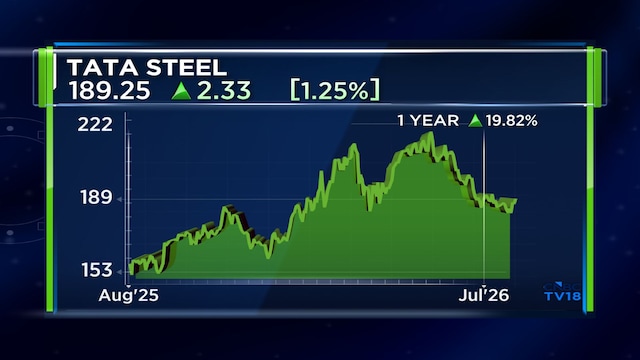
In the April-June quarter (Q1FY27), Tata Steel reported revenue of ₹60,794.3 crore, a net profit of ₹2,318.4 crore and a margin of 15.24%.
This is the edited transcript of the interview.
A: It's been a good quarter for India. We could have done better in terms of volumes. We had some shutdowns planned, and the recovery from some of those shutdowns took longer than we had thought. But overall, it's been a good quarter. We were helped, of course, last quarter by the markets, at least in April and May.
Coking coal prices went up last quarter by about $15 per tonne compared to the quarter before that. Going forward, we expect coking coal prices to be about $5 per tonne higher next quarter compared to this quarter. Realisations for Q2 are forecast to be ₹1,500 per tonne lower than Q1 because some of the prices have settled a bit lower. Long products, particularly flats, are still holding up a bit. But ₹1,500 per tonne lower than Q1 is what we are forecasting for Q2.
Q: Effectively, your EBITDA per tonne for the India business could be around ₹1,500-2,000 lower in Q2 compared to Q1?
A: Possibly, yes. EBITDA per tonne could be lower, but we'll have higher volumes in Q2 compared to Q1. So EBITDA in rupee crore terms need not be lower. EBITDA per tonne can be lower, but not necessarily the overall EBITDA.
Q: Let's talk about the Netherlands operations. It had a one-off in the past quarter, which was the shutdown. Do you see things getting back to profitability, and by when does it get to its normal run rate?
A: We'll certainly see a better Q2 than Q1, both in terms of production volumes and margins, because in Q1 we had the DSP impact and some one-off impacts because of the Middle East crisis. What we are positive about is that prices are still holding up in Europe, so we'll see that accrue to the margins.
We'll see better volumes because we've got permission now to run the DSP, which was shut down, for four weeks starting August 5. That will allow us some run time, and hopefully we will get clearance to run it regularly after that. We are expecting Q2 to be better than Q1 for the Netherlands.
Q: So things start moving up. Is the pollution issue more or less getting resolved, since the plant will be up and running?
A: One part of it, the DSP, which is 20% of our production, was shut down. Hopefully, that should start running from August. If we are able to deliver good numbers for the four weeks that we have, then we will have permission to run beyond that. We are hopeful that the worst is behind us.
Q: Let's talk about the UK. The losses have been coming down, which is good to see. There was a fire in the last 45 days to two months. How does that impact numbers in the coming quarter? Is that plant insured? And if you have a number to quantify the impact of this particular fire, what will the potential loss be?
A: It was a big fire in the pickling line in the cold rolling mill in Port Talbot. But the good thing is that the teams responded very quickly and very well. There were no injuries. The plant was damaged, but nobody was hurt. We had another similar line in Llanwern, which is about an hour away from Port Talbot, and we had mothballed it earlier. We restarted that line. Most of the volumes that were being produced in Port Talbot are now being produced at Llanwern.
The impact on the bottom line is not significant, maybe about £5-10 million. Going forward, the insurers are looking at it, and I don't want to comment on that. But this line was anyway due to be replaced by a new line at the end of next year. That was part of our transformation plan. For now, we'll use the Llanwern line until the new line at Port Talbot starts operations by the end of next year.
Q: When does Europe turn around? It's sitting with a negative $15 per tonne. Since the Netherlands is going to improve and you are not seeing any major impact on the UK business, do you think it returns to positive territory in this quarter itself?
A: It should, between the Netherlands and the UK, at least at an EBITDA level. In the UK, we will continue on this trajectory. The losses will continue to reduce in Q2 compared to Q1. We are not yet at break-even, but we are very close to that. In the Netherlands, as I said, we'll see a much better Q2 than we saw in Q1. We are not yet at the levels that we want to be, but Q2 will be significantly better than Q1. Between the two, we will certainly be EBITDA-positive during Q2.
Q: When does the UK business get into the black by itself?
A: Hopefully, by the end of the year. We have had some support from the trade measures that have been taken by the UK. There are some areas where we still feel the measures have not gone far enough. But market prices have improved because of this, and that makes the business more viable. As I said, we'll be close to break-even in Q2, and hopefully, in Q3 and Q4, we will continue in that direction. By the end of the year, we should be at positive EBITDA.
Q: Let's talk about the India business. You have announced the long-awaited NINL expansion. Give us the timelines, and what does this mean in terms of the debt outlook for the company?
A: We have been working on NINL and are at FEL 3 levels of detail as far as the engineering work is concerned. A lot of work has already been done. In the next 10-15 days, we'll be ready to place orders for a lot of the equipment. We are pretty close to where we wanted to be. We've got the board approval. The timeline is 48 months from today, which is the timeline we've set ourselves, and hopefully, we'll try and see if we can do better than that. We are ready to go. There are still some more clearances that we are awaiting, which we hope to get soon. But largely, we are on track now to expand that facility.
It will be a long products facility. We'll have a very high-end wire rod mill, a bar mill and a rebar mill. As we've said, Neelachal will be a long products complex. Across the road, we have Kalinganagar, which will be a flat products complex. Between these two plants, we have the potential to go to about 25-26 million tonnes. We are already at 8 million tonnes in flat products, and we'll get to 5 million tonnes in long products. There's a lot of room available for us to grow, and we'll exercise that optionality going forward.
Q: Any inorganic growth plans?
A: No, nothing right now. As you can see, what we are doing is simplifying a lot of our subsidiaries. We've been acquiring the stakes of many of our JV partners. We feel that in India, we need to have more control over the whole value chain. A few months back, we acquired BlueScope's stake in Tata BlueScope, and now it's called Tata Colors. Similarly, we bought out the stake of a German partner in a subsidiary called TM Logistics (TMILL).
It runs more than 100 rakes and is a very important part of our logistics operations. It takes care of 20% of Tata Steel's movements. We want to consolidate our holding in such companies because they are very critical to our future.
Watch accompanying video