 1 hour ago
The day so far
In a rebuke to Donald Trump’s anti-immigrant agenda, the supreme court upheld birthright citizenship, which provides nearly all people born in the United States with citizenship. In a 6-3 opinion, the justices ruled that the Trump administration violated a provision of the 14th amendment, which was affirmed by the supreme court 128 years ago. “Children born in the United States to parents unlawfully or temporarily present are ‘subject to the jurisdiction’ of the United States and are citizens at birth under the Fourteenth Amendment’s Citizenship Clause,” the ruling reads. The NAACP, a civil rights group dedicated to advancing the rights of Black people, called the decision a “powerful affirmation of the constitution and the enduring promise of equality it represents”. Voto Latino, a non-profit pushing for Latino voting power, said that “the court drew a permanent line in the sand – defeating a radical attempt to divide our families and strip away any doubt that our community belongs here”.
The president said the decision was “too bad”, but appeared undeterred in his quest to end birthright citizenship, turning his attention to Congress. Instead of trying to pass a constitutional amendment, Trump is pushing for lawmakers to create new legislation that establishes exceptions to birthright citizenship for children born to parents who do not have permanent legal status in the US. “Congress should start TODAY to work on ending expensive and unfair to our Country, Birthright Citizenship,” he wrote on Truth Social. But that will also be an uphill battle, as any legislation would need to overcome the 60-vote filibuster.
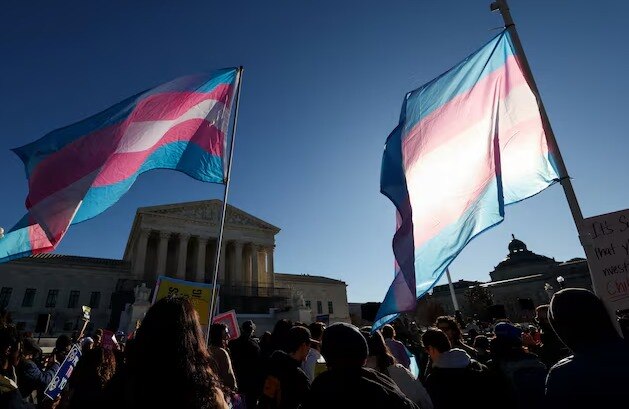
The supreme court also ruled that schools can determine eligibility for women’s and girls’ sports teams based on biological sex, effectively upholding a ban on transgender women and girls from taking part in female sports teams. The ruling centered on the case of Lindsay Hecox, a college student in Idaho, and Becky Pepper-Jackson, a 15-year-old high school student from West Virginia. The court said that West Virginia and Idaho did not violate Title IX – which bars educational programs that receive federal funding from discriminating based on sex. But the court’s three liberal justices said in a dissenting opinion that the bans do impede on the constitution’s equal protection clause. The far-reaching ruling is likely to pave the way for similar bans throughout the US.
Also today, the supreme court justices struck down limits on campaign spending in federal elections by political parties. In a 6-3 decision along ideological lines, the court held that the law’s “limits on political parties” coordinated expenditures violate the first amendment.
The supreme court also declined to consider the legality of laws that restrict people aged 18 to 20 from purchasing or using firearms, but said it will consider whether bans on semiautomatic rifles, often called assault weapons, violate the second amendment.
Key events

Chris Stein
Republican congressman Tom Kean Jr, who has not been seen in the Capitol for nearly four months without explanation, has reemerged and said that he was absent while dealing with depression.
“Several months ago, due to health concerns, I entered the hospital for some testing. I did not believe that this would result in a long-term stay. I was given the diagnosis of depression,” Kean said in a speech on the floor of the House Tuesday morning.
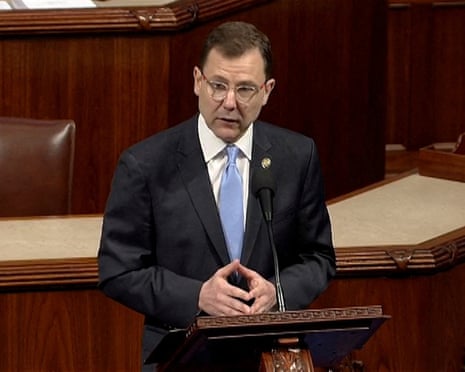
Kean, who represents a swing district in New Jersey, last voted on 5 March before disappearing, and his office said little about where he had gone or when he would be back. The congressman did not explain why he had kept his mental health struggles to himself, but indicated that treatment for depression took longer than expected.
“The doctors recommended that I remain in the hospital to address my illness. They explained to me that this would be the fastest way to recover, and to be honest, I was hesitant. I didn’t think that I had time for it,” Kean said, adding that he did not believe he would need a “long-term stay” in the hospital.
“When I first informed the public that I was dealing with a medical issue, I was still trying to understand what was happening myself. When I said I hope to return in a matter of weeks, I believed it. Those were the best estimates the doctors could provide, but as the over 48 million of my fellow Americans being treated for this illness have come to discover, there is no timeline for healing.”
Kean said that he was “grateful that I accepted help, because today I stand before you healthier, stronger, and excited to return to the work that I love.”
Kean’s mysterious absence fueled media speculation about where he might be, and what might have been keeping him away from the Capitol, where his absence complicated the GOP’s ability to control of the House of Representatives. Last week, a New York Times reporter found Kean at his New Jersey home, but the congressman declined comment.
In 2023, Democratic senator John Fetterman sought inpatient treatment for depression, but in that case, his office promptly announced his hospitalization.
The day so far
In a rebuke to Donald Trump’s anti-immigrant agenda, the supreme court upheld birthright citizenship, which provides nearly all people born in the United States with citizenship. In a 6-3 opinion, the justices ruled that the Trump administration violated a provision of the 14th amendment, which was affirmed by the supreme court 128 years ago. “Children born in the United States to parents unlawfully or temporarily present are ‘subject to the jurisdiction’ of the United States and are citizens at birth under the Fourteenth Amendment’s Citizenship Clause,” the ruling reads. The NAACP, a civil rights group dedicated to advancing the rights of Black people, called the decision a “powerful affirmation of the constitution and the enduring promise of equality it represents”. Voto Latino, a non-profit pushing for Latino voting power, said that “the court drew a permanent line in the sand – defeating a radical attempt to divide our families and strip away any doubt that our community belongs here”.
The president said the decision was “too bad”, but appeared undeterred in his quest to end birthright citizenship, turning his attention to Congress. Instead of trying to pass a constitutional amendment, Trump is pushing for lawmakers to create new legislation that establishes exceptions to birthright citizenship for children born to parents who do not have permanent legal status in the US. “Congress should start TODAY to work on ending expensive and unfair to our Country, Birthright Citizenship,” he wrote on Truth Social. But that will also be an uphill battle, as any legislation would need to overcome the 60-vote filibuster.
The supreme court also ruled that schools can determine eligibility for women’s and girls’ sports teams based on biological sex, effectively upholding a ban on transgender women and girls from taking part in female sports teams. The ruling centered on the case of Lindsay Hecox, a college student in Idaho, and Becky Pepper-Jackson, a 15-year-old high school student from West Virginia. The court said that West Virginia and Idaho did not violate Title IX – which bars educational programs that receive federal funding from discriminating based on sex. But the court’s three liberal justices said in a dissenting opinion that the bans do impede on the constitution’s equal protection clause. The far-reaching ruling is likely to pave the way for similar bans throughout the US.
Also today, the supreme court justices struck down limits on campaign spending in federal elections by political parties. In a 6-3 decision along ideological lines, the court held that the law’s “limits on political parties” coordinated expenditures violate the first amendment.
The supreme court also declined to consider the legality of laws that restrict people aged 18 to 20 from purchasing or using firearms, but said it will consider whether bans on semiautomatic rifles, often called assault weapons, violate the second amendment.
Supreme court will consider whether bans on semiautomatic rifles violate the second amendment
But the supreme court will consider whether bans on semiautomatic rifles, often called assault weapons, violate the second amendment.
The justices said that they will hear appeals challenging bans on the AR-15 and similar semiautomatic firearms in Connecticut and the Chicago area.
Similar laws are in place in about a dozen states, covering major cities like New York, Los Angeles and Washington DC Congress allowed a national assault weapons ban to expire in 2004, but Democrats have supported renewing it in response to a series of mass shootings. States have also continued to pass their own laws, including recent measures in Virginia and Rhode Island.
It is the latest high-profile dispute over guns to reach the court since its conservative majority handed down a landmark ruling in 2022 that expanded second amendment rights and spawned challenges to firearm laws around the country.
Arguments are expected to be heard in the fall.
The Connecticut law was passed after a mass shooter used an AR-15 to kill 26 children and educators at Sandy Hook Elementary in 2012.
Supreme court turns away cases testing firearm age restrictions
Also today, the supreme court declined to consider the legality of laws that restrict people aged 18 to 20 from purchasing or using firearms, an area of contention following the court’s expansion of gun rights in recent years.
The justices turned away appeals challenging a federal ban on handgun purchases by people ages 18 to 20, as well as a similar state law in Florida imposing the same age requirement on all firearms purchases. Lower courts had rejected the arguments by plaintiffs in those cases that those laws violate the US Constitution’s second amendment right to “keep and bear arms”.
The supreme court’s rejection of Pennsylvania’s appeal in another case, however, left in place a lower court’s ruling that the state’s laws that ban people ages 18 to 20 from carrying firearms in public during a declared state of emergency violate the second amendment.
It comes after a ruling on 26 June in which the court struck down a Hawaii law restricting the carrying of handguns on private property open to the public, like most businesses, without the owner’s permission. And on 18 June it limited the application of a decades-old federal law that bars firearms possession by certain drug users, narrowing a measure that had threatened the gun rights of millions of Americans who use marijuana and own firearms.
Rachel Leingang
In today’s decision, Chief Justice John Roberts wrote that “the Court exhaustively canvassed the text and history of the Citizenship Clause and at no point identified any evidence that the ratifiers thought themselves to be imposing a domicile limitation”.
Roberts repeatedly bats down the idea that “domicile” was much more expansive an idea, and that primary allegiance to the US was commonly seen as part of that definition, both arguments the government tried to make in its case. He writes that “there is scant evidence for this dramatically revisionist view”.
The quest to overturn birthright citizenship has gained steam among some conservatives in recent years, though most legal scholars still believe the amendment has been interpreted correctly. The administration is relying in part on the legal arguments of a white supremacists from the late 1800s, the Washington Post reported. John Eastman, a lawyer who worked with Trump to try to overturn the 2020 election results who has since been disbarred in California, is also a key proponent of the effort to overturn birthright citizenship, Politico reported.
Trump says he will try to end birthright citizenship through Congress after supreme court strikes down executive order
Donald Trump said that the decision by the supreme court to uphold birthright citizenship is “too bad”. But he appeared undeterred in his quest to abolish the right for people born in the US to undocumented people or temporary visitors to become citizens.
“We can easily make it up in Congress through Legislation,” Trump insisted. Instead of trying to pass a consitutional amendment – which is a steep and unlikely hill for the president to climb – Trump is pushing for lawmakers to create new legislation that establish exceptions to birthright citizenship for children born to parents who do not have permanent legal status in the US.
“Congress should start TODAY to work on ending expensive and unfair to our Country, Birthright Citizenship,” Trump wrote on Truth Social.
Any legislation would need to overcome the 60-vote filibuster, which has proven to be frequently insurmountable on extremely divisive bills during Trump’s second term.
Donald Trump has yet to weigh in on the supreme court decision overturning his executive order gutting birthright citizenship. However, he has now declared on Truth Social that court’s opinion to end limits on campaign spending by political parties in federal elections a “big win” for “FOR REPUBLICANS and, more importantly, The First Amendment!”
Top Trump adviser brands birthright citizenship ruling 'one of the most destructive' supreme court decisions in history
Stephen Miller, one of Donald Trump’s top advisers and the architect of his immigration agenda, branded the opinion to uphold birthright citizenship as “one of the most destructive and outrageous decisions” in the history of the supreme court.
“American citizenship is not the birthright of the world,” Miller added in a statement on X. “No provision of the Constitution can be read to require our national self-obliteration.”
Meanwhile, Kevin Roberts, president of the right-wing think tank the Heritage Foundation, called today’s ruling “a tremendous betrayal of the republic”.
Roberts, who masterminded the conservative playbook Project 2025, accused the justices in the majority of launching an “all-out assault” on US sovereignty. He also said they have “cheapened the sacred value of American citizenship”.
He then called for a constitutional amendment “to correct this gross injustice”. However, it’s worth noting that this requires the support of two-thirds of Congress, and for at least three-quarters of all 50 states to ratify a hypothetical amendment.
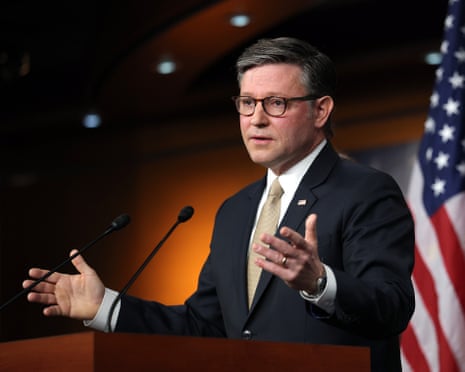
Johnson calls supreme court ruling upholding birthright citizenship 'disappointing'
Speaking to reporters as the news of the supreme court’s final decisions of this term were announced, House speaker Mike Johnson said he was “disappointed” in the court’s opinion to uphold birthright citizenship.
“I do think that this has been grossly abused in recent years,” the top Republican said at a press conference earlier. “You just come onto the soil and have your child, and then they’re they’re able to avail themselves of the welfare state and everything else.”
However, during the oral arguments in the Trump v Barbara case in April, the government’s lawyer conceded that “no one knows for sure” how significant a problem so-called birth tourism actually is. The Center for Immigration Studies, an anti-immigration thinktank, said that there are between 20,000 to 26,000 births by women on tourist visas annually. This is less than one percent of all babies born in the US each year.
Civil rights groups and Democrats welcome supreme court decision upholding birthright citizenship
Following the court’s opinion to strike down Donald Trump’s executive order to end birthright citizenship, swathes of civil rights groups have welcomed the highly anticipated ruling.
“Even a far-right supreme court realized overturning the constitutional mandate that people born here are citizens-a mandate that is more than 100 years old and has granted citizenship to millions of people-is not just a betrayal of the constitution itself but also deeply un-American,” said Neera Tanden, president and CEO of the Center for American Progress, in a statement.
The NAACP said the president’s “assault on the 14th amendement was dealt a major blow” following the court’s ruling.
“Today, the Court rightly rejected efforts to undermine that core protection and instead upheld a principle that is essential to our democracy,” Derrick Johnson, the organization’s president and CEO said.
Democratic members of Congress also applauded the news.
“There is, and shall be, no question. Donald Trump’s disgraceful actions as it relates to the Birthright Citizenship Clause are clearly unlawful and an assault on our way of life,” said top House Democrat Hakeem Jeffries.
Senator Alex Padilla, a Democrat representing California, said that today’s opinion was “personal”. The lawmaker’s parents were initially undocumented when they arrived in the US, before becoming citizens.
“While we celebrate this ruling today, we cannot rest. Because this is certainly not the end of Trump’s attacks on our constitution, our democracy, and the notion of what it means to be American,” Padilla added.
While we wait for the president’s reaction to today’s decision from the court that rules against his birthright citizenship executive order, he has weighed in on the justices’ decision to uphold the ban on trans athletes competing in female sports teams.
“BIG WIN: The United States Supreme Court just RULED AGAINST MEN PLAYING IN WOMEN’S SPORTS. Wow! That takes that ridiculous situation off the table!!!” the president wrote on Truth Social.
Supreme court rules against Trump's efforts to end birthright citizenship
In a stunning rebuke to the Trump administration’s immigration agenda, the US supreme court ruled against the president’s attempt to gut the ability for anyone born on American soil to obtain citizenship.
The president issued an executive order on the first day of his second term in office that sought to undo birthright citizenship. It swiftly drew lawsuits, including from the Democratic state attorneys general and the American Civil Liberties Union, and the court heard oral arguments in the case – Trump v Barbara – back in April.
In a 6-3 opinion, the justices ruled that the Trump administration violated a provision of the 14th amendment, which was affirmed by the supreme court 128 years ago. While conservative justice Brett Kavanaugh concurred with the judgment, he dissented in parts.
The Trump administration said that children born to undocumented immigrants and temporary foreign visitors were ineligible for citizenship, arguing that the landmark decision on birthright citizenship – United States v Wong Kim Ark – relied on parents having permanent “domicile” in the US. However, the term is not included in the 14th amendment.
Supreme court ends limits on campaign spending by political parties in federal elections
Also at the court today, the justices struck down limits on campaign spending in federal elections by political parties. In a 6-3 decision along ideological lines, the court held that the law’s “limits on political parties” coordinated expenditures violate the first amendment.
Supreme court allows states to ban transgender athletes in female sports teams
The supreme court has ruled that schools can determine eligibility for women’s and girls’ sports teams based on biological sex. As a result the justices effectively upheld a ban on transgender women and girls from taking part in female sports teams.
The ruling centered on the case of Lindsay Hecox, a college student in Idaho, and Becky Pepper-Jackson, a 15-year-old high school student from West Virginia.
The court said that West Virginia and Idaho did not violate Title IX – which bars educational programs that receive federal funding from discriminating based on sex. But the three liberal justices on the bench – Sonya Sotomayor, Elena Kagan and Ketanji Brown Jackson – said in a dissenting opinion that the bans do impede on the constitution’s equal protection clause.
On Monday, the supreme court sided against national Republicans and Donald Trump’s administration to allow mail-in ballots that arrive after election day to be counted, upholding the law in more than a dozen states. In response, the president used the 5-4 opinion to insist that lawmakers in Congress pass the sweeping voter ID bill, known as the SAVE America act. One of Trump’s legislative priorities.
One of the bill’s requirements would mean that voters have to show proof of citizenship when registering to vote, and would scrap mail-in voting. This, despite Trump having voted by mail in the past.
The president lambasted Republican senators who have stalled the legislation in recent months.
“There is only one reason to oppose – CHEATING! The House of Representatives has approved this vital Act, THREE TIMES. The United States Senate seems unable to do so. In a time when there is a powerful Communist Movement taking place in our Country,” Trump wrote on Truth Social.