1 month ago
Donald Trump warned Iran of consequences if it failed to honour the interim agreement after a tense round of talks in Switzerland. Even as both sides moved towards a 60-day roadmap, differences over inspections and frozen assets remained.
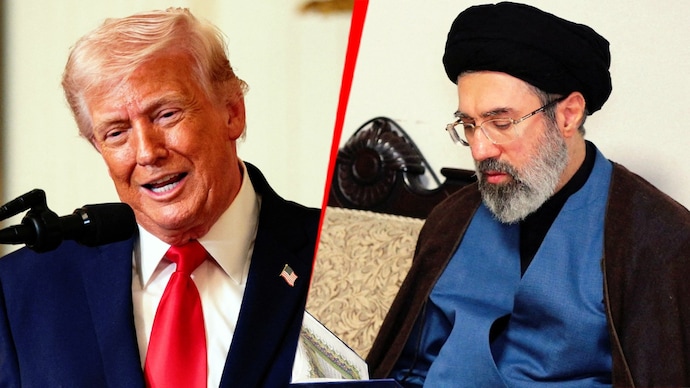
US President Donald Trump and Iran’s new Supreme Leader, Ayatollah Mojtaba Khamenei. (Photos: Reuters)

UPDATED: Jun 23, 2026 05:23 IST
A day after his remarks during US-Iran talks in Switzerland triggered a diplomatic flare-up, US President Donald Trump on Monday warned Tehran that Washington would respond if it failed to honour commitments under a nascent peace agreement.
"If Iran doesn't live up to their agreement, or if they're not behaving, I will do what I have to do," Trump told reporters.
Trump's comments came after tensions surfaced during the first round of negotiations in Switzerland, where Iranian officials reportedly protested remarks by the US president concerning the Strait of Hormuz and briefly walked out of the talks. The dispute threatened to derail the week-old interim accord signed by Trump and Iranian President Masoud Pezeshkian.
SANCTIONS RELIEF AND ROADMAP TO FINAL DEAL
Despite the setback, talks appeared to regain momentum. US Vice President JD Vance said discussions with Iranian officials had laid a strong foundation for a final agreement, although Tehran denied reports that negotiations had extended to its nuclear programme.
As part of the first economic relief measures under the agreement, the US Treasury granted Iran a sanctions waiver until August 21, allowing it to export oil and related products and receive payments.
The two sides, seeking to build on the interim deal signed last week, agreed on a roadmap towards a permanent agreement within 60 days during talks at the Swiss resort of Buergenstock, according to mediators Pakistan and Qatar.
They also agreed to establish a communication mechanism to help ensure safe passage for commercial vessels through the Strait of Hormuz and outlined steps to support a ceasefire in Lebanon between Israel and Hezbollah.
DIFFERENCES EMERGE OVER INSPECTIONS AND FROZEN ASSETS
Vance said Tehran had agreed to permit weapons inspections and establish procedures related to frozen Iranian assets and ceasefire arrangements. Trump later said Iran would agree to inspections to ensure "nuclear honesty" and warned of consequences if Tehran failed to comply with any agreement.
Iran, however, disputed parts of the US account. Foreign Ministry spokesperson Esmaeil Baghaei said Tehran had neither discussed nuclear issues nor made new commitments on its nuclear programme.
Iranian Foreign Minister Abbas Araghchi said the talks had secured sanctions waivers for oil and petrochemical exports, progress on the release of frozen Iranian assets abroad and plans for reconstruction and development projects.
Trump also claimed that any Iranian funds released under the agreement would ultimately flow back to the United States through purchases of American agricultural products. However, Iranian Central Bank Governor Abdolnaser Hemmati said Tehran was under no obligation to buy US farm goods and could use at least some of the funds for other non-sanctioned imports.
REGIONAL TENSIONS EASE AS TECHNICAL TALKS CONTINUE
Technical-level discussions are expected to continue throughout the week as negotiators seek to build on the interim accord and move closer to a broader settlement.
The diplomatic progress also appeared to calm markets. Oil prices fell around 3% on Monday as concerns over potential disruption to shipping through the Strait of Hormuz eased. Tanker traffic through the strategic waterway also began to recover after recent tensions.
US-Israeli attacks on Iran and Israeli strikes in Lebanon have killed thousands and displaced millions, while the conflict has rattled global energy markets. The outcome of the ongoing negotiations is being closely watched as a key test of efforts to stabilise the region.
- Ends
Published By:
Nitish Singh
Published On:
Jun 23, 2026 05:23 IST