1 month ago
Tens of thousands of young British and European citizens would be given the right to live and work in each other’s countries under plans for a scheme that ministers are aiming to finalise within the next year.
Ministers want to secure a youth mobility scheme with the EU by the end of 2026, as part of a broader reset of Britain’s relationship with Europe six years after leaving the bloc.
Labour strategists believe there is a growing political benefit to ministers stepping up their criticism of Brexit and arguing more openly for a closer relationship with Europe.
In a speech on Monday, Keir Starmer attacked the “wild promises” made by Brexit campaigners and said the UK was “still dealing with the consequences today, in our economy, and in trust”.
“The idea that leaving the EU was the answer to all our cares and concerns has clearly been proved wrong,” he said, though he stressed that he would “always respect” the outcome of the referendum.
David Lammy, the deputy prime minister, said this week that Turkey, which is in a partial customs union with the EU, was “seemingly benefitting and seeing growth in their economy”. He told the News Agents podcast that rejoining the EU customs union was “not currently where we are” but that it was self-evident that Brexit had “badly damaged the economy”.
The government views the youth mobility scheme as one of a number of agreements it can finalise in the coming months that would deliver tangible benefits to the British public.
A government source said Nigel Farage was increasingly in “uncomfortable territory” over the UK’s relations with the EU, citing polling suggesting that a majority of voters now favour closer ties and more than 70% want to see a controlled and time-limited youth mobility programme.
UK officials are pushing for a two-year time limit on the scheme and a cap in the “tens of thousands”, the Guardian understands, with negotiations continuing over a draft text.
A government source briefed on the talks said that if a two-year scheme were up and running by 2027, the first tranche of Europeans arriving in the UK would return home before the next election expected in 2029.
They said this would demonstrate to voters that the programme was controlled, time-limited and ensure it had no overall impact on the UK’s net migration figures. The numbers of Europeans temporarily moving to the UK would also be offset by Britons going to Europe.
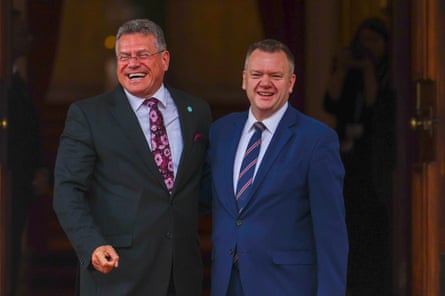
Nick Thomas-Symonds, the Cabinet Office minister leading the negotiations with Europe, is due to meet his European counterpart, Maroš Šefčovič, in Brussels on Wednesday to discuss progress.
UK and EU officials stressed that the talks were at an early stage and the details were still being negotiated, including the age range at which young people would qualify. One source said the EU was pushing for a four-year limit to the scheme.
Thomas-Symonds has previously said that any youth mobility agreement would be modelled on the UK’s existing schemes with countries including Australia, New Zealand, Japan and South Korea.
Britain’s scheme with Australia is capped at 45,000 – although only 9,750 Australians came last year, fewer than a quarter of the limit. Given the EU has a population of nearly 450 million compared with Australia’s 28 million, Brussels is likely to expect a higher cap.
Formal negotiations over the scheme began in September, and talks over other aspects of the EU reset – including food standards and a joint carbon emissions scheme – only started in mid-November.
UK government figures have expressed frustration at the delay, which they said was caused by the slowness in the European Commission obtaining its mandate from EU governments.
One priority for the EU is ensuring that Britons who participate in the youth mobility scheme are committed to living and working in one European country for the duration of their participation, rather than moving around. There is also a desire that all the EU’s 28 members benefit.
A priority on the UK side is to ensure the scheme is designed in such a way that young Britons from working-class backgrounds can take advantage of it, with no prohibitive fees or barriers to their participation.
More than 60 Labour MPs publicly endorsed a youth mobility scheme with Europe earlier this year, and are supportive of the government’s drive for closer ties with the EU.
“There has been a real step change in the language used by the people at the top of government compared with where we were in the first few months when we got elected,” one Labour MP said.
“The impetus on our side has got to be that we can move quickly … The route to getting closer to the EU is by demonstrating that, step by step, we can make agreements that are concrete.”
In a YouGov poll in September, 62% of voters said Brexit was more of a failure than a success for the UK, compared with just 11% who said it had been more of a success than a failure.
However, experts warned that the collapse of negotiations between the UK and EU over defence last week demonstrated the difficulties of seeking improved terms across a host of areas. The talks, which were seeking to allow UK companies to play a greater part in the EU’s €150bn (£130bn) defence loans scheme, failed because of a dispute over money.
Anand Menon, the director of the UK in a Changing Europe thinktank, said the episode demonstrated that UK relations were not a priority for the EU. “I think the urgency has totally gone on the EU side, and there’s also a disappointing tendency on the EU side to think in terms of how much cash they can screw out of us,” he said.
David Henig, a trade expert, said: “I think the immediate optimism of a successful summit has now given way to the usual difficulties of negotiations, which are being exacerbated by Brussels being heavily focused on other issues, not least with regard to the US and China.”
A government spokesperson said: “We are working together with the EU to create a balanced youth experience scheme which will create new opportunities for young people to live, work, study and travel.
“As agreed with the EU in May, any final scheme must be time-limited and capped. We will not give a running commentary on ongoing talks.”