 3 weeks ago
The pilot of the US F-15E Strike Eagle has said a jellyfish-like drone swarm possibly downed the fighter jet during the Iran conflict. If confirmed, it would mark a major shift in Iran's drone warfare capabilities.
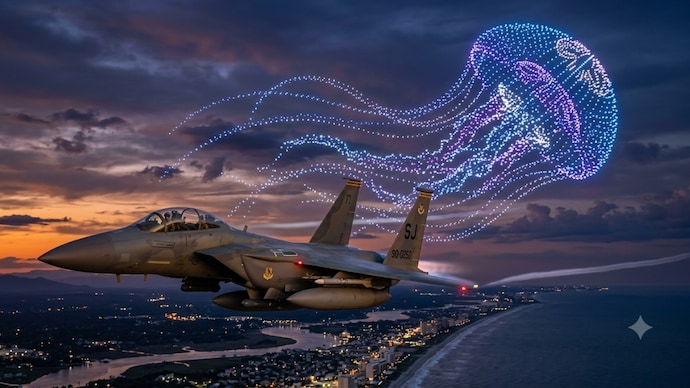
If the US aircraft was indeed shot down by a 'jellyfish-like' swarm of drones, it points to a never-before-seen Iranian capability

New Delhi,UPDATED: Jun 24, 2026 11:36 IST
At first instance, it would seem like a narrative straight out of a science-fiction movie - multiple drones hovering in the sky, connected, and moving together in a formation that resembled a jellyfish. But it is believed to be behind the downing of the F-15E Strike Eagle over Iran during the conflict in April. The testimony of the F-15E pilot, who ejected from the jet and was rescued by US special forces, suggests a major leap in Iran's drone capabilities, CNN reported.
Since the crash of the F-15E jet on April 3 - the first time that a US aircraft was shot down over Iran during conflict - the Trump administration has not revealed the exact cause behind the downing. The incident marked a crucial moment in the war, which saw the US commandos conduct a daring operation inside Iran to rescue the pilot and the weapons system officer (WSO).
'REAL ALIEN S**T'
The pilot's debriefing has stirred a hornet's nest within the US intelligence community. Earlier reports suggested that the US jet might have been brought down by Iran's Majid infrared air defence system or shoulder-fired missiles. However, if the aircraft was indeed shot down by a 'jellyfish-like' swarm of drones, it points to a never-before-seen Iranian capability - one believed to be possessed by only China and Russia.
"Multiple drones interconnected and moving as one with smaller drones below the bigger drones like legs... Real alien s**t," a source familiar with the pilot's testimony told CNN. Another official said the pilot claimed to have witnessed a "minefield of drones" in the air as he ejected.
However, intel officials are treading with caution on the pilot's recollection of events with caution. Not only was he badly concussed, but he was also among the US pilots downed earlier in the war in a friendly-fire incident involving Kuwaiti jets.
If his account is correct, Iran is likely among the few countries to possess "meshed networking capabilities". This is what basically gives it a jellyfish-like structure - multiple drones using mesh networking to stay connected with one another.
These smaller drones are controlled by a so-called "mothership" drone. This mothership drone acts like a command platform. Smaller drones remain below. This swarm can move together, giving it a jellyfish-like appearance from afar. This is likely what the US pilot might have seen.
In fact, such meshed networking can be used to provide internet connectivity in remote areas lacking existing infrastructure.
WHAT IS JELLYFISH-LIKE DRONE SWARM?
So, how does it function?
The mothership drone, sometimes connected to a tether, goes way up in the air to provide an overview. Smaller drones, which are likely strung together using a mesh network, are then dispatched to conduct strikes if an enemy jet or UAV is spotted.
Essentially, the technology allows a single operator to potentially control several drones simultaneously.
Such a formation is kind of a nightmare for traditional radar and air defence systems. Since it can operate at lower altitudes and cover a wide area, the jellyfish-like drone structure basically functions like an airborne minefield.
Before this, such advanced drone capabilities were largely believed to be limited to China and Russia. Drone expert Brett Velicovich, however, said Iran developing such a technology, with possible help from China or Russia, was not a bolt from the blue.
"They are adapting faster than us. Iran has spent years developing capabilities designed to offset the overwhelmingly conventional advantages of the US," Velicovich told The New York Post.
Defence expert Emma Bates said the X-factor is that such drone swarms can not only maintain their structure during an attack, but also replace destroyed drones with reserves and continue coordinated operations.
Bates told CNN that building defence capabilities against such jellyfish-like swarm drones would require "huge dollars".
Iran itself has remained tight-lipped about it. After the downing of the US jet in April, Iran said it used a new air defence system. It did not provide further specifics.
- Ends
Published By:
Abhishek De
Published On:
Jun 24, 2026 11:36 IST