1 hour ago
Bangladesh says it would positively consider joining the Makkah Joint Defence Agreement if invited. The stance signals a possible foreign policy shift even as India watches and analysts remain divided.

Stock photo used for illustration

Dhaka,UPDATED: Aug 30, 2026 22:44 IST
Bangladesh on Sunday said it saw no risk in joining the Makkah Joint Defence Agreement signed by Saudi Arabia, Turkiye and Pakistan, and asserted that such a move would not limit Dhaka's engagement with other partners.
The statement came days after Foreign Minister Khalilur Rahman told Parliament that Bangladesh would positively consider joining the pact if invited, and said it was an internal matter of "our Muslim family" with no scope for others to be concerned about it.
State Minister for Foreign Affairs Humaiun Kobir made the remarks at a media briefing at the Foreign Ministry after meeting Saudi Ambassador to Bangladesh Abdullah Zafer bin Abiyah. "This is a unique pact that presents new opportunities," Kobir told reporters. He said Bangladesh was holding discussions on the matter and that "those discussions are progressing positively with all bilateral partners".
Kobir said Bangladesh must approach foreign policy and security cooperation "in a highly integrated and flexible manner, aligned with the dynamics of the current international political system". He added that, in line with this approach, "we will balance our international relations". "Entering into one specific sphere within today's volatile or crisis-driven international political climate does not mean you cannot contribute to other alliances or fields. It does not restrict your scope," he said.
He also said he held a series of bilateral meetings, including with Saudi Foreign Minister Prince Faisal bin Farhan Al Saud, during his visit to Jeddah last week, and that the pact figured in those talks. According to Kobir, the response from his interlocutors was "positive, very positive".
Earlier on Thursday, replying to an independent lawmaker in Parliament, Rahman said, "We view this pact positively." He said the defence treaty was an "internal matter of our family, the Muslim family" and that "there is no scope for others to be concerned about it". Replying to a separate question by a ruling Bangladesh nationalist Party lawmaker, he said Bangladesh now stood tall with dignity because of Prime Minister Tarique Rahman's strong and successful foreign policy. "Bangladesh will never bow its head to anyone again -- we have buried the subservient foreign policy," he said. Rahman added that Bangladesh had not yet received any offer to join the pact, but if there was an intention to include it, "we will certainly consider it positively".
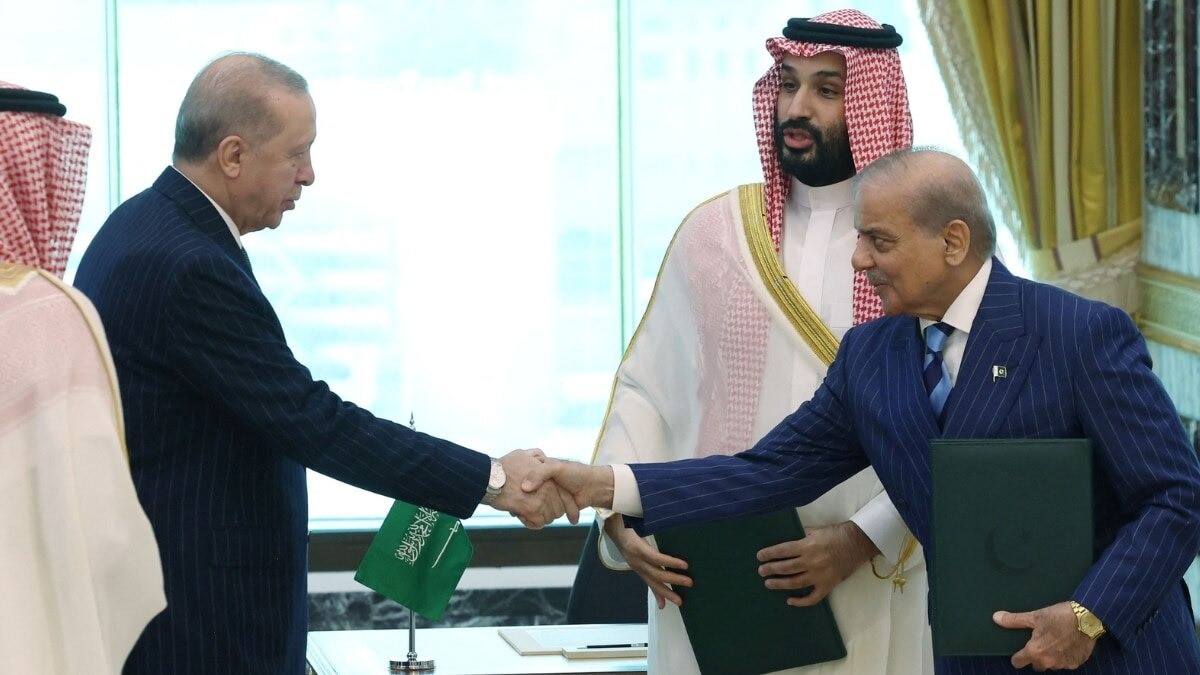
Pakistan, Saudi Arabia and Turkiye signed the Makkah Joint Defence Agreement on August 7 amid increasing security concerns following escalating tensions in West Asia. Prime Minister Shehbaz Sharif, Saudi Crown Prince Mohammed bin Salman and Turkish President Recep Tayyip Erdogan signed the pact after the Makkah Al-Mukarramah Summit for Joint Defence at Al-Safa Palace in Mecca. A joint statement said the agreement was intended to strengthen collective deterrence against any act of aggression and that any armed attack against one of the three states would be regarded as an attack against them all.
In New Delhi, India's External Affairs Ministry spokesperson Randhir Jaiswal said on Friday, "We continue to closely follow all developments having a bearing on India's security and take all necessary steps to safeguard it." Foreign policy experts and former diplomats said Bangladesh's willingness to join the pact marked a departure from its long-held doctrine of strict non-alignment and could complicate its foreign relations, particularly with neighbouring India.
Former ambassador and commentator Mahfuzur Rahman said the existing three partners were in military conflicts or could be involved in armed confrontations with other countries, while Bangladesh had little possibility of facing such a situation. "A military accord like the Mecca Pact could be important for Saudi Arabia, Pakistan and Turkiye, but not essential in any way for Bangladesh," he told PTI. He said Bangladesh could get involved in a war situation for "no justified reason" if it joined the pact, which "has an article on collective security".
Another former diplomat, Humayun Kabir, who runs the Bangladesh Enterprise Institute, said Bangladesh had traditionally followed a policy of not joining military pacts. "If this is a military pact, then we have to examine how the security interests of all its members align with Bangladesh's national security interests," he said, adding that the country would need to understand how the inclusion of certain countries would affect its security, economic interests and broader strategic interests. Supporters of the pact, however, said the alliance would give Bangladesh strategic depth and strengthen national security. Retired military general Fazle Elahi Akbar, a former defence adviser to ex-prime minister Khaleda Zia who runs the Foundation for Strategic and Development Studies, said the argument that joining an alliance would "drag us into war" was an "overestimation of the risks".
Bangladesh has yet to receive a formal offer to join the Makkah Joint Defence Agreement, but its leaders have said they view the pact positively, while diplomats and analysts remain divided over what such a move could mean for the country's foreign and security policy.
With PTI Inputs
- Ends
Published By:
India Today Web Desk
Published On:
Aug 30, 2026 22:44 IST