3 weeks ago
An installation at a London gallery which described former British PM Winston Churchill as responsible for the "wilful starvation" of millions of Indians during the 1943 Bengal famine, has been removed from the public display. The artist was forced to take the installation off after at least 50 members of the House of Lords, including Chirchill's grandson, protested and demanded its removal.
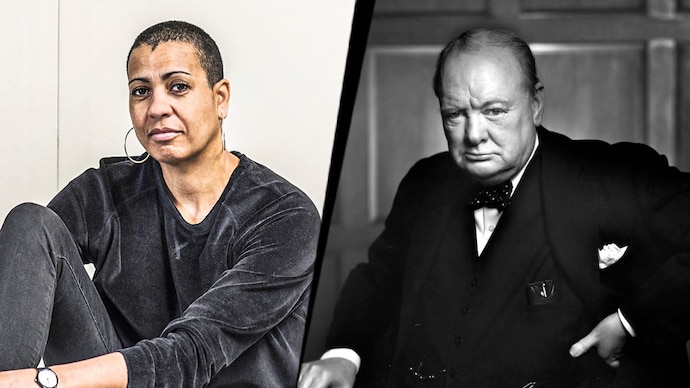
Helen Cammock's (Left) video installation highlighted Winston Churchill's role in the 1943 Bengal famine at London's Gallery. (Images: Wikimedia Commons)

New Delhi,UPDATED: Jun 23, 2026 19:04 IST
A video installation at London's Portrait Gallery (NPG) that described former British Prime Minister Winston Churchill as responsible for the "wilful starvation" of millions of Indians during the 1943 Bengal famine has been taken off public display. The removal came after members of the British House of Lords, including Churchill's grandson, criticised the work as historically inaccurate and lodged formal objections with the gallery.
The dispute centres on Persistence, a 40-minute video work by Turner Prize-winning artist Helen Cammock, which had been on display at the gallery for the past 10 months as part of the exhibition Artists First: Contemporary Perspectives on Portraiture, according to a report in the BBC.
In the film, Cammock compared English statesman and parliamentarian Oliver Cromwell's military campaigns in Ireland to Churchill's actions during the Bengal famine, stating that Cromwell "starved people, en masse, a little like the wilful starvation of the Indian population by Winston Churchill".
The claim prompted a wave of backlash led by Churchill's biographer Andrew Roberts (Lord Roberts of Belgravia). According to reports by the BBC and The Guardian, Roberts wrote an open letter to the Portrait Gallery that was signed by more than 50 members of the House of Lords, including Churchill's grandson, Nicholas Soames.
Soames, a grandson of Churchill, was elevated to the House of Lords as a life peer in 2022 and now sits as Baron Soames of Fletching.
The letter by Churchill's supporters described artist Helen Cammock's assertion as a "barefaced lie" and labelled the film an "ideologically motivated rant".
Churchill's biographer, Roberts, argued that the Bengal famine was primarily caused by a devastating typhoon and wartime conditions. He also claimed that Churchill had instructed his War Cabinet to make every effort to alleviate the crisis and sought grain imports from international partners, reported The Guardian.
The Bengal famine remains one of the deadliest humanitarian disasters in India's history, with an estimated 3.8 million people dying in eastern India in 1943. While historians in India have held Churchill responsible, British historians remain divided over the former British prime minister's role.
Some scholars argue that Churchill's wartime policies worsened existing food shortages. They contend that warnings about declining rice supplies were ignored and that food resources were diverted elsewhere within the British Empire during World War II rather than being retained in India.
The Japanese conquest of Burma (now Myanmar) in 1942 also contributed to the crisis. Fearing a Japanese invasion, British forces implemented a "Denial Policy" that involved the large-scale seizure and destruction of boats in coastal Bengal, disrupting the transport and distribution of rice and other essential goods. The Burma Road had also been cut off, effectively shutting down a key potential route for rice imports into Bengal.
Some historians reject the idea that Churchill deliberately caused the famine. They point to factors such as crop failures, wartime disruption, inflation, supply-chain breakdowns and local administrative failures. Defenders of Churchill also argue that once the scale of the crisis became clear, the British government took steps to provide relief, although critics say those efforts came too late.
The Telegraph also criticised Cammock's interpretation, describing the famine as "a lethal food shortage caused by natural disasters and exacerbated by local mismanagement and wartime supply problems".
Following the public dispute, Cammock decided to remove the work from display.
In a statement reported by the BBC, she defended the installation and criticised what she described as growing pressure on artists and cultural institutions.
"There is incredible pressure on artists and art institutions to bend to external pressure; to be benign at best and silent at worst," she said, adding, "I do not accept this pressure. To question, challenge and explore ideas and histories is vital to a healthy society and art is intrinsic to this."
Cammock also stressed that Persistence was not intended to be a historical documentary. In comments reported by The Guardian, she said, "It is not a documentary, it is a creative work that explores ideas and thoughts in response to the Portrait Gallery, its collection and its archives."
She added that the work sought to examine "who is honoured and valorised and who is not; whose stories are told and whose are not... and how histories are created and then maintained."
The Portrait Gallery said it respected Cammock's decision to withdraw the installation while acknowledging criticism from those who found its content offensive. The gallery said the work had been presented as an artistic response rather than a documentary account and that the views expressed did not necessarily reflect those of the institution.
British Prime Minister Winston Churchill, leader of the UK throughout World War 2, and one of those chiefly responsible for failing to reign in the humanitarian catastrophe that was the 1943 Bengal Famine, died in 1965. Around 61 years later, artwork on his deeds continues to rile up the British.
- Ends
Published By:
Shounak Sanyal
Published On:
Jun 23, 2026 19:04 IST