3 weeks ago
Newly declassified intelligence records have reignited one of the most contentious debates of the pandemic era. The documents place fresh scrutiny on Anthony Fauci, US funding linked to Wuhan research and the way intelligence agencies assessed competing theories about Covid's origins.
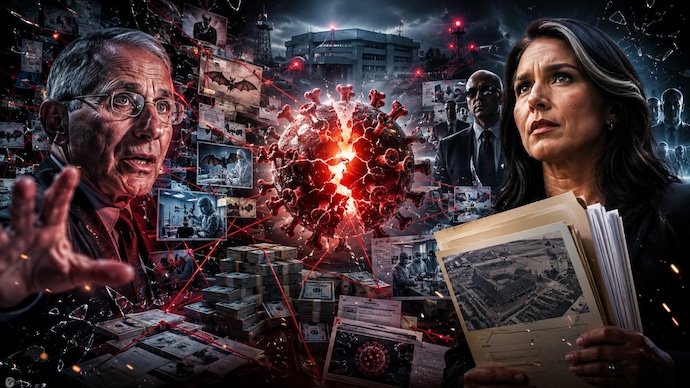
Former DNI Tulsi Gabbard releases declassified files (AI Generated)

UPDATED: Jun 23, 2026 23:16 IST
Five years after COVID changed the world, one of the pandemic's biggest controversies is back in the spotlight. A fresh release of declassified documents by outgoing Director of Intelligence Tulsi Gabbard has reopened the debate over the origins of COVID, the role of US-funded research in Wuhan and whether key public officials influenced how the story was told.
At the centre of the storm is Anthony Fauci, the former head of the Institute of Allergy and Infectious Diseases. According to the newly released records, Fauci authorised millions of dollars in US taxpayer funding for coronavirus research connected to the Wuhan Institute of Virology through research partnerships involving bat coronaviruses.
That fact alone does not prove that the research caused the pandemic. However, it has renewed attention on where funding went, what type of experiments were conducted and how closely American agencies were linked to research taking place in Wuhan before COVID-19 emerged.
The documents released by Gabbard go further. They accuse Fauci of playing a significant role in shaping intelligence assessments about the virus's origins and claim that his recommendations were frequently incorporated into official analyses.
According to the release, Fauci supplied scientific experts who advised intelligence officials examining competing explanations for the pandemic. Critics argue that this created a feedback loop in which scientists linked to Fauci helped shape assessments that were later cited as evidence supporting particular conclusions.
The records also challenge statements Fauci made under oath before Congress in 2024. Correspondence included in the release suggests he had interactions with intelligence officials concerning COVID-related research and origins investigations. The documents argue these contacts contradict parts of his congressional testimony.
The renewed attention comes alongside the release of a previously undisclosed May 2020 assessment from Lawrence Livermore Laboratory.
The report concluded that all conditions necessary for an accidental release of a laboratory-modified coronavirus were present at the Wuhan Institute of Virology before the pandemic began. Researchers at the laboratory identified access to relevant viruses, coronavirus modification capabilities, experiments involving human receptors and the possibility of biosafety failures.
Importantly, the assessment did not conclude that a laboratory leak occurred. Nor did it state that the virus was engineered.
Instead, analysts assigned equal weight to three possibilities: a laboratory-modified virus accidentally escaping, a naturally emerging virus or a naturally occurring virus accidentally released from a laboratory.
The newly released emails paint a picture of intelligence officials wrestling with competing explanations rather than reaching a settled conclusion. Some analysts argued that natural origins remained plausible. Others believed laboratory scenarios deserved serious consideration.
The document release also highlights whistleblower allegations from intelligence personnel. Several individuals claimed that analysts who challenged prevailing views on COVID-19’s origins faced pressure, marginalisation or professional consequences. These allegations have been referred to the Intelligence Community's Inspector General.
The significance of the controversy extends beyond the origins of a single virus.
The debate touches on government transparency, oversight of high-risk scientific research, and the relationship between scientific experts and intelligence agencies during a global crisis.
The new records do not provide a definitive answer to where COVID came from. What they do provide is a detailed glimpse into how decisions were made, how intelligence assessments evolved, and how one of the most consequential debates of the modern era unfolded behind closed doors.
Five years later, the search for answers remains as politically charged as ever.
- Ends
Published On:
Jun 23, 2026 23:16 IST