3 weeks ago
Keir Starmer expected to announce exit timetable
Good morning. Tomorrow is the 10th anniversary of the referendum to leave the EU, which means that Wednesday is the 10th anniversary of the day David Cameron announced he was resigning as PM. After Cameron was forced out by the result of his own referendum, another three Tory PMs were forced out by their own MPs (Theresa May, Boris Johnson and Liz Truss) and another was forced out by the electorate (Rishi Sunak). Keir Starmer has been PM for less than two years, but he is about to become the sixth PM forced out within a decade, being replaced almost certainly by Andy Burnham.
In the past the British used to joke about Italy being a country where prime ministers kept changing all the time. These days Italy looks like a beacon of stability, and Britain has become the place never that far from another bout of political turmoil.
Starmer spent the weekend pondering his future at Chequers. He is back in London now and – although No 10 has not confirmed this – journalists are on standby for an announcement potentially this morning.
Here is our overnight story by Peter Walker and Pippa Crerar.
While a Starmer resignation looks inevitable, we don’t know whether there will be a leadership election or (more likely) an uncontested handover of power to Burnham. And we don’t know whether Starmer will propose staying on until September, or whether the handover will be accelerated. We will find out more as the day goes on.
The crucial event is not in the diary, because it has not been confirmed, but these are the timings we do have.
11.30am: Downing Street is expected to hold a lobby briefing.
2.30pm: Andy Burnham is due to take his seat in the Commons as the new MP for Makerfield.
After 3.30pm: Keir Starmer is expected to make a Commons statement about the G7 summit last week.
If you want to contact me, please post a message below the line when comments are open (between 10am and 3pm), or message me on social media. I can’t read all the messages BTL, but if you put “Andrew” in a message aimed at me, I am more likely to see it because I search for posts containing that word.
If you want to flag something up urgently, it is best to use social media. You can reach me on Bluesky at @andrewsparrowgdn.bsky.social. The Guardian has given up posting from its official accounts on X, but individual Guardian journalists are there, I still have my account, and if you message me there at @AndrewSparrow, I will see it and respond if necessary.
I find it very helpful when readers point out mistakes, even minor typos. No error is too small to correct. And I find your questions very interesting too. I can’t promise to reply to them all, but I will try to reply to as many as I can, either BTL or sometimes in the blog.
Key events
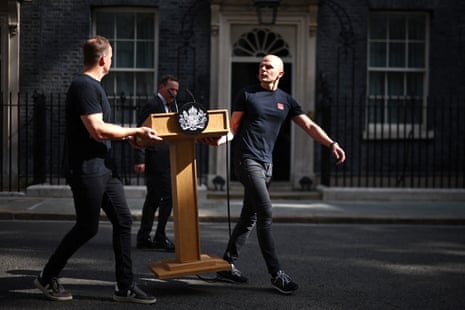
From ITV’s Paul Brand
The podium has now been wheeled out in No10. Keir Starmer is expected to make a statement imminently - within 10 mins or so.

Peter Walker
There are now some Downing Street staff beginning to assemble at the far end of the street.
Peter Walker
Peter Walker is a senior Guardian political correspondent, who is in Downing Street.
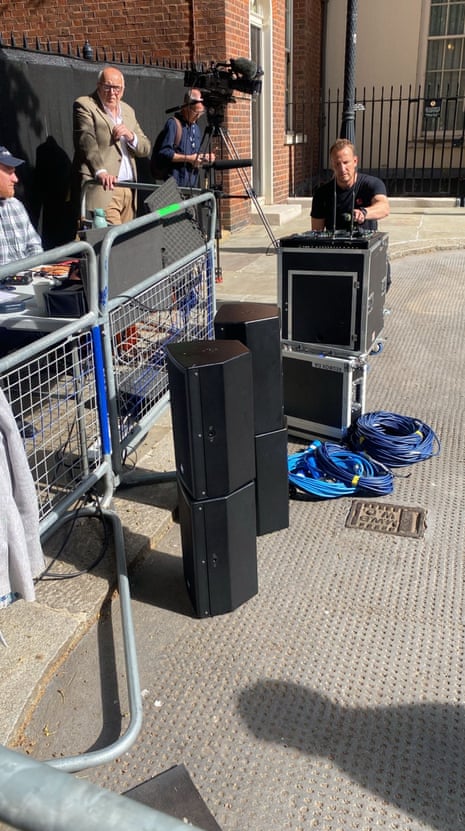
Outside No 10 they have just tested some speakers …
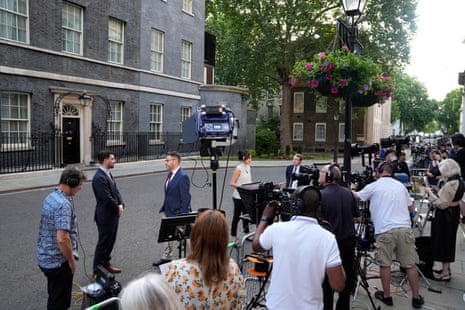
There is a sense of activity stepping up in Downing Street, with officials making sure the media are behind barriers, and otherwise dashing around. It feels like it should be soon now …
And now the lectern is out.
The BBC’s Laura Kuenssberg has posted this on social media.
All the signs are there in Number 10 that Starmer statement is not far off

Jessica Elgot
Jessica Elgot is the Guardian’s deputy political editor.
A July transition is the strong preference from many of the most influential figures around Andy Burnham - if there is no other candidate in a leadership contest.
There is a fear among some of his supporters that a longer transition would leave a vacuum for Burnham’s opponents - and online agitators - to start damaging the incoming prime minister before he took power. “There are pros and cons, but we have told the country we are ready to make him prime minister and we should make good on that,” said one.
The Guardian reported in May that the main aim of Burnham’s team was to ensure he was in place to give the leader’s speech by Labour party conference in mid-September - and to give him time to make preparations for entering government.
But there are growing fears of a scenario similar to when Boris Johnson was a “lame duck” prime minister during the summer of 2022 when there was an energy crisis and no government intervention.
No 10 is gearing up for an announcement. This is from the BBC’s Henry Zeffman.
The equipment for a lectern moment is being assembled in Downing Street
This is from Tom Baldwin, Keir Starmer’s biographer, and head of communications for Ed Miliband when he was Labour leader.
We seem to be in a strange place where Keir Starmer is being told he must quit to prevent more uncertainty and chaos (by those who have caused much of it) but then stay on for a couple of months because the guy who has been desperate to take his job is not yet ready to do so…
And these are from John Slinger MP, another Labour voice supportive of the PM.
Keir Starmer has a mandate from Labour members.
He stood on a manifesto and won a mandate from the British people
His challengers haven’t even bothered to challenge him.
What is their manifesto, their prospectus for [Britain].
What would their mandate be?
[Coronations] are for Kings not PMs
Modern politics:
Consumerisation
Rights not responsibilities
Instant gratification
Rolling news over analysis
Blame culture
Toxic social media
Charisma over character
Popularity over policy
Politics = my life over life experience
Disagreeing disagreeably
Short-termism
Out-dated
If you are curious as to why the Labour party is ditching Keir Starmer as PM after less than two years in office, when he clearly isn’t a total disaster like Liz Truss, or a complete scoundrel like Boris Johnson, you should have a look at a terrific series of essays by Chris Clarke on Substack about trust in politics. Starmer is being forced out in part because of mistakes he has made, and weaknesses he has as a communicator and a leader. But he is also in part being forced out because he is operating in an environment where the public are more hostile to politicians than ever before in the modern era.
This chart illustrates this best; it shows the average net satisfaction with all the main party leaders at all points since 1977. As with much in British public life, it’s got a lot worse since Brexit.
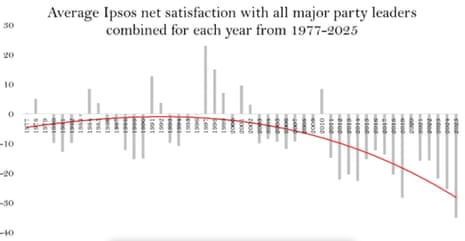
It is worth reading the Clarke essays in full, but in essence his argument is that “low trust is the result of a context where our leaders have less agency, but are subject to more exposure and higher expectations. In particular, the intense scrutiny of the information age has caused politicians to shrink from the light.”
In a passage that chimes with what Gus O’Donnell said on the Today programme this morning about manifesto pledges (see 8.29am), Clarke says:
Sections of the population are asking our leaders for things which cannot be done without self-harm to the economy, for reasons which are extremely technical and complex to explain. Steps that the right or the left see as basic common sense – such as sending boats back or banning eight figure salaries, respectively – require almost significant extrication from the international system to be achieved. This is not to say we could not do more on wealth inequality. But it’s to say that room for manoeuvre has narrowed, forcing the main parties closer together.
Jacqui Smith, the education minister, was also on the Today programme. When Nick Robinson, the presenter, put it to her that ‘it’s over, isn’t it?’, Smith replied: “No, I think you’re getting ahead of yourself.”
Gus O'Donnell questions whether political turmoil linked to PMs being constrained by manifesto promises
Gus O’Donnell, the former cabinet secretary, was interviewed on the Today programme this morning. Asked if he was worried about Britain becoming as unstable politically as Italy used to be (see 7.11am), O’Donnell replied:
It will be our seventh [PM] in a decade.
I do think we need to think about, if we’re having a prime minister change in mid-term, what’s the problem?
And it quite possibly could be that they’re elected on a manifesto that doesn’t work given the circumstances have changed.
So we’ve had a Middle East war, we’ve had a spike in inflation. Lots of things have changed.
So, maybe, maybe, you need to think some of those things in the manifesto that were perfectly legitimate at the time may not be appropriate given the circumstances we’re in now.
All the national newspapers are splashing on the fate of Keir Starmer. The BBC has a summary including pictures of all the front pages. Two papers, the Times and the Daily Telegraph, have headlines saying Burnham wants to be PM by September.
Alex Burghart, the shadow Cabinet Office minister, was on the Today programme this morning putting the Conservative party’s case on Keir Starmer being replaced. He said having a new PM would not make much difference because the government’s problems were down to the views of Labour MPs. He said:
Constitutionally there doesn’t have to be a general election, you can change prime ministers. What matters is whether the prime minister has the support of MPs in parliament.
But I have to say that there, it’s not just Keir Starmer’s legitimacy that is being called into question, it’s Labour’s.
You can change the person at the top, but if the MPs underneath still think and vote the same way, then nothing will change.
Burghart quoted Pat McFadden’s joke about Labour MPs wanting higher taxes to fund more welfare, revealed in the Mandelson files, as evidence to support his case.
Normally, when the governing party replaces the PM with the public being consulted, opposition parties demand an election. But given that the Tories changed their leader four times when they were in power without calling an immediate election, the party cannot credibly make that argument now.
But on BBC Breakfast Burghart did say that a period of instability would be “very bad for the United Kingdom” and that “we can’t be a country that changes PM every few years” – implying that he does accept that the Tories’ record in this respect left something to be desired.
Starmer will put 'interests of British people' first in any decision he takes, says education minister Jacqui Smith
Jacqui Smith, the education minister, is doing a broadcast round this morning. Speaking to Times Radio, she said she “would have been happy for [Keir Starmer] to continue” – which sounded like a confirmation that Starmer will announce his resignation, but may just be confirmation that Smith has read the papers.
She also said:
My understanding from those I’ve spoken to who are close to the prime minister yesterday is that the prime minister has spent the weekend thinking really carefully about the future of the country, about what’s the best thing to do for the British people.
He’s also, by the way, been of course engaged in government, responding to the terrible train crash, talking to the chief executive of the East Midlands ambulance service, responding to the attack in Edinburgh.
But he always thinks carefully about the future of this country and the interests of the British people – he puts them, by the way, ahead of the interests of the party – and he will make his own decisions in the light of what obviously everybody can see is a considerable amount of pressure and turbulence.
Peter Kyle, the business secretary, also stressed that Starmer’s priority was acting in the national interest when he gave an interview to the BBC yesterday.
Libby Brooks has written about Keir Starmer’s predicament in her First Edition briefing this morning. Here it is.
And here is an excerpt.
Since then, I’ve reported on people’s anger at successive prime ministers, but none have been so viscerally disliked across the spectrum as Starmer – so I called up Polly [Toynbee], who was busy working on her column, to ask what it is about him that stirs such passion. I’ve heard it myself on the doorsteps during the recent Holyrood election campaign: welfare reforms, Gaza, Mandelson … Weren’t no clothes peg big enough. And still Starmer didn’t take us into an illegal war or party while grieving relatives were kept away from their dying loved ones during Covid lockdowns.
Is it down to that enduring criticism of Starmer’s poor storytelling, or voters’ accumulated disappointments, or simply politics in the social media age?
“I’ve tried to analyse it a bit in the column,” Polly tells me, “which is a kind of warning to Andy Burnham too, that first impressions are so important. First there was Starmer’s very dismal speech in the Downing Street garden, then Rachel Reeves’s very dismal £22m black hole …” Polly’s list goes on: freebies, the winter fuel payment, the farmers’ tax.
“They did a whole string of things behind the scenes that were really important – Great British Energy, the wealth fund – but they’re not the sort of things people notice.
“What’s interesting is that the last four prime ministers have each been the most unpopular ever,” Polly adds. “That’s extraordinary. Maybe we’re in a time of such hatred of politics, after 20 years of stagnation and disappointed expectations.”
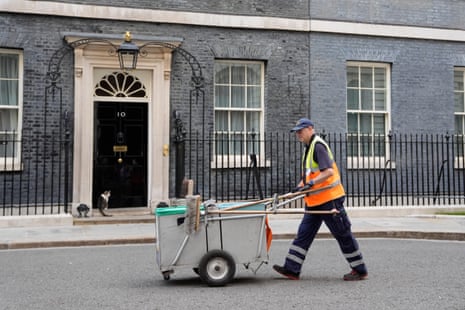
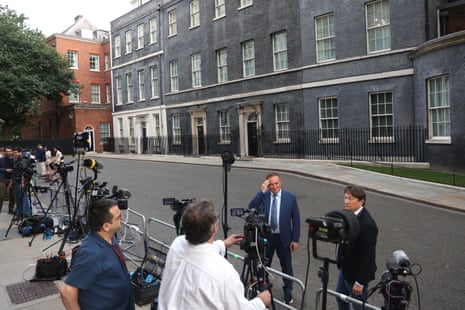
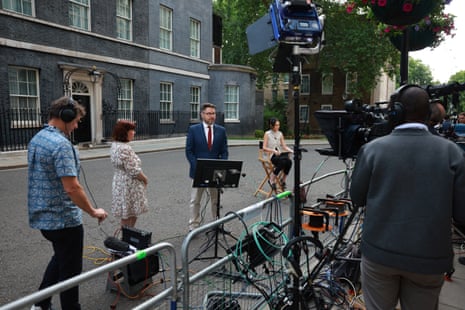
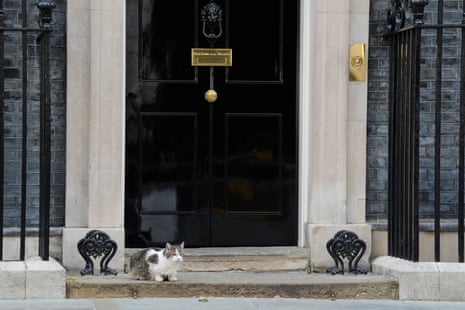
Here are some pictures from Downing Street this morning.
Keir Starmer expected to announce exit timetable
Good morning. Tomorrow is the 10th anniversary of the referendum to leave the EU, which means that Wednesday is the 10th anniversary of the day David Cameron announced he was resigning as PM. After Cameron was forced out by the result of his own referendum, another three Tory PMs were forced out by their own MPs (Theresa May, Boris Johnson and Liz Truss) and another was forced out by the electorate (Rishi Sunak). Keir Starmer has been PM for less than two years, but he is about to become the sixth PM forced out within a decade, being replaced almost certainly by Andy Burnham.
In the past the British used to joke about Italy being a country where prime ministers kept changing all the time. These days Italy looks like a beacon of stability, and Britain has become the place never that far from another bout of political turmoil.
Starmer spent the weekend pondering his future at Chequers. He is back in London now and – although No 10 has not confirmed this – journalists are on standby for an announcement potentially this morning.
Here is our overnight story by Peter Walker and Pippa Crerar.
While a Starmer resignation looks inevitable, we don’t know whether there will be a leadership election or (more likely) an uncontested handover of power to Burnham. And we don’t know whether Starmer will propose staying on until September, or whether the handover will be accelerated. We will find out more as the day goes on.
The crucial event is not in the diary, because it has not been confirmed, but these are the timings we do have.
11.30am: Downing Street is expected to hold a lobby briefing.
2.30pm: Andy Burnham is due to take his seat in the Commons as the new MP for Makerfield.
After 3.30pm: Keir Starmer is expected to make a Commons statement about the G7 summit last week.
If you want to contact me, please post a message below the line when comments are open (between 10am and 3pm), or message me on social media. I can’t read all the messages BTL, but if you put “Andrew” in a message aimed at me, I am more likely to see it because I search for posts containing that word.
If you want to flag something up urgently, it is best to use social media. You can reach me on Bluesky at @andrewsparrowgdn.bsky.social. The Guardian has given up posting from its official accounts on X, but individual Guardian journalists are there, I still have my account, and if you message me there at @AndrewSparrow, I will see it and respond if necessary.
I find it very helpful when readers point out mistakes, even minor typos. No error is too small to correct. And I find your questions very interesting too. I can’t promise to reply to them all, but I will try to reply to as many as I can, either BTL or sometimes in the blog.