1 month ago
A night of panic at the White House Correspondents' dinner was followed by a familiar Trump refrain. Back at the White House, he invoked Abraham Lincoln again, tying danger to presidential greatness.
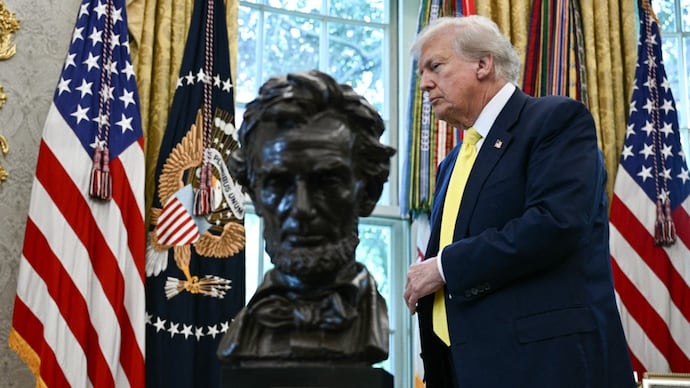
US President Donald Trump, alongside a bust of former President Abraham Lincoln, in the Oval Office. (AFP photo)
For the third time in three years, Donald Trump found himself close to gunfire — or the fear of it. On Saturday night, a man with multiple weapons allegedly charged a security checkpoint at the White House Correspondents’ Association dinner, sending guests under tables and prompting a swift evacuation of Trump and senior officials.
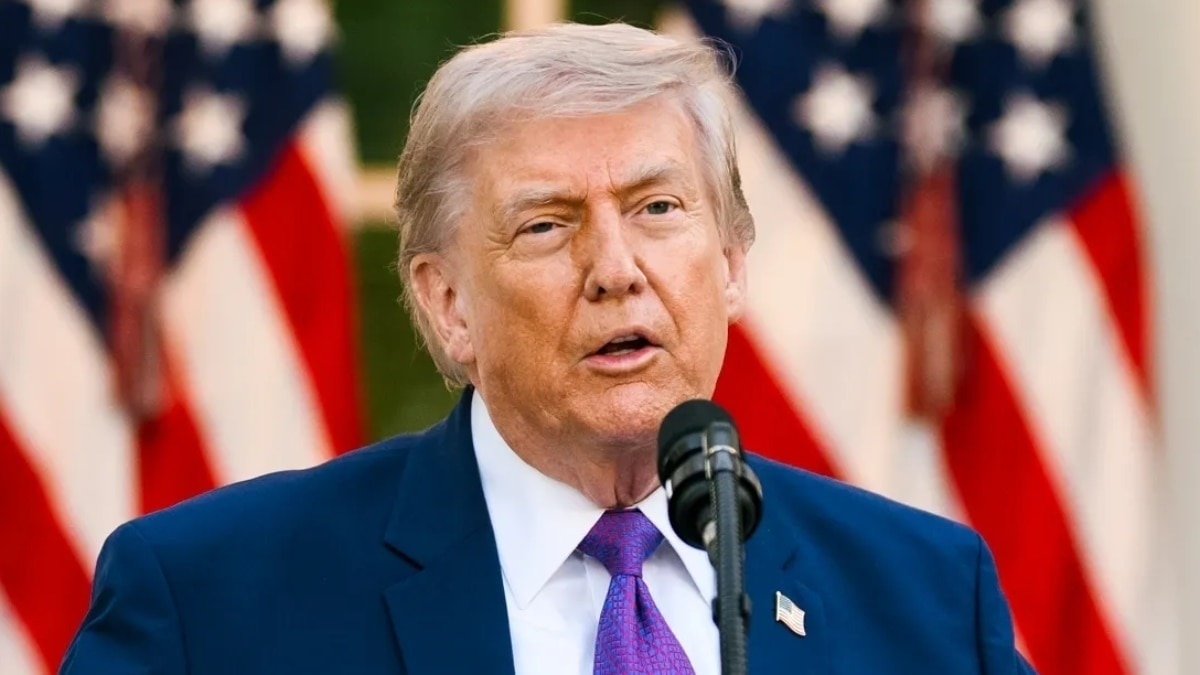
Hours later, back at the White House and still in his black-tie dinner jacket, Trump tried to explain why he believed he had repeatedly become a target. “I studied assassinations,” he said. “The people that make the biggest impact, they’re the ones that they go after.”
Then he invoked Abraham Lincoln – the president assassinated in 1865 after being shot by John Wilkes Booth at Ford’s Theatre.
It was not the first time Trump had reached for Lincoln. For years, he has used the nation’s 16th president as a measure of greatness, political resilience and historic stature, sometimes reverently, sometimes competitively.
GALA DESCENDS INTO CHAOS
The annual correspondents’ dinner at the Washington Hilton had only just begun. Salad plates were out, glasses of wine poured, and some 2,600 journalists, officials and guests were settling into one of Washington’s most ceremonial evenings.
Then came what attendees first described as strange thuds.
Doors burst open. Security agents rushed in. Some tackled officials to the floor. Others drew weapons. Guests ducked beneath banquet tables as plainclothes officers moved through the ballroom.
Trump later said he initially mistook the sound for a catering mishap.
“I thought it was a tray going down,” he said. “There was a gun and some people really understood that quite quickly.”
Authorities said the suspect had run through a checkpoint above the ballroom and fired at a Secret Service agent, who was protected by a bulletproof vest. The man, identified as Cole Tomas Allen, was subdued before reaching the ballroom doors.
Officials have not publicly confirmed a motive or whether Trump was the intended target.
‘A DANGEROUS PROFESSION’
Trump has often treated peril as both burden and credential. On Saturday night, he did so again.
“It’s a dangerous profession,” he said, comparing politics to race-car driving and bull riding. “Nobody told me this was such a dangerous thing.”
He added, jokingly, that Marco Rubio had not warned him about the risks of seeking office.
Yet beneath the bravado was a reality impossible to ignore: no recent American political figure has faced as many high-profile threats in such a compressed period.
SHADOW OF 2024
Trump returned to office after surviving two grave security incidents during the 2024 campaign.
In July of that year, a gunman opened fire at a rally in Butler, Pennsylvania, grazing Trump’s ear and killing a spectator before being shot by Secret Service snipers.
Two months later, authorities said another armed man was discovered hiding near Trump’s golf club in Florida, in what investigators described as an apparent assassination plot.
Saturday’s confrontation, though different in scale and still under investigation, instantly revived those memories.
LINCOLN, MEMORY, AND POWER
Lincoln occupies a singular place in American memory: wartime leader, emancipator, martyr. To invoke him in the context of assassination is to suggest not just vulnerability, but consequence.
Trump made the point explicitly.
“They don’t go after the ones that don’t do much,” he said. “They go after the people that make the biggest impact.”
To Trump, Lincoln has frequently functioned less as a historical subject than as a symbol — proof that embattled leaders are consequential ones.
He has long treated Lincoln less as a distant historical figure than as a benchmark against which to measure himself.
In 2019, he told supporters he could be “more presidential than any president in history except for Honest Abe Lincoln, when he’s wearing the hat.” At another rally that year in Texas, he joked that Lincoln “could not win Texas under those circumstances.”
He has also noted that Lincoln was a Republican, drawing partisan continuity between the 19th century party of Union and emancipation and the modern Republican Party he leads.
On Saturday night, in the aftermath of another security scare, Trump returned to the comparison in a darker register, linking Lincoln not to style or elections, but to assassination.
THE SHOW GOES ON
According to officials, Trump initially wanted the dinner to continue and hoped to return another time. Eventually, security officials persuaded him otherwise.
By then, guests were leaving the Hilton in tuxedos and evening gowns, bow ties loosened, heels in hand, phones raised to record the scene outside.
- Ends
(With inputs from Reuters)
Published On:
Apr 26, 2026 17:37 IST
Tune In