1 month ago
US Representatives Tom Suozzi and Max Miller have introduced the bipartisan SACRED Act to curb harassment outside places of worship. The proposal has drawn backing from faith groups and is being presented as consistent with First Amendment protections.
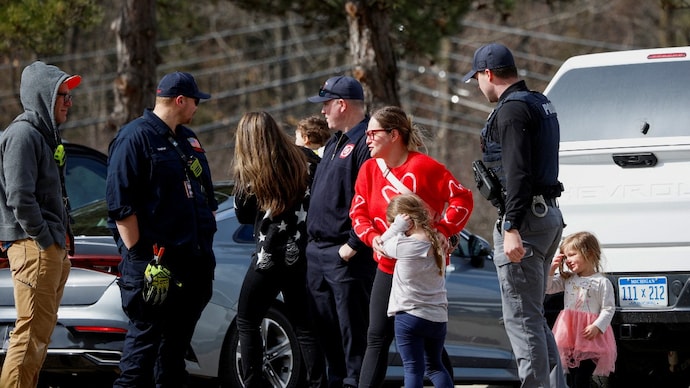
Parents who pulled out their kids from the Temple Israel Synagogue stand near police after the Michigan State Police reported an active shooting incident there, in West Bloomfield, Michigan, US, March 12, 2026. (Photo- Reuters)

New York,UPDATED: Apr 28, 2026 07:52 IST
In response to a nationwide surge in harassment and intimidation outside religious institutions, US Representatives Tom Suozzi (D-NY) and Max Miller (R-OH) have introduced bipartisan legislation aimed at protecting Americans' ability to safely access their places of worship.
The lawmakers unveiled the Safeguarding Access to Congregations and Religious Establishments from Disruption (SACRED) Act on Monday during a press conference at the Holocaust Memorial and Tolerance Center of Nassau County. Surrounded by leaders from diverse faith and advocacy groups, Rep. Suozzi emphasized the urgent need to address the growing fear among constituents who face hostility simply for practicing their religion.
“No one deserves to be harassed or intimidated, especially on their way to their place of worship,” Rep. Suozzi said. “We have a responsibility to address that fear in a thoughtful, targeted way that protects our constituents while balancing the First Amendment right to peacefully protest.”
KEY PROVISIONS OF THE SACRED ACT
Currently, there is no dedicated federal statute explicitly protecting worshippers from harassment right at the doors of their religious institutions. If passed, the SACRED Act would establish strict federal penalties to bridge this gap.
Under the proposed legislation, it would become a federal crime to intentionally intimidate, obstruct, or harass individuals exercising their right to religious worship. Specifically, the bill prohibits:
* Threatening or physically blocking the path of worshippers within 100 feet of a place of worship.
* Approaching an individual within 8 feet for the explicit purpose of harassment or intimidation while they are within that 100-foot buffer zone.
A RESPONSE TO RISING TIDES OF INTIMIDATION
The legislation comes at a time when communities across the country—including synagogues, churches, mosques, Hindu mandirs, and Sikh gurdwaras—have reported an unprecedented wave of aggressive demonstrations. Worshippers have frequently reported being shouted at, physically blocked from entering services, and subjected to threatening rhetoric.
According to the Anti-Defamation League (ADL), antisemitic incidents have reached historic levels, with the organization tracking over 9,300 incidents in 2024 alone. Similarly, the American Jewish Committee (AJC) recently reported that 55% of American Jews have altered their behavior in the past year out of fear of antisemitism.
“Every American deserves to practice their faith free from fear, intimidation, or harassment,” said Rep. Miller, the bill's Republican co-lead. “This commonsense legislation draws a clear line: intimidation and threats have no place in our communities.”
BROAD COALITION OF SUPPORT AND LEGAL BACKING
The SACRED Act has garnered sweeping endorsements from a wide array of religious and civil rights organisations. The coalition of supporters includes the ADL, AJC, the Union of Orthodox Jewish Congregations of America (OU), Hadassah, the Islamic Society of North America (ISNA), the Hindu American Foundation (HAF), and United Sikhs, among others.
Faith leaders at the rollout stressed that protecting the sanctity of worship is a universal concern. Azhar Azeez, CEO of the Islamic Society of North America, noted, “Let every place of worship be a sanctuary free from intimidation, obstruction, or harassment so all people may practice their faith in peace, dignity, and safety.”
Similarly, Samir Kalra of the Hindu American Foundation highlighted the disturbing rise in the desecration of Hindu mandirs, stating the bill is a "critical step" in ensuring these spaces remain safe for devotees.
Anticipating questions regarding freedom of speech, the bill's sponsors noted that the legislation was crafted to safeguard constitutional rights. Erwin Chemerinsky, Dean of the UC Berkeley School of Law and a prominent constitutional scholar, has reviewed the legislation and stated that the bill is entirely "consistent with the First Amendment."
- Ends
Published By:
Zafar Zaidi
Published On:
Apr 28, 2026 07:52 IST