1 month ago
India Today's Open Source Intelligence (OSINT) team pieces together how the US plans to reopen the troubled Hormuz after 66 days of traffic disruption.
Representative image generated with AI
Risking a breaking point in an already fragile ceasefire, the United States and Iran have exchanged direct hostilities in the Strait of Hormuz. The escalation came hours after US President Donald Trump launched “Project Freedom,” an exercise he claimed would enable the United States to assist vessels from countries not involved in the conflict to safely transit the contested waters of the Strait of Hormuz.
However, US Secretary of War Pete Hegseth clarified that this does not signal an end to the ceasefire, adding that he would “certainly urge Iran to be prudent in the actions it takes to keep the situation below this threshold.”
Further stressing the same point, US Chairman of the Joint Chiefs of Staff General Dan Caine said all the escalatory attacks by Iran were “below the threshold of restarting any major combat operations at this point.”
For now, what is clear is that, on the sidelines of Operation Epic Fury, the US is opening a sub-theatre with Project Freedom by creating a gateway for stranded ships to exit the troubled waters.
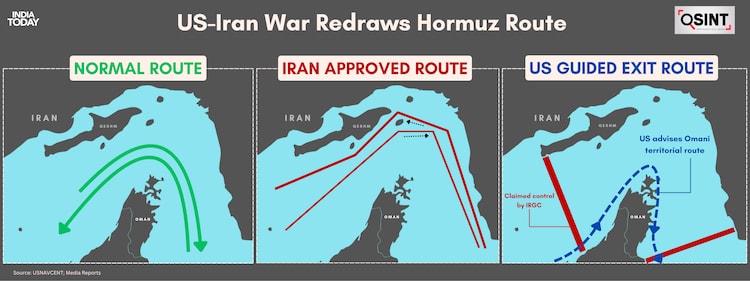
Both Iran and the US have issued separate directives on the routes merchant ships should follow for safe passage. The US Navy has advised vessels to move closer to Omani territorial waters, while Tehran insists that ships pass nearer to its own boundary and seek clearance from the Islamic Revolutionary Guard Corps.
Caine said that “the US has established an enhanced security area on the southern side of the Strait of Hormuz using its naval, land, and air capabilities Commercial vessels opting for this security area will see, hear, and frankly feel the US presence at sea, in the air, and over radio.”
The larger question now is: how many of the roughly 1,500 stranded vessels will choose this new route?
Two US-flagged merchant vessels were safely escorted through the waterway with the support of US destroyers, Apache helicopters and MH-60 aircraft. A CBS News report suggests that two US destroyers, the USS Truxtun and the USS Mason, aided by air support, transited into the Persian Gulf via the Strait of Hormuz on Monday.
Both the United States and Iran acknowledge that Tehran launched a barrage of drones and missiles as the US attempted to guide two US-flagged merchant vessels. However, the difference lies in the outcome.
Iran claims it forced US vessels to retreat, while the United States maintains that the transit was completed safely.
India Today’s Open Source Intelligence (OSINT) team analyses media reports and government briefings to piece together what prompted this disruption on Monday, and how this event unfolded just days before what was expected to be a month-long ceasefire.
While several explosions across the Gulf remain confirmed, aligning with claims made by both sides, the escalation has clearly spilled beyond the Strait of Hormuz, with the UAE’s Fujairah Port entering Tehran’s radar for the first time since the April 8 truce.
US MUSCLE FOR HORMUZ RESCUE
The US blockade continues, while Tehran maintains that the IRGC controls Hormuz and that any transit is possible only with its permission. Iran further claims that its attack on Moday thwarted the US attempt to cross the contested waters and forced American vessels to turn back. The US claims otherwise.
The identities and the exact timing, however, of the two merchant vessels, which the US claimed to have successfully transited, remain undisclosed. What is known, however, is the capability of the assets involved.
The USS Truxtun is a multi-mission powerhouse designed to handle air, surface, and undersea threats simultaneously. As a Flight IIA Arleigh Burke class destroyer, its primary system is the Aegis Combat System, which integrates sensors and weapons at high speed to counter modern threats such as swarm attacks.
The vessel last made headlines in February this year when it collided with the USNS Supply (T-AOE-6) during a replenishment operation at sea.
The USS Mason is also a Flight IIA Arleigh Burke class destroyer, configured for multi-domain combat and littoral warfare. Its capabilities are built around the Aegis Combat System, enabling it to track and engage more than 100 targets simultaneously.
It has a strong operational record, including intercepting over 22 Houthi targets during the 2023-2024 Red Sea crisis following the Gaza war outbreak.
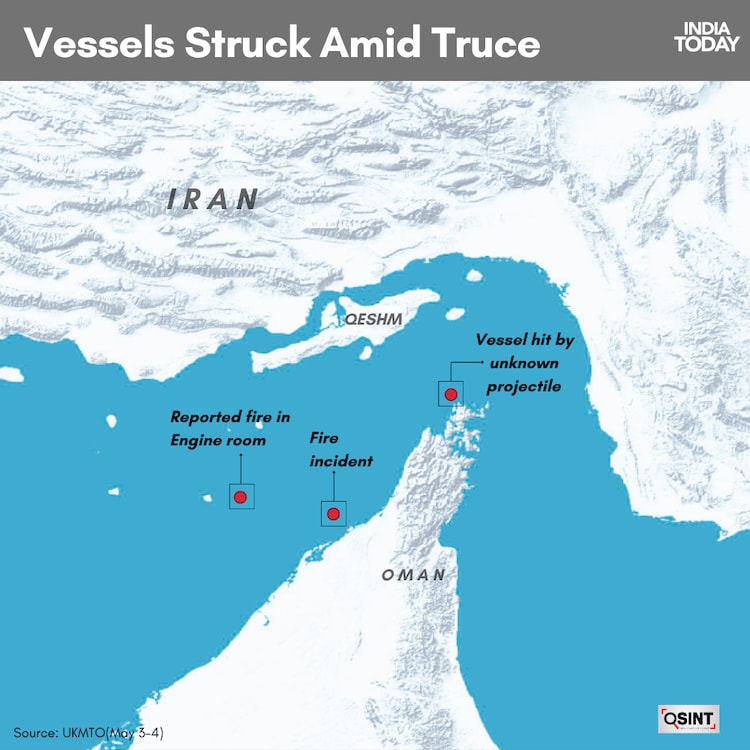
Corroborating the exchange of fire, the UKMTO, in its summary report for Monday, noted three incidents in the Strait of Hormuz region. These included an explosion northwest of Fujairah, a fire onboard a vessel near Dubai, and another vessel fire near Mina Saqr in Ras Al Khaimah, UAE.
Iran has alleged that it was “US military adventurism” that forced Tehran to strike the UAE’s Fujairah Port. The United States, on the other hand, has claimed to have sunk seven Iranian “fast” boats. Both sides, however, have rejected each other’s claims so far.
Later, Tehran accused US forces of killing at least five civilians by attacking two cargo boats amid Washington’s efforts to force open Hormuz.
Donald Trump also wrote on Truth Social that Iran had taken shots at vessels from unrelated nations, including a South Korean cargo ship. He further suggested that it may be time for South Korea to join the mission, Project Freedom, adding that US forces had shot down seven Iranian small boats.
All these accounts remain contradictory, and in the absence of reliable facts and verifiable maritime traffic data, the claims could not be independently confirmed.
However, what followed was critical. The UAE, which has witnessed the brunt of Iranian strikes in what can now be described as the first phase of the conflict, faced another round of escalation. The UAE Ministry of Defence stated that the country was targeted by four UAVs, three cruise missiles, and 12 ballistic missiles, adding that, as this constituted unprovoked aggression, the UAE reserves the right to respond.
Later, Iranian state broadcaster IRIB, quoting an unnamed military official, reported that “Iran had no pre-planned intention to attack the Fujairah oil facilities. The incident resulted from US military adventurism aimed at creating an illegal passage through restricted areas of the Strait of Hormuz. The US must be held accountable.”
WHY IS FUJAIRAH IMPORTANT?
UAE’s Fujairah Port, which has been attacked at least twice during the first phase, is one of the few crucial facilities that enable oil transit while bypassing the Strait of Hormuz chokepoint through the Habshan-Fujairah Abu Dhabi Crude Oil Pipeline (ADCOP).
It is a 380 km artery, commissioned in 2012 at an estimated $3.3 billion, designed to bypass the Strait of Hormuz by routing 1.5 to 1.8 million barrels per day of Abu Dhabi crude directly to the Gulf of Oman.
In its April Oil Market Report, the Energy Agency (IEA) noted that by the end of March, Saudi Arabia had rerouted supplies through its East–West Petroline, increasing Red Sea oil exports by 2.4 million barrels per day month on month to 4.4 million barrels per day. Despite repeated strikes on the port, crude exports from the UAE’s Fujairah rose by 0.45 million barrels per day compared to the previous month to average 1.6 million barrels per day.
- Ends
Published On:
May 5, 2026 19:54 IST