3 weeks ago
As protests rage in Pakistan-occupied Kashmir, families recount losing loved ones in a deadly crackdown. Doctors, grieving families and protesters describe fear, loss and the growing unrest gripping the region.
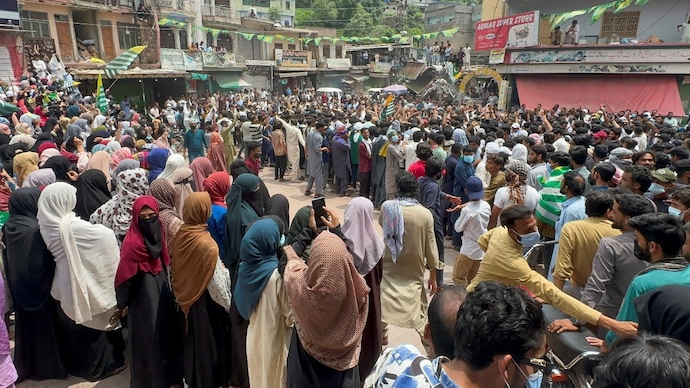
People gather in support of a protest by the banned Joint Awami Action Committee (JAAC) in POK. (File Photo: Reuters)
A blood-soaked mattress beneath a red tarpaulin, a dying protester with a gunshot wound to the chest, and a doctor working out of a makeshift clinic with little more than first-aid supplies. That was the grim reality inside Rawalakot in Pakistan-occupied Kashmir (POK), where weeks of anti-government protests have spiralled into one of the deadliest crackdowns in recent years. As security forces and protesters clash over political rights and economic grievances, grieving families say an entire generation is paying the price.
As per the BBC, one such facility is a makeshift clinic run by a local doctor, Dr Anwar, located just a short distance from one of Rawalakot's main protest sites. A spare bedroom serves as a medical storeroom, while a bed beneath a stretched red tarpaulin has become an emergency treatment area. It was there that Shafqat Hussain, who had suffered a gunshot wound to the chest, was brought in. The bed already bore bloodstains from earlier casualties. The doctor said many of those arriving at the clinic had suffered life-threatening injuries.
"We have enough supplies to provide first aid. We can stop bleeding, clean and dress wounds, and remove superficial bullets. But patients with serious injuries to the chest, abdomen, head, or other vital organs need advanced hospitals," Dr Anwar told the BBC.
"Even major hospitals would struggle if many such patients arrived at the same time."
According to the report, the clinic has treated between 50 and 60 critically injured people since July 27, with Dr Anwar personally treating between 15 and 20 gunshot victims. He said many protesters avoided government hospitals because they feared arrest or further violence, an allegation the authorities have rejected.
"Most of those who have been killed or seriously injured are young people between about 15-16 years old and 32-35 years old. I have seen very few patients over the age of 40," he said.
The protests are being led by the outlawed Joint Awami Action Committee (JAAC), whose members say they are campaigning for affordable electricity, cheaper wheat, improved education and healthcare, greater political rights and accountability for those killed during the security crackdown.
The movement also accuses Islamabad of decades of interference in local governance and demands political autonomy, the release of detained activists and a fairer distribution of resources.
Pakistan's authorities dispute those claims and maintain that the JAAC has engaged in violent activities aimed at disrupting the electoral process.
'WE WERE ONLY ASKING FOR OUR RIGHTS'
At Hussain's bedside stood his friend, Ali, struggling to hold back tears.
"We only asked for affordable flour, electricity and our basic rights," he said. "Instead, our brothers are being killed. What was our crime? Why are live bullets being fired at us?"
According to the BBC, similar accounts emerged across Rawalakot, where families described losing sons and brothers during the demonstrations.
Asma, who lost her only son, said she was participating in the protest when she learned he had been shot.
"We were only asking for our rights. We are not terrorists," she said.
"He knew there were risks, but he believed standing up for justice was important. He used to say that dying for a just cause was an honour."
COMPETING NARRATIVES
Among those mourning was Ayub, a retired soldier who blamed the POK administration for calling in paramilitary forces.
"I am a retired soldier. I lived through the martial law periods of General Zia-ul-Haq and General Pervez Musharraf. But I have never seen anything like what is happening now. In my opinion, it is extreme injustice. My son had done nothing wrong. None of the protesters had done anything wrong." he told the BBC.
Pakistan's authorities have rejected accusations that security personnel fired indiscriminately at peaceful demonstrators, saying law enforcement acted only against individuals who attacked officers, threatened public safety or obstructed lawful authority.
The communication restrictions, blocked roads and internet shutdowns have made independent verification of many claims difficult. Shortages of food in Rawalakot, with residents sharing limited supplies and some reportedly attempting to transport rice into the city on motorcycles. Authorities denied blocking food or medical assistance, insisting supplies were being facilitated.
Officials have repeatedly described the JAAC as a violent organisation, releasing drone footage that they say shows armed men on rooftops and displaying weapons allegedly seized from protesters.
Police have also said security personnel were killed during the unrest and claimed one detained suspect admitted being promised financial rewards for targeting paramilitary forces.
JAAC leader Umar Nazir rejected those allegations.
"Look, perhaps such deaths did occur - I will not comment on that," he said.
"However, I believe that certain elements, who are under their control, were infiltrated into our ranks. Such people were certainly present among us."
NO END IN SIGHT
The unrest has unfolded alongside elections in Pakistan-occupied Kashmir, where Pakistan Muslim League-Nawaz (PML-N) secured a sweeping victory.
India has described the protests as the result of decades of exploitation, denial of fundamental rights and administrative oppression in Pakistan-occupied Kashmir, while urging the international community to hold Islamabad accountable for human rights abuses. Pakistan rejects those allegations.
Despite the heavy security presence, the protests show little sign of ending. JAAC leaders say demonstrations will continue, while authorities insist law and order must be maintained.
- Ends
Published By:
Satyam Singh
Published On:
Aug 3, 2026 19:46 IST