1 month ago
Trump and Xi used a highly choreographed Beijing summit to project warmth and reopen dialogue. The display masked unresolved disputes over Taiwan, the Iran war and trade issues.
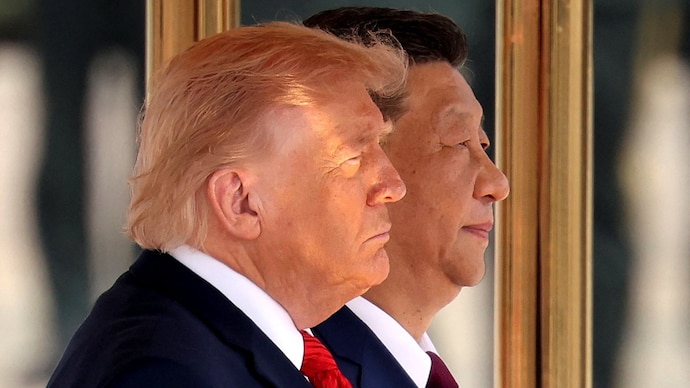
US President Donald Trump and his Chinese counterpart attend a welcome ceremony in China. (Photo: Reuters)
Donald Trump arrived in Beijing to a spectacle few would have imagined during the bitter period of tariff wars, pandemic accusations and open political hostility between the US and China. The welcome from Chinese President Xi Jinping was lavish, symbolic and carefully choreographed.
The first day of Trump's state visit to China transformed Beijing into the stage for a remarkable reset. Outside the Great Hall of the People, a military honour guard stood in formation as bands played the American national anthem and schoolchildren waved Chinese and US flags. Trump paused repeatedly to greet the children. He warmly shook hands with Xi, later patting the Chinese leader on the arm in what many observers interpreted as a deliberate display of personal warmth.
"You're a great leader. I say it to everybody," Trump made the off-script remarks, which were a sharp contrast to the anti-China rhetoric that once fuelled his political rise.
Only a few years ago, Trump had accused China of "ripping off the United States like no one has ever done before", blamed Beijing for the Covid-19 pandemic and vowed to "make China pay". During the height of the trade war, both countries imposed tariffs exceeding 100 per cent on each other's goods, pushing relations to one of their lowest points in decades.
The mood, however, has become strikingly different.
BEIJING’S GRAND DISPLAY FOR TRUMP
The visit appeared designed as much around optics as policy. Trump toured Beijing's historic Temple of Heaven, praised China's beauty before reporters and later described the talks as a "cherished" opportunity during a state banquet attended by some of most influential business leaders.
The White House said the two sides "discussed ways to enhance economic cooperation", including greater access for American companies to the Chinese market and expanding Chinese investment into US industries.
According to Reuters, Ali Wyne, senior adviser for US-China relations at the Crisis Group, noted that Beijing once sought Washington's approval by purchasing large volumes of American goods during Trump's first term. This time, he said, the US appeared more willing to acknowledge China's status as a global equal.
"This time around it's the United States, unprompted, of its own volition, that is acknowledging that status," Wyne said.
That message became even clearer after Trump revived references to a "G2" framework -- the idea that the US and China together dominate global power politics.
Analysts paid particular attention to the interactions and gestures shared by the two presidents.
According to the New York Post, Isabelle Vladoiu, founder of the US Institute of Diplomacy and Human Rights, said the atmosphere felt "significantly more jovial, conversational, and personally interactive" than previous meetings.
"What changed tonight was not the ceremony -- it was the chemistry," she told the newspaper.
Body language expert Lillian Glass described Trump as projecting confidence "like a peacock or a lion", while also appearing unusually comfortable around Xi. She added that Xi -- typically highly reserved during public appearances -- reciprocated several gestures, including back pats and walking closely in step with Trump.
Glass said there appeared to be "genuine affection" between the two leaders.
TRADE, TAIWAN AND THE REAL TEST AHEAD
Despite the warmth, major thorny issues remain unresolved.
Chinese state media reported that Xi warned Trump during their discussions that Taiwan remained the issue most capable of dragging the two countries into conflict. Beijing is expected to pressure Washington to scale back or delay arms sales to Taiwan, though the US remains legally obligated to support the island's defence capabilities.
Notably, both leaders ignored questions from reporters about Taiwan during their appearance at the Temple of Heaven.
Trade also remains unsettled. While a fragile truce replaced the tariff escalation of last year, neither side has explained what a long-term agreement might look like.
US Secretary of State Marco Rubio admitted before the trip that both countries had incentives to stabilise relations.
"It's in their interest to resolve this," Rubio told Fox News. "And we hope to convince them to play a more active role."
Iran and the Middle East also featured prominently in the discussions. According to the White House, both governments agreed that "Iran can never have a nuclear weapon" and that the Strait of Hormuz "must remain open to support the free flow of energy".
The summit was organised at a delicate moment for both leaders, particularly Trump, who is dealing with pressure at home over inflation, legal battles tied to his tariff policies and growing unease over fallout from the Iran war.
Xi, meanwhile, is facing a very different set of problems. China’s economy continues to struggle with rising unemployment and weak consumer spending. But unlike Trump, Xi is not under immediate electoral pressure.
DIPLOMACY WRAPPED IN GRANDEUR
Still, the messaging from both capitals appears deliberate.
The two leaders agreed to frame bilateral ties as "constructive, strategic and stable". Trump, clearly pleased by what he called a "magnificent welcome like no other", invited Xi to the White House in September.
Xi responded with perhaps the clearest sign yet of Beijing's preferred narrative for the relationship.
"The great rejuvenation of the Chinese nation" and "Make America great again" can go hand in hand, he said before ending his remarks with a toast: "Cheers."
Whether that warmth produces lasting policy breakthroughs remains uncertain. The disputes over Taiwan, trade, technology, military influence and global power have not disappeared simply because the tone has become friendlier.
For now, at least, the smiles are serving a purpose.
- Ends
Published By:
Satyam Singh
Published On:
May 15, 2026 00:51 IST