1 month ago
Donald Trump arrived in Beijing to red carpets and gun salutes. Xi Jinping's message, however, was far less festive. Taiwan is a red line, and both sides know that mishandling it carries consequences neither country can afford.
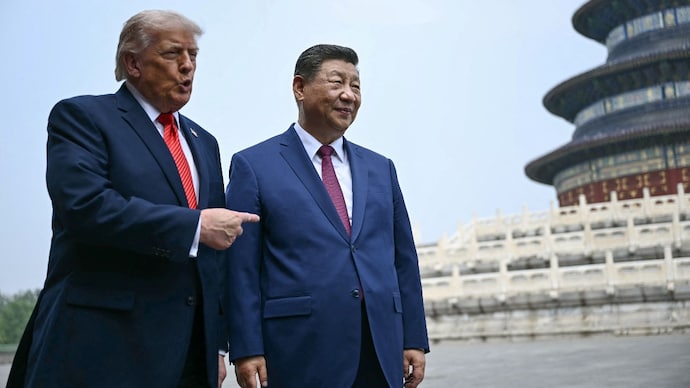
US President Donald Trump and his Chinese counterpart Xi Jinping visit the Temple of Heaven in Beijing. (Image: Reuters)

UPDATED: May 15, 2026 00:29 IST
Donald Trump landed in China this week to military band fanfare, schoolchildren chanting "Welcome!" and a gun salute outside the Great Hall of the People. The first visit by an American president to China in nearly a decade, the summit carried the weight of a bruising trade war, an ongoing conflict in Iran and one question that hung over everything: what happens to Taiwan?
Before Trump even set foot in Beijing, China had made its position clear. Four red lines, Beijing declared, must not be crossed. Taiwan heads that list. Xi Jinping wasted no time ensuring Trump understood precisely what that meant.
The warning
"The Taiwan question is the most important issue in China and US relations," Xi said, according to China's state broadcaster CCTV. He warned that if the matter were mishandled, the two nations "could collide or even come into conflict", pushing the entire relationship into "a very dangerous place."
Xi also invoked the Thucydides Trap, the ancient Greek theory about what happens when a rising power challenges a ruling one, and asked whether China and the United States could instead find a way to work together as equals. It was a warning, yes, but also, in its own way, an opening.
Trump called Xi a "great leader" and a "friend", and said the two countries would have "a fantastic future together." When reporters asked how the Taiwan conversation had gone, he ignored them. Whether that reflects quiet confidence or deliberate ambiguity is not yet clear.
Why Taiwan matters so much to Beijing
To understand why Xi draws this particular line so firmly, you have to understand what Taiwan represents to China. It is historical, strategic and economic all at once.
Historically, Beijing traces the Taiwan question back to 1949, when the Communists won the civil war and the ists retreated to the island. For over seventy years, the People's Republic of China has insisted Taiwan is a rogue province that must eventually return to the fold. From Beijing's perspective, this is not expansionism. It is the completion of a civil war that was never formally resolved.
Strategically, Taiwan sits at a critical node along the first island chain. Control of Taiwan gives China direct access to the western Pacific. Without it, China views itself as strategically encircled by a network of American allies and bases. Washington, naturally, sees that same geography as essential to regional stability and the security of its partners.
Economically, Taiwan produces the world's most advanced semiconductors. Both China and the United States understand that whoever has influence over Taiwan has influence over the global technology supply chain.
A delicate American balancing act
The United States has, for decades, walked a careful line on Taiwan. It officially recognises Beijing under the one China policy, yet maintains informal ties with Taipei and is legally obligated under the Taiwan Relations Act to supply the island with defensive weapons. That balancing act has never been easy, and it has grown more complicated under Trump's second term.
Earlier this year, the State Department revised language in its Taiwan fact sheet, removing a line about not supporting Taiwan independence. Officials described it as routine. Critics saw it as a shift. The Trump administration has since signed the Taiwan Assurance Implementation Act and included deterring conflict over Taiwan as a priority in its new Security Strategy, suggesting the policy picture is more nuanced than either alarm or reassurance alone would indicate.
The bigger picture
Taiwan's own opposition party, which favours closer ties with Beijing, recently sent its leader to meet Xi, a reminder that Taiwan's internal politics are themselves divided on how best to navigate relations with the mainland.
Taiwan's government has been clear. It called China's military the "sole source of instability" in the region and expressed gratitude for continued American support. For its part, Secretary of State Marco Rubio struck a careful tone, saying neither Washington nor Beijing had an interest in destabilising events in the Indo-Pacific.
The summit will not resolve the Taiwan question. It never could. But how both sides manage the conversation around it matters enormously, not just for Taiwan, but for the stability of the entire region.
- Ends
Published By:
indiatodayglobal
Published On:
May 15, 2026 00:29 IST